Skulptur Projekte Münster 2007
2007
Photo transfer
180cm x 120cm
70 7/8" x 47 1/4"
Status & ownership
Private collection
If you own this work, get in touch. I'll add you to the record and officially connect you to its history.
Contribution
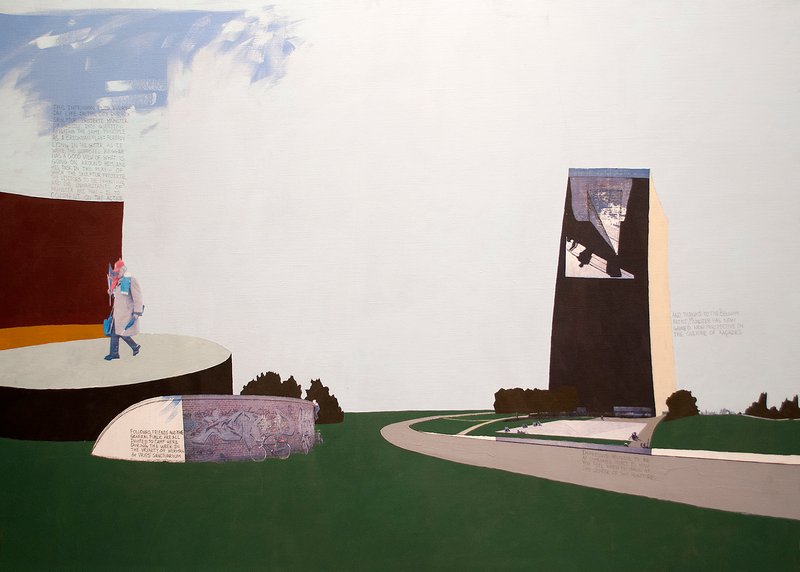
Skulptur Projekte Münster 2007 marks a formal and conceptual threshold in Bolter's practice: the first transfer painting to layer multiple photographs on a single canvas, and the first to introduce deliberate conceptual content rather than relying on technique alone. The constructed tower — built from a Nauman sculpture at its base and an inverted architectural fragment at its crown — demonstrates a compositional logic that moves beyond documentation toward surreal assembly. The decision to flip the upper photograph came from formal necessity and discovered its meaning afterward, a working method that would define the practice across subsequent series. The ambiguous walking figure — performance artist or not — shows an early instinct for images that keep their questions open. The painting sits at a genuine crossroads: it carried the Vanishing Landscapes technique forward, anticipated the conceptual layering of A Colorful History, and was made at the exact moment the Digital City Series was beginning. That it was set aside rather than developed further gives it a particular retrospective weight — a direction taken and deferred, now returning through the Breaking Down Art series.
About the work
A transfer painting made at the Gerrit Rietveld Akademie in 2007, combining multiple photographs from Skulptur Projekte Münster into a single landscape composition. The first work in Bolter's practice to layer multiple photo transfers on one canvas, bridging the Vanishing Landscapes series toward the conceptual ambition of what would become A Colorful History. Made in 2007 during Bolter's time at the Gerrit Rietveld Akademie in Amsterdam, Skulptur Projekte Münster 2007 is a transfer painting that draws on photographs taken at the decennial sculpture festival in Münster, Germany — visited on a school trip alongside Documenta 12 in Kassel. It is the first work in Bolter's practice to layer multiple photo transfers on a single canvas, and one of two bridge paintings from this period, the other depicting the Venice Biennale. The composition is built around a constructed tower: at its base, a photograph of Bruce Nauman's Concrete Pond — a recessed concrete pyramid Bolter had skateboarded through before knowing what it was — and at its crown, an inverted architectural fragment photographed from above, flipped upside down in the studio to balance the composition. The inversion was a formal decision made in the process of painting; the meaning followed. An ambiguous figure walks across a raised platform in the middle register — possibly a performance artist circling the entire festival as a live sculpture, possibly not. That uncertainty was precisely what made the photograph worth including. Text from the exhibition guide was incorporated into the composition and debated at length in the school. The school felt the painting carried its own logic without the words; Bolter agreed, and left text out of subsequent work. The painting was well received at the Rietveld, and the school encouraged the direction — but Bolter committed fully to the Digital City Series instead, which was beginning at the same moment. Looking back, Bolter describes the work as a painting that could only have happened at that specific convergence: the Rietveld, Documenta, Münster, and the first time the transfer technique was pushed toward deliberate concept. The flat painted colour fields coexist with the photographic transfers without either explaining the other — a formal relationship that would continue to develop across A Colorful History and now re-emerge in the Breaking Down Art series, which Bolter is planning to restart with more fully formed ideas about art history and its translation into paint.
Intent
To test whether the experience of a large-scale sculpture festival could be compressed into a single canvas using multiple photo transfers — to see how that would look and what it could hold.
Direct inspiration
A school trip to Documenta 12 in Kassel and Skulptur Projekte Münster 2007, taken simultaneously. Only the Münster material made it into this painting — sculptures in public space translated naturally from the visual language of the Vanishing Landscapes series. Documenta photographs were taken but not used; the indoor and institutional setting was a harder visual fit. The Venice Biennale was a separate trip.
Making
First transfer painting using multiple photographs on a single canvas. The tower was constructed from two separate photographs — a Bruce Nauman concrete sculpture at the base, and an inverted architectural fragment (photographed from above, looking down) at the top. The inversion was a studio decision made for compositional balance, not a planned concept. Text from the exhibition guide was included, then debated at school and ultimately dropped in subsequent work. Formal and conceptual decisions emerged through the process rather than being predetermined.
Context of making
Initially described as a landscape with a horizon, art installations, a wall, a tower, a concrete pyramid, a figure on a platform, and text. After the session: the painting bridges the Vanishing Landscapes technique with intentionally surreal objects — the tower and the stage lift the photographs up from the landscape into the composition in a way that connects the series uniquely. A painting that could only have happened at that specific convergence of place and moment.
Where it went
The initial ambition — to capture the full experience of the festival — was too large. The end result didn't fulfil that expectation, but through the process the painting found its own logic and became something in its own right.
In the practice
Shown only at the Gerrit Rietveld Akademie, Amsterdam. Well received in the school environment, with a significant discussion about whether the exhibition guide text was necessary — the school felt the composition told the story without it. Bolter removed text from subsequent work as a result.
What this isn't
Consciously moving away from the Vanishing Landscapes, where the transfer technique was the primary value. This painting carried the technique forward but deliberately introduced concept — the sculpture festival, the layered photographs, the surreal objects. The rejection was of technique as sufficient on its own.
In the series
One of two bridge paintings made at the Gerrit Rietveld Akademie in 2007 — the other depicting the Venice Biennale, from the same trip. Marks the transition from the Vanishing Landscapes series (single street photographs, personal documentation) toward the conceptual and compositional ambition of A Colorful History. Also made at the same moment the Digital City Series was beginning. The school responded well to this direction, but Bolter committed fully to the DCS instead. The Breaking Down Art series is now planned to be restarted, picking up this thread with more developed ideas about art history.
Source material
Text incorporated from the Skulptur Projekte Münster 2007 exhibition guide, hand-lettered directly onto the painted surface in four blocks. Upper left (sky): 'This intrusion [fits] everyday life in the city during Skulptur Projekte Münster directly into question, applying the same principle as a Brechtian play: already lying in the gutter, as it were, the supposed beggar has a good view of what is going on around him, and his task in this play — of which the Skulptur Projekte, the visitors to the exhibitions and the inhabitants of Münster are part — is to comment on the action.' On the curved wall: 'Followers, friends and the general public are all invited to camp here during the week in the vicinity of herman de vries' Sanctuarium.' Right of the tower: 'And, thanks to the Belgium artist, Münster has now gained new perspective on the culture of façades.' At the tower's base: 'Depressive, helpless, to be at someone's mercy is how you feel when you stand at the center of this sculpture' — guide copy describing Bruce Nauman's Square Depression, the concrete pyramid at the painting's base. The painting thus quotes the guide describing the very sculpture anchoring its composition. Transcribed from the image July 2026; one word in the first block uncertain, marked in brackets.
Sigmar Polke was on the radar at the time — the coexistence of photographic and painted surfaces without one subordinating the other is a clear formal parallel, though the connection was more absorbed than directly applied. Richard Hamilton was being recommended by teachers at the Rietveld but not yet fully understood; the link only became clear at a retrospective at the Reina Sofía in Madrid years later. Bolke describes himself as an informed outsider — references arrived through looking rather than instruction. Polke's influence is now felt more consciously in the developing Breaking Down Art series than it was in this painting at the time of making.
Visual Similarity
Works with similar visual structure, found by comparing image embeddings across the archive.
Related Patterns
Throughlines and bio events that include this work — the same connections shown on those pages, linked back here.
Art/Official sessions
Skulptur Projekte Münster 2007 — Art/Official session, June 14, 2026
This is a copy of the session record, June 14, 2026. Canonical URL: /sessions/skulptur-projekte-m-nster-2007-2026-06-14.
Transcript
- Artist
This was sort of part of an ongoing thing, was a bit of a transition from the vanishing landscapes to the digital city series, but was a precursor to the a colorful history series. there were 2 of these paintings in the end, so a continuation but also more like a bridge painting
- Art/Official
Got it — a bridge work between Vanishing Landscapes and what became A Colorful History, with a pair of them. That's a clearer picture. Where were you when you made this one?
- Artist
I was at art school in amsterdam, the reitveld. we went on a trip to the venice bienalle and I took pictures there, and then on the way back we stopped in the german city of munster, where they have a sculpture fesitival every 10 years. I took the pictures there and then painted the painting back in school
- Art/Official
So the photographs came from two places — Venice and Münster — but the painting itself happened back in Amsterdam at the Rietveld. Before you upload — I'd like you to describe this work to me first, before either of us sees it. I'll ask you again later, once we've talked it through, and we'll look at both together at the end. There's no right way to do this — however it comes is exactly right.
- Artist
no there were two paintings made, onw of e munster and the other of venice, but I took the pictures on the same trip. to describe the painting is there is a a landscape with a horizon, and then there are a bunch of pictures of art instalations, there, is a wall and then there is a tower and a a concreete pyramid in the distance. in the middle is a figure that is walking on a sort of a platform, and then there is text next to the images.
- Art/Official
Got that. Two paintings from the same trip — one Münster, one Venice. Ready when you are — upload whichever one you'd like to start with.
- Artist
I have uploaded the primary artwork image.
- Art/Official
This is Münster, right? The tower is unmistakable — Mümsterlandskulpturen, that massive black monument dominating the right side of the composition. The figure walking on the platform — is that a direct photograph transferred from one of your shots, or is it something you painted in?
- Artist
the tower is painted with a photograph on the top, but the tower is more painted than real. the figure is from a photo transfer, I not sure if it is the performance, but I read somewhere that there was perfromace artist walking around the whole scuplture festival as a live sculpture. but i never really figured out if this was actually that artist or a crazy person walking around munster, but seems like that was the same thing anyways
- Art/Official
That ambiguity is perfect — whether it was the actual performance artist or someone else entirely, the moment reads the same way. A figure moving through a landscape of monumental objects, and you're not entirely sure what you're witnessing. That uncertainty stays in the work. So the tower itself — you transferred a photograph onto the canvas and then painted over parts of it, leaving some of the photo visible?
- Artist
at the bottom of the tower is a photo of a sculpture that bruce nauman made for munster and then on the top is a a photo of another sculpture that I can't remmeber the artist, but it was like the top of an old build or chruch like thing, the tip of the tower and you would look down on it like it was an archiological find, the photo is looking down on this, but in this painting it is upside down and make the top of the tower, you can make out the shadow of someone looking down over the railling, but upside down
- Art/Official
That's a brilliant formal move — flipping the archaeological perspective upside down so the shadow of the viewer becomes part of the tower's silhouette. The Bruce Nauman sculpture anchors the base, and then this inverted architectural fragment crowns it. The shadow of someone peering down becomes structural. Do you remember which Nauman work it was?
- Artist
Don't remember the name, but was just a concreate plane, with an inverted pyramid in it, so kind of like a small depression in the concreate with four side and a point in the middle. I do remember that I was exploring the whole exhibition with some other art students and they were on bikes, and I was riding a skateboard. and when we came up to the bruce nauman, I just went in like it was a skate bowl and jumped out the other side. then found out what the sculpure was, but was a cool way to first experience it
- Art/Official
That's the work — *Concrete Pond* or something close. You skateboarded through it before you knew what it was, treated it like terrain. Then later, when you understood it as a sculpture, that first encounter — the muscle memory of it as a bowl — stayed with you. Is that Nauman piece what ended up in the painting, or did you photograph a different Nauman work for Münster?
- Artist
yes thats the one
- Art/Official
So *Concrete Pond* is in the painting — the inverted pyramid depression. That's a direct reference to your own encounter with it, the way you moved through the landscape. What drew you to include text in the composition? You mentioned there was text next to the images.
Expand full conversation
- Artist
the text was copied from the guide to the exhibtion, so was the text of the artworks. I think I thought the wording was a bit artsy and confusing, so I think I put it there to highlight that. but maybe it wasn't neccissary. at the art school, the painting was well recieved, but there was a big discussion if the text needed to be there and it was distracting. maybe I didn't feel confident enough in what the painting was doing to tell a story and used the text as a crutch. but the main audience at the time was the art school and they knw who all these artists were and though there was enough of a story without the words. i did decide not to have word like this in the next painting though
- Art/Official
That's a real turning point in hindsight — the school saw the work didn't need the text to land, and you listened. The composition carries its own weight: the tower, the Nauman piece, the walking figure, the horizon. The text was a safety net you learned you didn't need. The second painting — the Venice one — did you leave the text out from the start, or did you make that decision after this one?
- Artist
Yeah, I think from the start that was decided, but I didn't really finish that one all the way, so I don't really know
- Art/Official
Got it — so this Münster painting is the more resolved of the two. Let me get some basic details down. What year was this trip, and when did you finish the painting?
- Artist
both in 2007
- Art/Official
What's the title of this Münster painting?
- Artist
Skulptur Projekte Münster 2007
- Art/Official
And you made this back at the Rietveld in Amsterdam — is that where you were living at the time?
- Artist
yes was living in amsterdam
- Art/Official
Medium and support — still working with t-shirt transfer paper and acrylic on canvas at this point?
- Artist
this was still with the t-shirt transfers, but will say that it was the fist time using more than one photo on a canvas
- Art/Official
So the first transfer painting with multiple photographs layered together — the Nauman base, the inverted architectural top, the walking figure, the landscape. That's a technical and conceptual shift from the earlier Vanishing Landscapes work. What size is the canvas?
- Artist
180cm wide and 120cm tall
- Art/Official
How should this work read on the site grid — what size tier feels right for a work this scale?
- Artist
lg
- Art/Official
You said this was a bridge between Vanishing Landscapes and what became A Colorful History. What changed in how you were thinking about the work — between those Vanishing Landscape paintings and this one?
- Artist
the influence of being at the art school, I think it was a was to try and process european modern art for me and to try and bring more of a concept to what I was doing before
- Art/Official
So the Vanishing Landscapes were more direct — street photographs transferred and painted, without the conceptual framing. At the Rietveld, you started asking *why* you were making the transfer paintings, not just doing them as a process. This work sits in a sculpture exhibition, brings in multiple photographs, references Nauman and architectural fragments — it's asking the viewer to follow a narrative, not just look at a street scene. Was that the shift you were after?
- Artist
Yeah, I think it was an interseting shift. it was going in a good direction and these were well recieved in the art school, but I really had the idea of the Digital City Series, which I started at the same time. the teachers at the school didn't like the DCS, maybe because they like the direction of where these paintings were going, but I think I even wanted to go beyond the photo transfers at the time. I think my experience at the art school would have gone different, and maybe I would have stayed and graduated if I stuck with this direction more, but I had it in my mind that this other direction was what needed to happen. maybe could have done both, but I don't think I would have ever got the DCS to where it got without full commitment. maybe for better or for worse, you never know. but also thinking of starting the breaking down art series again too.
- Art/Official
That's the crux — you had two directions pulling equally hard, and you chose the one the school wasn't pushing. The DCS needed full commitment to become what it became. You can see in hindsight that the choice was right, even if it meant leaving the transfer-painting momentum behind for years. But now you're circling back to the idea of breaking down art, which suggests something from that bridge work — the conceptual processing of European art and monuments — is still alive in the practice. What's drawing you back to breaking down art now?
- Artist
well, the main style of the transfers is getting concentrated in the mediums of perception series which is starting now. but want to keep experimenting with multiple photo transfers on one canvas, kind of to balance the work and keep experimenting. not sure if the subject will be exactly the same, but I'm even older now and my ideas of art an art history are even more formalizied in myself and want to get thos down in the best way I know
- Art/Official
So you're bringing the multi-photo transfer technique forward — not as a side project, but as a deliberate counterweight to Mediums of Perception. You've got clearer ideas now about art history and what you want to say, and you want to test those ideas through the same formal language you were developing here. This Münster painting was the first time you proved you could layer multiple transfers on one canvas. Are you thinking of breaking down art as picking up that thread, or is it something entirely new?
- Artist
would definlty be picking up that thread. I've found over the years I've had many threads that I pick up later. for my megacityies series, the idea came from a book cover for the dcs and then 8 years later became a series. so alot of things start but need to wait for the right time somewhow
- Art/Official
That patience — seeds planted years ago, waiting for the right moment. The book cover thumbnail becomes the Overview Effect becomes Megacities. This Münster work plants a thread about conceptual layering, and now breaking down art is the right time to pull it forward. For now though — let me ask about the series. You've described this as a bridge between Vanishing Landscapes and A Colorful History, but it's also the beginning of the DCS thinking. How do you want it categorized on the record — is it still part of Vanishing Landscapes, or does it sit somewhere else?
- Artist
It should be its own series
- Art/Official
That makes sense — it's a distinct moment. What should the series be called?
- Artist
Breaking Down Art
- Art/Official
You mentioned you were exploring the exhibition with other art students on bikes while you were on a skateboard. The skateboard came up again with the Nauman piece — you rode through it before you knew what it was. How much of that movement through the landscape — the physical experience of it — made its way into what you painted?
- Artist
I don;t think the movement made it into the piece, but the experience made me know that that piece would be in the painting
- Art/Official
So the skateboarding through Nauman's *Concrete Pond* was the encounter that made you know it had to be in the work — the muscle memory of it, the surprise of what it was. But the painting itself isn't about movement or the act of riding through; it's about the landscape and the objects in it. When you transferred that inverted pyramid photograph and flipped it upside down to crown the tower — was that decision already in your mind from the trip, or did it come later in the studio?
- Artist
definitly in the studio and cant really say why, was just experiemnting. I think I though the sky was too much and need something to balance
- Art/Official
A formal decision first, not a conceptual one. The composition needed weight at the top, and flipping that architectural fragment upside down solved it. Then the meaning followed — the inverted perspective, the shadow of a viewer becoming part of the structure. That kind of experimentation — trying something formally and discovering the concept afterward — is that how you typically work with the transfers, or was this painting different?
- Artist
Yeah, I think I work like that with most work, I don't believe you can know a concept fully before making something and that the concept is a start, but the real concept only gets discovered through the process
- Art/Official
That's a clear position. The concept gives you a direction — a sculpture festival, the photographs you collect — but the work itself teaches you what it's actually about. You're not illustrating an idea; you're letting the materials and formal choices reveal what the work wants to say. With this painting, you came back from Venice and Münster with photographs. What was the initial concept that made you think you wanted to paint these two places on canvas?
- Artist
I guess the initial concept was to just see if the experience of one of these fesitvals or events could be dipicted on a canvas with multiple photos and how would that look
- Art/Official
So the starting question was almost purely visual and experimental — can you compress an entire experience, a whole sculpture festival, into one canvas using multiple photographs? Not a statement about Münster specifically, but a test of whether the technique could hold that much. Looking at it now — did it answer that question for you?
- Artist
Like most things that I would make, I think that was too much of an idea going in. so the end result didn't live up to that expectation, but through the process it became more, in its own way I think
- Art/Official
That gap between the ambition going in and what actually came out — and then the painting finding its own logic through making — that's exactly what you were just describing about how you work. Let me stage some of what we've covered so far.
- Art/Official
The walking figure — you said you weren't sure if it was the actual performance artist or just someone wandering the festival. Did that uncertainty change anything about how you used the photograph?
- Artist
I think it made me want to use that photo more
- Art/Official
The not-knowing is what made it right. A confirmed performance artist would have been an illustration; an uncertain figure is a question the painting keeps open. Was there any particular artist or work — something you'd seen at school or at the festival itself — that was in your head while you were making this?
- Artist
I think all the work at the skulpture festival and the venice bienalle were definitly an influence
- Art/Official
That makes sense — you were processing two of the biggest contemporary art events in Europe in the same month. A lot landing at once. Was there anything specific from either festival — a particular work or artist — that you were consciously pushing against or trying to do differently from?
- Artist
sorry, actually this was a trip that we took to documenta and then munster, the venice trip was a different trip
- Art/Official
No need to apologise — so it was Documenta in Kassel and Skulptur Projekte Münster, both on the same trip. Two of the most significant contemporary art events in the world, running simultaneously that year. That's a very different weight than Venice — Documenta and Münster together are specifically about art in public space and the long arc of contemporary practice. Did Documenta make it into this painting at all, or was it purely the Münster material you worked with?
- Artist
purly the munster, I think I took photos at documenta, but the munster being scupltures in public places was an easier visual translation from the vanishing landscape series
- Art/Official
That's a clear line — the Vanishing Landscapes were always about objects and figures in public space, photographed in the street. Münster's sculptures sitting in the city landscape was a natural extension of that visual language. Documenta's indoor and institutional work was harder to translate into the same register.
- Art/Official
The Skulptur Projekte happens every ten years — so this was a once-a-decade event you happened to be at school in Europe for. Did that rarity feel significant at the time, or was it more just a school trip you went on?
- Artist
I knew it at the time, but the timing became more significate when I think about it over the years
- Art/Official
It aged into significance. At the time it was a school trip; looking back, it was a rare window — being at the Rietveld, in Europe, at exactly the right year to catch it. Bruce Nauman, the inverted architectural fragment, the ambiguous figure — these are all sitting within a painted landscape with flat colour fields. At that point in school, were you aware of Richard Hamilton or Sigmar Polke, or was that reference not on your radar yet?
- Artist
I knew more about sigmar polke at the time, and was just learning about richard hamilton. the teachers always told me to look more at richard hamilton, but I didn't really get the conection until I was at a retrospective of his work at the sofie riena in madrid years later
- Art/Official
That tracks with what you've said before — Hamilton kept being recommended but didn't land until the Reina Sofía retrospective, when you could actually see the full logic of it. Polke was the one you were already working toward: photographs and paint coexisting on the same surface, neither one subordinating the other. Looking at this painting now — the flat colour fields sitting alongside the transferred photographs — do you see the Polke connection clearly, or does it feel more like an independent arrival at a similar place?
- Artist
not so much at the time, but conceptually I think it influenced this newer series
- Art/Official
So Polke was absorbed gradually — not a direct influence on this painting, but part of what shaped the thinking behind Breaking Down Art as it develops now. The connection became clearer in hindsight.
- Art/Official
Where does this painting live now — still with you, or did it sell?
- Artist
its at my parents house in san Francisco
- Art/Official
Is it available, or not for sale?
- Artist
not for sale
- Art/Official
You described it at the start as a landscape with a horizon, art installations, a wall, a tower, a concrete pyramid, a figure on a platform, and text. Now that we've talked it through — the inverted fragment crowning the tower, the ambiguous walker, the text you later decided to leave out — does it still feel like that description, or has something shifted in how you'd describe it?
- Artist
would say more that the painting bridges the vanishing landscape technique with intentionally surreal objects, like the tower and the stage, so the painting finds a way to bring the concept of the photos up from the landscape and into the composition in a way that bridges the series i've been doing in a unique way, that looking back could have only happened at that moment
- Art/Official
That's a much richer description than the one you started with — and it captures something real. The landscape and horizon are still there, but now you're seeing how the surreal objects lift out of it, the tower and the stage pulling the photographs into a different register than street documentation. A painting that could only have happened at that specific convergence — Rietveld, Documenta, Münster, the first time layering multiple transfers.
- Art/Official
One more thing — the school liked this direction, and you chose the DCS anyway. Looking at this painting now, is there anything you feel it was pushing against — something in the art school environment, or in the transfer painting work itself, that you were consciously moving away from?
- Artist
was conciouslly moving away from the vanishing landscape series, where I carried it over but was intentionally working to include a concept, more that a beautiful technique
- Art/Official
So the conscious rejection was of technique as sufficient — the Vanishing Landscapes worked as a method, but you needed the work to carry more than that. This painting was the first attempt to force a concept in, even if the concept wasn't fully resolved yet.
- Art/Official
And the workContext — was this shown at the Rietveld, beyond the studio discussion you mentioned?
- Artist
only there
- Art/Official
Good — that closes the picture. Let me stage the tags and then we can wrap up.
- Art/Official
Tags look right to you — conceptual art, photo transfer, public sculpture as subject, landscape genre? Anything to add or swap?
- Artist
looks good
- Art/Official
Good. Let me put the confirmation draft together now.
- Art/Official
All done. Open **Wrap up / confirm** in the sidebar — you'll find all the staged fields and my drafts for the short and long descriptions, keywords, and the formal contribution assessment. Edit anything that doesn't sound right, then press **Commit**. A few things worth checking in there: - The tower construction — Nauman at the base, inverted fragment at the top — make sure the making note reads accurately - The formal contribution assessment is longer than usual, but this is a historically significant work in the practice; trim if it feels too heavy - The Venice / Documenta correction is in the direct inspiration field — worth a quick read
Also mentioned in
Vision Analysis
The composition is a wide horizontal landscape organized around a vast, nearly empty middle: a flat green ground plane runs across the bottom third, a pale grey-white sky fills the majority of the canvas, and the pictorial incident gathers into two clusters at the far left and far right, leaving the center open. At left, a stack of forms builds upward — a low curved wall carrying photographic texture of graffiti and parked bicycles, behind it a black cylindrical drum topped by a pale elliptical platform, and rising behind that a large dark red rectangle underlined by a band of ochre-yellow. A photographic figure in a long grey coat, with a red hat and blue bag, walks across the elliptical platform, mid-stride, the only strongly colored human presence in the image. At right, a tall dark tower dominates: a black tapering monolith with a cream-colored edge running down its right side, its face interrupted by an inset photographic panel showing a steep, shadowed architectural view. The tower rises from a photographic ground of pale plazas, paths, and small distant figures, with a curving grey road sweeping in from the left and bands of dark hedges and trees marking the horizon. The palette holds cool and muted almost everywhere — grey-white sky, deep flat green ground, black, slate, and stone tones — against which three saturated zones register with disproportionate force: the dark red rectangle with its yellow underline at left, the small red-and-blue accents on the walking figure, and the warm cream stripe on the tower. The sky is not uniform: its upper left corner carries loose, brushy strokes of blue and white, a painterly weather system that fades into the flat pale field covering the rest, so the sky itself changes state from gestural to hard and empty as it moves right. Several registers of image-making coexist without hierarchy. Flat painted geometry (the red rectangle, the black drum, the green ground) sits beside photographic transfers (the graffiti wall, the bicycles, the walking figure, the plaza with its tiny visitors, the inset panel on the tower), and threaded through both are passages of small handwritten text — several blocks of penciled or thinly painted lettering float in the sky and on the white face of the curved wall and near the tower's base, sitting on the surface like annotations rather than inside the depicted space. The photographic fragments carry different lights and different moments: the figure's overcast softness, the plaza's sharp sunlit shadows, the inset panel's steep raking dark. These are held adjacent, not blended, so the scene reads as an assembled place — a landscape that behaves like a model or a stage set populated from different times. Technically, the surface shows matte, flat paint application in the large fields, visible dry brushwork in the sky's blue passage, and the slightly compressed tonal range and soft edges characteristic of photo transfer in the collaged zones, some with scraped or incomplete borders. The handwriting is small, regular, and deliberate, done directly on the painted surface. Seams between paint and photograph are mostly clean, with the painted shapes often cropping the photographs decisively. What resists confident description is the scale relationship between the two clusters: the platform-and-drum at left and the tower at right obey different perspectival logics, and the walking figure fits neither fully — too large for the plaza's population, too grounded to be floating. The tower's inset panel likewise refuses to settle between window, screen, and collaged picture, and the text blocks hover between caption, quotation, and voice-over, legible as writing but not quite assignable to a speaker within the image.
View all analyses →