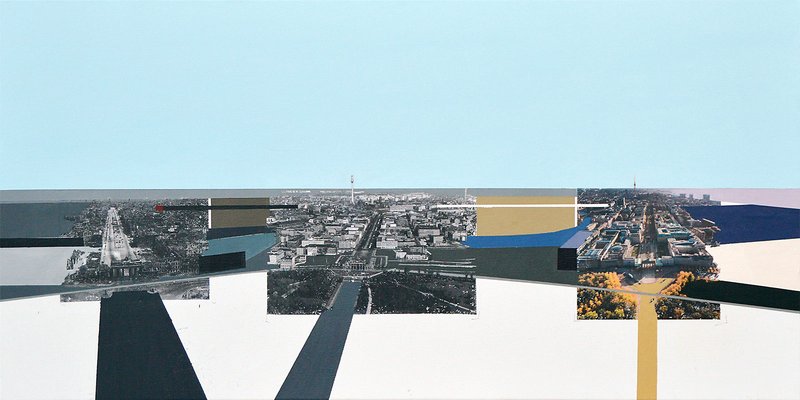
Brandenburg Gate . 1947-1961-2020
2025
acrylic transfers and acrylic on canvas
100cm x 50cm
39 3/8" x 19 5/8"
Visual Similarity
Works with similar visual structure, found by comparing image embeddings across the archive.
Vision Analysis
The composition is a wide horizontal field, roughly twice as wide as tall, divided by a hard continuous horizon line running the full width at close to the vertical midpoint. The entire upper half is a flat, unmodulated pale sky blue with no cloud or gradient incident. Below the horizon, three aerial photographic panels hang like a frieze — left, center, right — each looking down the same broad axial avenue from an elevated vantage, with a low gate-like structure near the bottom of each view and the avenue receding toward the shared horizon. Beneath the photographs, the lower quarter of the canvas is dominated by white painted ground crossed by dark charcoal and navy diagonal bands that fan downward and outward, as if the avenues in the photographs continued past their frames as abstract roads or cast shadows. The palette is split cleanly by panel. The left photograph is grainy grayscale reportage: a devastated city, the avenue cutting through rubble fields and hollowed facades. The center photograph is also monochrome but smoother and more even — a rebuilt, orderly city with a slender tower rising on the skyline, dense mid-rise blocks flanking the boulevard, a dark mass of parkland at its lower edge, and a fine speckle of crowds near the gate structure. The right photograph is full contemporary color: autumn trees in saturated yellow and orange lining the avenue, crisp modern rooftops, a tower again on the horizon, and a sandy-ochre roadway whose color spills out of the photograph and continues downward as a painted vertical band. The painted passages between and around the panels carry slate gray, olive-khaki rectangles, a deep navy wedge and a pale lavender-pink wedge at the far right edge, a curving mid-blue organic shape near the right panel that reads like water in plan, and a long thin black horizontal bar overlaying the left panel, terminated by a small red rectangle. A thin white bar spans part of the center-right region at the same height. The three views read unmistakably as one vantage at three moments. The axial avenue, the gate at its near end, and the tower on the skyline recur across panels while the city's condition changes — ruin, monochrome order, full-color present. The frame does not sequence them left to right with borders or captions; they share a single horizon and sky, so the moments coexist on one continuous ground rather than following one another. Each panel keeps its own photographic signature — coarse halftone grain on the left, smooth mid-century tonality in the center, sharp digital color on the right — so the eye registers the change of era as a change of image texture before it registers the change of subject. Technically, the photographic panels have straight cut or masked edges with occasional ragged transitions where they meet paint, and slight scraped translucency at some boundaries. The painted areas are hard-edged, matte, and flat, laid with clean seams. The dark diagonals in the lower half are the most physically assertive painted elements, their edges ruled and their angles echoing the perspectival lines inside the photographs, which binds the abstract lower zone to the photographic upper zone geometrically. What resists confident description is the role of those lower diagonals: they read simultaneously as shadows thrown by the photographed cities, as plan-view continuations of the avenues, and as autonomous geometry, and nothing in the image arbitrates between the readings. The small red rectangle ending the black bar over the left panel likewise hovers between notation — a marker or measure — and pure compositional incident, and the gray band at the far left horizon stays ambiguous between painted plane and photographic remnant.