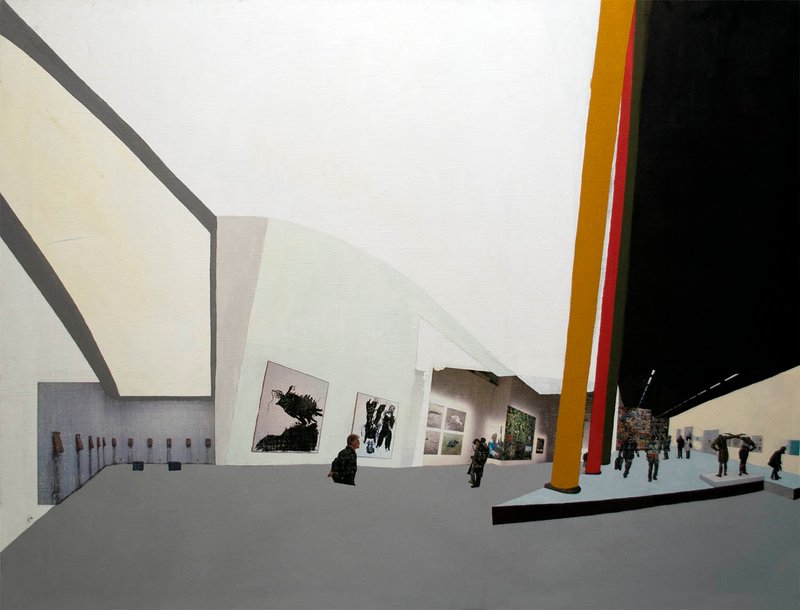
Venice Biennale 2007
2008
Mixed media on canvas
180cm x 120cm
70 7/8" x 47 1/4"
Intent
The artist's later reflection on the piece: a figure on the inside trying to make sense of the inside, while yearning for the outside. Reflects real ambivalence about the high-art world at the time — engaged enough to build a whole composition around it, but never fully absorbed into it.
Direct inspiration
A Rietveld Akademie school trip to the Venice Biennale in 2007 — the artist's first and only visit — combined with photos taken for the concurrent 3rd Digital City Series (Venice) piece shot just outside the same building.
Making
The central challenge was compressing a sprawling, multi-room exhibition experience into what reads as a single space — a problem the artist feels he never fully solved. Considered by the artist as unfinished even though the painting is complete as an object. Color contrast drove most compositional choices (the grayscale European work set against a Pan-African red/green/yellow column group placed near the African Pavilion reference); the artist selected photographed material compositionally rather than for its art-historical content, since he wasn't fluent in most of the artists referenced.
Context of making
Photographs taken live at the Biennale, overwhelming and sprawling in person. Painted afterward at Rietveld's studios in Amsterdam, in a shared room divided among roughly 40 artists.
In the practice
The last Breaking Down Art painting before the artist abandoned the series to begin the Digital City Series — a hinge point between two distinct bodies of work, made on the same trip as the third DCS piece (Venice).
What this isn't
Full immersion in or expertise about the art world being depicted — the artist worked from a position of partial fluency and conscious distance rather than insider knowledge.
Source material
Photographs the artist took himself at the 2007 Venice Biennale (Arsenale and Giardini), transferred onto canvas and painted over.
Visual Similarity
Works with similar visual structure, found by comparing image embeddings across the archive.
Related Patterns
Throughlines and bio events that include this work — the same connections shown on those pages, linked back here.
Art/Official sessions
Venice Biennale 2007 — Art/Official session, July 23, 2026
This is a copy of the session record, July 23, 2026. Canonical URL: /sessions/venice-biennale-2007-2026-07-23.
Transcript
- Artist
Hey C would like to start a art official session about the painting https://bernardbolter.com/venice-biennale-2007
- Art/Official
Venice Biennale 2007 — Breaking Down Art series, 2008, t-shirt transfers and acrylic on canvas, 180x120cm. This sits in Breaking Down Art, which draws on your own past work as source material, so a blind visual reading can't identify what's being broken down. Tell me if that's off, or we can just start.
- Artist
That's good let's start
- Art/Official
Before we look at it together — is this a recent work, or something you've been sitting with for a while?
- Artist
This one, at this point is a pretty old work, from around 2007-2008. The photos for the painting were taken at the Venice biennale in 2007, and was there on a school trip with the rietveld akademie in amsterdam. And the painting was made at the studios in the school
- Art/Official
That gives it a real anchor. Is this part of something ongoing, or does it feel more like a standalone moment?
- Artist
In a way it is ongoing, but at the time was the end of something. I liked the painting and the one before I made at the school, but then at the time got the idea to start the digital city series and kind of abandoned this painting series and i dont feel like i even finished this painting specifically.
- Art/Official
That's a real hinge moment then. Where were you physically when you were making it?
- Artist
Well was at the biennale taking pictures, first time and only time I've ever been there. Was impressive, but also overwhelming. Then was back at the rietveld when I transferred and painted it. Was a large room divided among about 39 other artists
- Art/Official
Before you upload — describe this work to me first, before either of us sees it.
- Artist
The painting is of a bunch of photos from the Venice biennale transferred on canvas and then painted. Almost makes the place look like one room. There is a picture of some georg baselitz paintings in there, also a picture of concrete bags spilling on the floor and hung on the wall, I think by a Polish artist. And then there are three colorful columns that raise up into the ceiling or sky, and on the other side is a picture of part of the exhibition focusing on african artists that was in the arsenal exhibit, with the sculpture of two headless colonialists shooting each other's heads off.
- Art/Official
Got it — that's stored. Go ahead and upload the image whenever you're ready.
- Artist
[image uploaded: 1000020404.jpg]
- Art/Official
That architectural sweep is striking in person, then those three columns cutting up into black on the right, figures scattered small across the gray floor. The concrete bags and the headless-colonialists sculpture aren't legible to me at this resolution.
- Artist
Ok, don't forget to copy that vision analysis and get the colors and other stuff at this point
- Art/Official
Noted. Was this piece ever exhibited or shown anywhere after Rietveld?
Expand full conversation
- Artist
It's stayed unseen and is back in San Francisco at the 27th ave studio there
- Art/Official
You described the Biennale as sprawling, but what you painted compresses it into a single space. Was that compression deliberate?
- Artist
Was a challenge, I had done vanishing landscapes and the munster transfer, but all were outside, so trying to figure out how to do inside here was tricky and in a way I don't think I really figured that out, so a bit unfinished, but at the same time it is finished somehow
- Art/Official
Do you think that unresolved indoor-compression problem is part of why the series ended here?
- Artist
Hmm, I think that was a little bit of it, but definitely more involved than that. These two paintings were well received at the school... I wasn't well versed in all the artists I was putting in these pictures... always wondered how the teachers were perceiving them.
- Art/Official
The Baselitz piece — deliberate choice, or it happened to be in your photos?
- Artist
I did know that name, and I liked those paintings... I did think a lot of the European art was very greyscale, so having the African artists in there was a conscious decision in composition, and the columns going up being red green and yellow
- Art/Official
Red, green, yellow aren't neutral colors next to African artists in a grayscale European field. Front of mind while painting, or only naming it now?
- Artist
Definitely while painting. I have a love hate relationship with the high art world... the colonial sculpture had some meaning to me, i don't know exactly what, but sits with me right
- Art/Official
That ambivalence feels present in the whole painting.
- Artist
Ok, once again, we are getting to the end too quickly.
- Art/Official
You're right, that's fair. The concrete bags by a Polish artist — what drew you to that image?
- Artist
I have grown up doing a lot of construction, so probably was interesting that someone took a job site staple and put on the wall like that. Is there anyway you can look up artwork from the 2007 venice biennale.
- Art/Official
[web search] The Polish Pavilion that year was Monika Sosnowska's '1:1' — a warped steel structure, not concrete bags. Possibly a different piece.
- Artist
Ok I do remember that sculpture very well. The bags were close to there though, sand bags or concrete bags stuck to the wall, a hole made so material fell down and made a pile on the floor.
- Art/Official
[web search] Still can't confidently pin it down. Best left as an open thread.
- Artist
It was next to the polish pavilion, I remember the sculpture and then it was a side room
- Art/Official
[web search] Still no confident match. Likely needs biennale catalogue archives rather than general web search.
- Artist
Ok let's note it, and maybe we can find more info on the baselitz paintings. And possibly the sculpture of the two headless colonial people holding guns to each other's head. That was definitely in the curated arsenal show.
- Art/Official
[web search] Found it — Yinka Shonibare's 'How to Blow Up Two Heads at Once' (2006). 2007 was also the first year the African Pavilion showed. No Baselitz match found.
- Artist
Let's log that reference, and the baselitz were for sure exhibited somewhere at the biennale, although there is a lot going on there.
- Art/Official
Logged. Out of everything you photographed, what made these three stick?
- Artist
The color contrast was something I noticed quite a bit... at the same time I was skateboarding around Venice and taking photos for the Venice Italy DCS composition, the 3rd. One of the scenes in the DCS is from the outside of the arsenal while this was going on inside.
- Art/Official
You were physically standing both inside and outside the same building on the same trip, making two entirely different kinds of work. Did you realize that at the time?
- Artist
Or at all. Maybe only seeing this now in a large part of the corpus doing it's work
- Art/Official
Was 'Venice Biennale 2007' the title from the start?
- Artist
From the start
- Art/Official
You mentioned one before this at the school that you also liked — do you remember what it was called?
- Artist
[image uploaded: 1000020414.jpg] Yes this one https://bernardbolter.com/skulptur-projekte-m-nster-2007
- Art/Official
Strong companion piece — logged as paired. Was there something in these two that felt different from what came before?
- Artist
I think there really was something there... was inside the school system, half in awe of a world I wasn't sure I belonged to. Living in Germany now, definitely worth a trip to redo the munster one.
- Art/Official
Given that, is 'bringing this up again' concrete, or still just the seed?
- Artist
It definitely is. There's still something after the SFMOMA installation in 1996. Made a three-part series after, a bit of a failure. Right after that wrote maybe thirty ideas of art — this is the breaking down art series.
- Art/Official
The SFMOMA moment in '96, the three-part series afterward that didn't land, thirty ideas that became Breaking Down Art. Does the painting still feel like what you described at the start, or has something shifted?
- Artist
Just to check, are we finished?
- Art/Official
Not quite — step 8 of the flow, comparing your blind description to the painting now.
- Artist
Well, after this conversation, the painting is more about someone just on the inside trying to make sense of the inside, but yearning for the outside.
- Art/Official
Does that inside/outside line feel like the seed of a short abstract statement?
- Artist
Nah. Not really. You gotta see the corpus to kinda get that part.
Also mentioned in
Vision Analysis
The painting compresses what was, by the artist's own account, a sprawling and overwhelming exhibition experience into what reads as a single continuous room. Curved and angular gray-toned architectural planes sweep across the upper portion of the canvas, bending inward like the underside of a vaulted structure, and beneath them a flatter gray wall carries several smaller photo-transferred images — dark, graphic, print-like fragments that read as framed works within the painted space. To the right, three vertical bands of color — a warm orange, a deep red, and a dark olive green — rise from a low gray platform and climb into a large solid black field that dominates the upper-right quadrant. This trio of columns is the single strongest color event in an otherwise muted, grayscale composition, and it functions as a visual anchor pulling the eye up and to the right even as the architecture above leans left. The lower third of the canvas flattens into a plain gray floor populated by small, loosely rendered figures, dark and schematic, scattered at a scale that quietly establishes the real size of the room implied above them — some pausing near the framed images, others gathered close to the base of the columns. The overall mood is quiet and slightly hushed despite the visual incident of the columns, closer to the stillness of an empty or thinly populated exhibition hall than to a crowded opening. There's a deliberate imbalance between the loose, airy handling of the architecture and sky and the tighter, more graphic treatment of the transferred images and figures, which gives the painting a sense of moving between registers — from atmosphere to document — within a single continuous space. Areas that resist easy reading: the black field's exact spatial role is ambiguous, functioning simultaneously as a night sky, an interior shadow, and a flat color plane, and it's not fully resolved which of the three it is meant to be.
View all analyses →