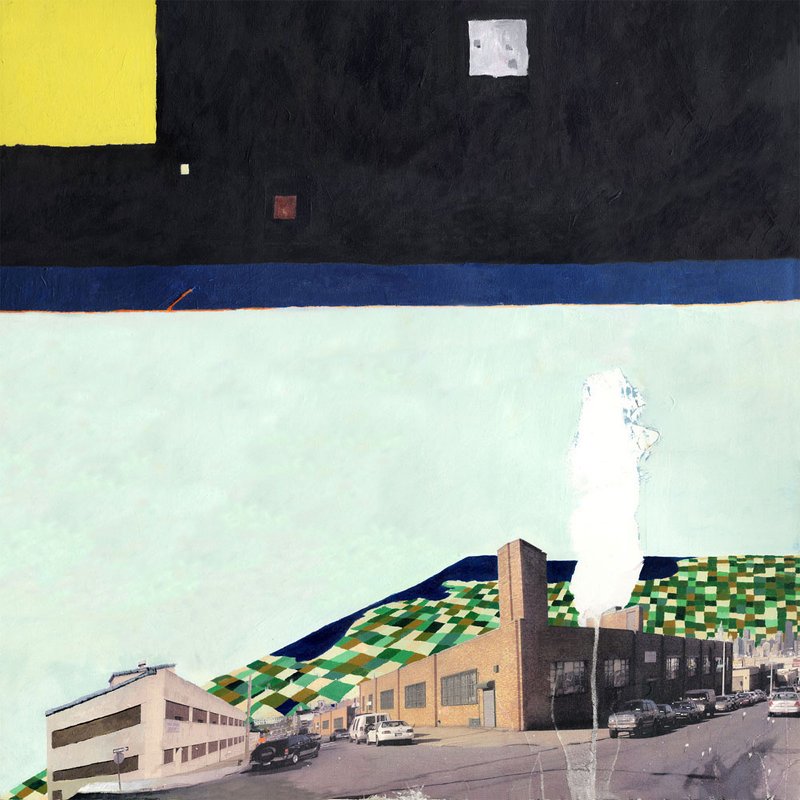
Four Corners
2002
Digital
Status & ownership
Currently in artist's studio, Berlin
What runs through this work
Claims that include this work, and the other works they connect.
Throughlines
- The square confesses the pixel
The square as an exposed confession of pixel logic: Four Corners (2002) -- the artist's first digital photo collage -- was made while actively learning the mechanics of digital resolution and printing, discovering that a photograph is secretly a grid of tiny squares built to look continuous.
Read the full claim
In the one part of the painting with no photographic source at all, the black sky, the artist painted the grid undisguised: a flat square sun, moon, Mars, and star, contrived and 'man-made' rather than naturalistic or naively symbolic. This same pixel-grid instinct may also underlie the square canvas format itself, used across all four founding Art Collision paintings and only much later given explicit theoretical language in Basel Switzerland's 'neither portrait nor landscape' framing (Digital City Series) -- one instinct operating at two scales, the unit and the whole canvas, five years apart in articulation.
2 works
- Two models of paint on photograph
Two coexisting photograph/paint relationships within a single founding series: across the four original Art Collision paintings, and most clearly within Four Corners itself, two distinct models of paint's relationship to photograph operate at once.
Read the full claim
A Richter/Polke-style opposition (paint as an outside force disrupting or filling a fixed, 'settled' photograph) governs the swatch-to-checkerboard-to-square lineage running through Transition and Four Nations, and traces to a confirmed direct influence -- Sigmar Polke's Rasterbilder, seen in Barcelona c. 2000, before Art Collision began. A separate, Richard Hamilton-style continuity model (paint drawing out a quality already latent in the photographic medium itself, rather than opposing it) governs Four Corners' exposed pixel-grid sky specifically -- arrived at independently in 2002, years before Hamilton entered the artist's awareness around 2010. The artist confirms holding both at once: one conscious, one unconscious.
4 works
- The founding four ascend
The founding four's ascent, earth to sky: across Prophecy, Transition, Four Nations, and Four Corners -- made sequentially from one shared starting point following the Global Peace Walk 2000 -- the artist's implied vantage climbs painting by painting: level with a rooted, growing city-tree (Prophecy); ascending alongside a composite tower (Transition); elevated but tethered, standing on a real bridge overlooking real towers (Four Nations); and finally untethered entirely, standing on unstable, finite ground beneath a fully invented cosmic sky (Four Corners).
Read the full claim
This tracks a parallel handover from photograph to paint across the same four works, and connects backward to an earlier, unexplained seed of the same intimate/elevated duality in Self Portrait 1995 (1995), and to the vortex-sky-over-small-world lineage of The Thinker and Antiquity (1993/1996) -- as well as to Antiquity's 'unfinished as resolved' device, echoed in Four Corners by the kept, uncorrected accidental water drip running through the painted sky. Prophecy's own numeric echo of four was clarified in this session: not absent, as previously thought, but structurally embedded as three pairs plus a fourth (tree and small building) in the painting's row of diminishing forms, drawn from the Hopi prophecy cave painting as orally told to the artist on the Peace Walk -- a full cycle of growth, disappearance, and return, not a one-way ascent.
7 works
- The hybrid mode returns
World War One (2022), and by extension World War Two and Vietnam, mark the first documented return of the Art Collision 'unrepeated hybrid mode' — visible composited photograph and visible hand-worked paint coexisting on one surface — in over 20 years.
Read the full claim
Where Art Collision's digital compositing erased seams to create a false continuity that never existed, the Mediums of War paintings keep every photo-fragment discrete and legible: paint does the coherence-work that Photoshop once did, without hiding the seams. Recognized only now, through the archive process itself, not at time of making.
4 works
- The Peace Walk as root
Global Peace Walk 2000 as the shared root of Art Collision and Mediums of War: The Global Peace Walk 2000 (San Francisco to New York, events at American University and elsewhere in DC with Native spiritual leaders, arriving in New York for the UN's 55th anniversary) is already on record as Art Collision's philosophical turning point.
Read the full claim
Stated this session as also underlying Mediums of War, made twenty-plus years later: the same peace-oriented conviction turned toward a direct examination of war. Explicit stated intent: the paintings exist in part to make people 'look again and remember that we need peace.' Background: the walk followed the Nipponzan Myōhōji tradition of walks reenacting the Trail of Tears as meditation; a monk named Yamato, who participated in walks since the 1970s and in a 1995 walk, is recalled by the artist as involved, held as artist-remembered history without external documentation (the walk was deliberately low-media).
7 works
Vision analysis
A description of the work written by an AI looking at the image, kept separate from the artist's account so the two can be compared.
claude-sonnet-4-6 · 4 September 2026
Four Corners divides into three horizontal registers. The lower register is a photographic composite: a low brick warehouse with a tall square chimney runs along a street receding in strong diagonal perspective, cars and a parking garage at left, Manhattan's skyline faint at right in the far distance. A checkered patchwork field in white, green, brown, and gold rises from the rooftop line and extends upward and outward across a warped, undulating ground plane -- not a rigid grid, but a landscape that tilts and narrows until it terminates abruptly at a corner rather than a horizon, giving the ground a finite, almost flat-earth quality. Above a pale mint-toned sky band and a hard navy horizon stripe, the upper half of the canvas is a near-total black field holding four small, flat, geometric marks: a yellow square upper-left, a small white square, a small dark maroon-red square, and a silver-gray square upper-right -- rendered with no shading, gradient, or atmospheric modeling, reading as symbolic units rather than naturalistic representations of a sun, moon, planet, and star. A vertical white drip runs from within the black sky down through the checkered field and into the chimney, irregular and unbounded in a composition otherwise built entirely from flat, hard-edged, geometric units. The palette splits cleanly by register: warm ochre, brick red, and gray-brown in the photographic lower third; cool mint and navy at the horizon band; near-total black above, broken only by the four small, saturated color notes of the celestial squares. This produces one of the highest tonal-contrast relationships in the composition -- small, bright, flat color notes suspended in an otherwise undifferentiated black field. Formally, the painting holds two entirely different representational logics side by side without reconciling them. The lower register is photographic, continuous-toned, and spatially coherent, receding correctly in perspective. The upper register is diagrammatic: flat, non-modeled squares with no attempt at illusionistic rendering, floating in a field with no light source, horizon reference, or scale cue relating them to one another or to the landscape below. Nothing in the image marks this shift as a device -- there is no frame, border, or transitional passage separating photographic reality from invented symbolic cosmology; the two simply meet at the horizon line as though equally factual. What resists confident description is the checkered field's exact relationship to the ground plane beneath it -- whether it should be read as a textile, a cultivated or paved surface, or a purely symbolic overlay unconnected to any real material, since its undulation does not consistently follow the implied topography of the land it sits on. Also unresolved is the white drip's origin point within the black field -- it appears to emerge from the sky itself rather than from any specific mark, making it read as an intrusion into the painting's symbolic register rather than a feature belonging to it.
Intent
To translate an outer-borough, infrastructural view of New York -- Queens warehouses with Manhattan reduced to a distant background presence -- into a painting that ultimately became a fully invented, hand-painted cosmology. The squares (sun, moon, Mars, star) were not planned as symbolic content from the outset; they arrived while painting, after the swatch device in Transition and the checkerboard in Four Nations had already been worked out, and the sacred-four color palette of the Native American Church (white, red, black, yellow) is echoed loosely rather than deliberately -- Mars-as-red the one conscious anchor, black relocated from a checkerboard-equal color to the entire field of the sky.
Direct inspiration
Made in the immediate period following the Global Peace Walk 2000, in the same shared starting point as Prophecy, Transition, and Four Nations. The four square celestial bodies loosely echo, without full deliberateness, the four sacred colors of the Native American Church already made explicit in Four Nations' checkerboard (white, red, black, yellow) -- Mars-as-red the one confirmed intentional color choice.
Making
Made in a Fort Greene, Brooklyn apartment in 2002, in the same photo-collage prep phase and roughly two-week painting sprint as Prophecy, Transition, and Four Nations -- the four original Art Collision compositions. This was the artist's first digital photo collage, made while actively learning the mechanics of digital printing, resolution, and pixel density -- how a grid of squares can be printed to read as a continuous, photographic image. The painted sky squares are read, in retrospect, as an exposure of that underlying pixel logic rather than a naive invented symbolism: a 'man-made,' contrived sky, honest about being constructed rather than observed, extending the same square logic already implicit in the photographic collage itself. The vertical white drip through the checkered field and chimney began as an accidental water spill -- the canvas could not hold water, which is why all four founding paintings were finished by dry-brushing acrylic -- and was kept rather than corrected, standing as the one truly physical, uncontained mark against the otherwise fully squared, artificial sky.
Context of making
Revisited across an extended session alongside all three other founding Art Collision paintings, plus Self Portrait 1995, Education, The Thinker, and Antiquity. The artist reflected that seeing these connections now -- a direction that existed before it could be articulated, including to art teachers who asked directly at the time -- constitutes its own meaningful moment in the archive process, confirming a throughline the artist felt but could not name at the time it was being lived.
Where it went
Blind description, before the image was reviewed again in this session: 'a warehouse street scene in Queens with Manhattan in the distance, a square patchy landscape that extends out, and the sky with a square moon and square mars' (later confirmed to include a square sun and star as well). Closing description, after full session: 'a painting of pixels on pixels.' The shift from an inventory of contents to a statement about the painting's own underlying logic mirrors the same arc found in the Four Nations session.
In the practice
Made in a Fort Greene, Brooklyn apartment, the same working conditions as Prophecy, Transition, and Four Nations. This was the artist's first digital photo collage, made while learning the mechanics of digital printing and pixel resolution for the first time -- a technical education running in parallel with, and possibly shaping, the painting's square vocabulary.
What this isn't
The squares were not rendered toward astronomical accuracy or naturalistic detail -- a deliberate (though not fully premeditated) refusal to resolve the sky into anything other than flat, artificial units, consistent with an 'unfinished/unresolved as the finished state' instinct traceable back to Antiquity's ghost-white unrendered Acropolis (1996). The accidental water drip was likewise not corrected or painted over.
In the series
Last of the four original Art Collision compositions (Prophecy, Transition, Four Nations, Four Corners), made sequentially but from one shared starting point following the Global Peace Walk 2000. Confirmed by the artist as completing the founding four's ascent from earth to sky, from photograph-dominant to fully painted, worked in a state closer to mysticism than the concept-first-execute method taught at art school in Utrecht. The square-format origin, previously attributed only to the 36-inch printer width used across all four originals, is reconsidered here as possibly rooted in the same instinct as the sky's squares -- an early, working awareness that a digital photograph is fundamentally a grid of pixels, absorbed while learning digital printing for the first time on this body of work. This same square-canvas instinct later resurfaces, fully theorized, in the Digital City Series (see Basel Switzerland, 'neither portrait nor landscape').
Two distinct photograph/paint relationships coexist in this single painting. The checkerboard-adjacent square logic follows a Richter/Polke-style opposition -- paint as an outside force disrupting or filling what the photograph left unresolved -- consistent with Sigmar Polke's Rasterbilder, seen by the artist at a Barcelona exhibition circa 2000, a confirmed direct pre-Art-Collision influence. The sky's exposed pixel-grid squares instead follow a Richard Hamilton-style continuity model -- paint drawing out a quality already latent in the medium itself (the pixel grid a digital photograph is built from but designed to conceal) -- arrived at independently in 2002, years before Hamilton entered the artist's awareness around 2010. The artist confirms these as operating at the same time: Polke consciously, Hamilton unconsciously.
Sigmar Polke · Sigmar Polke
Ambivalent, simultaneously drawn-to/repelled-by relationship to mass-culture imagery — relevant to the billboard's dual role as scenery and advertisement.
Richard Hamilton · Richard Hamilton
Continuity model -- paint drawing out qualities already latent in a photograph -- arrived at independently in Four Corners' exposed pixel-grid sky in 2002, years before Hamilton entered the artist's awareness c. 2010. Recognition, not influence.
Visual Similarity
Works with similar visual structure, found by comparing image embeddings across the archive.
Art/Official sessions
Every work in this archive is catalogued through a recorded conversation between the artist and an AI. The record above was written during this session — the transcript is where it came from, kept whole so any claim on this page can be checked against what was actually said.
Four Corners — Art/Official session, September 4, 2026
- Artist
Hey C want to catalogue this artwork https://bernardbolter.com/four-corners
- Art/Official
Asked series orientation before fetching the page.
- Artist
Art collision, is the four in the first 4 that were made
- Art/Official
Confirmed as fourth of the founding Art Collision set. Asked about timing relative to the other three.
- Artist
They were all made in succession together, maybe over the period of 2 weeks for the painting, there was of course the photo taking and collage making before, but then these 4 were printed on canvas at the same time
- Art/Official
Asked for the blind first description before image upload.
- Artist
Also was made in fort greene brooklyn, the painting is of a warehouse street scene in Queens new York with Manhattan in the distance, then there is a square patchy landscape that extends out and then the sky with a square moon and square mars
- Art/Official
Captured blind description. Asked about paint/photo balance and the title's meaning.
- Artist
[uploaded image: warehouse street scene, checkered field, black sky with squares] Also was a square sun and a square star too
- Art/Official
Confirmed four celestial bodies (sun, moon, Mars, star) as the source of the title 'Four Corners' -- not literal canvas corners. Asked about the white drip running through the composition.
- Artist
That was a mistake, but kept it and like it, the painting was below my loft bed and when I got down I spilt some water on the canvas, like I said the canvas couldn't hold water, so I dry brushed all the acrylic paint in these paintings. Can you look up the other paintings now, would be a good reference. Bernardbolter.com/prophecy bernardbolter.com/transition bernardbolter.com/four-nations
- Art/Official
Fetched Prophecy, Transition, and the Four Nations front-end stub for reference. Confirmed catalogue number BB-COL-2002-005, stub-only status prior to this session.
- Artist
It does something different, but definitely in the series. Did you read the whole text for the other paintings or just go from memory
- Art/Official
Confirmed pages were freshly fetched, not recalled from memory. Continued comparing Four Corners' Queens/outer-borough vantage against Transition and Prophecy's Manhattan-centered subjects.
- Artist
I wouldn't really say that it's different, but a continuation somehow... the photos are of buildings in Queens, with Manhattan in the background, so the subject is more removed from the other ones that are all Manhattan pictures
- Art/Official
Explored the shift from arrival/Manhattan-fixation to settled, insider knowledge of the city's outer-borough infrastructure.
- Artist
Maybe in the way that when you first come to New York it's all about Manhattan, then the more you stay you start to settle in and chill in the outerborough, also the buildings are a bit of more warehouse buildings, so a bit like how the city actually runs, is dependent on the warehouse outside of the center to get everything there
- Art/Official
Asked about the checkered field's origin, appearing to grow from the warehouse roof.
- Artist
It's not growing out of the roof, but it a bit of a warped perspective and the land extends out but ends in a corner, almost as if it's a flat earth
- Art/Official
Asked whether this connected to the squared sky bodies -- a reinvented cosmology.
- Artist
Yeah, somehow everything is square, the earth the sun the moon mars and the stars
- Art/Official
Traced the square device back through Transition's RGB/CMYK swatches. Asked if Four Corners was where the device became the whole painting.
- Artist
Yes, the squares lead up to this and then in this painting they became the whole painting... It stopped here and it's part of this mini series
- Art/Official
Confirmed the device's arc: contained in Transition, central in Four Nations, total system in Four Corners, then not repeated after. Asked about current location.
Show the remaining 34 turns
- Artist
It's in the SF studio
- Art/Official
Asked to keep the session open rather than close, per standing instruction.
- Artist
Let's not wrap this up... now is the time to look at them all together. Can you see the raw session conversations for the other 3 paintings
- Art/Official
Attempted direct API session-endpoint fetches; blocked by tool permissions. Asked Bernard to paste the raw transcripts directly.
- Artist
[uploaded Prophecy sessions-feed JSON, which bundled the Transition, Color Theory 1995, and Prophecy session transcripts]
- Art/Official
Read all three transcripts. Surfaced the RGB-three/CMYK-four numeric echo from the Transition session, and flagged Prophecy as the apparent outlier without a numeric four (later revised).
- Artist
So you could read all 3, I only posted prophecy
- Art/Official
Clarified the sessions endpoint appears to bundle mentioned-artwork sessions, not just the primary artwork's own session -- flagged as a possible archive bug. Asked whether the number four was consciously tracked across the four originals.
- Artist
[uploaded Four Nations full tier-4 record JSON]
- Art/Official
Read the record. Surfaced the confirmed four sacred colors of the Native American Church (white, red, black, yellow) in Four Nations' checkerboard, and the form-first, meaning-following sequence confirmed as typical of all four founding paintings. Asked whether the same sequence held for Four Corners' squares.
- Artist
Came while making the painting, or when I started painting it, after the other ones
- Art/Official
Connected the sequencing: by the time of Four Corners, the swatch/checkerboard vocabulary was already established, so the mid-painting arrival of the squares was a discovery within an existing device rather than an invention from nothing.
- Artist
Tge paintings themselves were square, which is a format Ive carried through to the DCS and a colorful history read bernardbolter.com/basel-switzerland
- Art/Official
Fetched Basel Switzerland. Confirmed the square format's later theorized meaning ('neither portrait nor landscape') as DCS founding logic, and traced it back to the Art Collision originals. Asked whether the square choice was deliberate at the time.
- Artist
Was just a feeling I guess, the printer I had to use was 36 inch wide, so then just went with the square... At this time the square was not as popular as now
- Art/Official
Noted the square as a felt choice within a printer constraint, not a mandate. Asked about the color choices for the four celestial bodies relative to Four Nations' sacred four.
- Artist
Tge printer was 36 wide, I didn't necisarrily have to make it square, but worked out... Was thinking about that a bit, but then there was black for the sky
- Art/Official
Noted black as relocated from a checkerboard-equal color to the entire field. Asked about the silver-gray star's color logic.
- Artist
Not deliberate, the colors were not so intentional, but somewhat part of the process, especially by including mars as red
- Art/Official
Confirmed Mars-as-red as the one deliberate anchor amid an otherwise intuitive color process.
- Artist
In contrast. The square world is contrived, controlled. A square sun looks like something man (or machine, which man made) made
- Art/Official
Reframed the squares as artificial/man-made rather than naive-mystical, in contrast with the accidental water drip. Asked how this related to the archive.
- Artist
Yes, and my next question was gonna be be how does that reading relate to the archive interpretation. Maybe now we have better graphics, bit I grew up in an 8 bit world, that's what a computer world looked like to me
- Art/Official
Connected the pixel-grid childhood memory to the squares. Asked if this was felt consciously at the time of painting.
- Artist
A bit of both, this was also my first go at digital photo collage, so maybe not the 8 bit part specifically, but well aware that those collages came from pixels
- Art/Official
Reframed the connection as material rather than nostalgic: the photographic collage itself was pixel-based, and the hand-painted sky extends that same underlying unit. Connected this to the square-format origin question from earlier in the session.
- Artist
Yes it does, but we might have also uncovered my instinct for the square format, the pixel
- Art/Official
Proposed the square format and the sky's squares as one instinct operating at two scales -- unit and whole canvas. Asked if this felt like a stretch.
- Artist
I think it does. Maybe a stretch, but I do remember really learning about how it worked at the time, about resolution and pixel density and digital printing. And how all these squares could make an image that looked like an analog picture
- Art/Official
Confirmed the squares as an exposure of the pixel grid the print process was designed to conceal. Raised the Richard Hamilton continuity model as a possible fit.
- Artist
Ok, this starts to get towards Richard Hamiltons idea of photo and paint a bit, but with digital. In the last session we looked more at the Sigmar polke and richter relation
- Art/Official
Distinguished the checkerboard's Polke/Richter-style opposition (paint disrupting a fixed photograph) from the sky's Hamilton-style continuity (paint revealing something already latent in the medium). Asked whether both models coexisted.
- Artist
Yes I think that fits for this, they both exist at the same time. Consciously for the polke and unconcious for Hamilton
- Art/Official
Confirmed the dual-model reading as a distinct throughline. Reviewed session scope covering all four founding paintings plus adjacent works, and asked whether to consolidate.
Copy of the session record (September 4, 2026). Canonical: /sessions/four-corners-2026-09-04