Bernard Bolter

All Artwork

smoothism.com

ArtworkBioCVStatementContact
Mokum Straat

Mokum Straat

1997

Expressive line

10.5cm x 14.8cm

4 1/8" x 5 7/8"
Medium
Mixed media on canvas
Support
Paper
Dimensions
/
10.5cm × 14.8cm
Scale
Small
Year
1997
Made in
Amsterdam, Netherlands
Series
Drawings

Currently in artist's studio, Berlin

BB-DRA-1997-002

Record fully catalogued via Art/Official

Last updated July 2026

Contribution

Mokum Straat sits outside Bolter's named series as an archival document of the practice forming. Its formal contribution is the one-line figure technique — a mark-making method developed independently during early European travels, before formal training, and subsequently set aside on arriving at art school. The drawing demonstrates that the instinct toward loose, expressive, figure-dissolving line was native to the practice, not acquired. The reinforced perspective lines working against the loose ground anticipate the later structural tension between photographic precision and painted looseness in the transfer paintings, though the connection is implicit rather than deliberate. As an early work, its primary value to the archive is biographical and sequential — placing the practice in motion before any named series, and holding a feeling of first encounter with European urban culture that the later, more resolved work no longer carries.

About the work

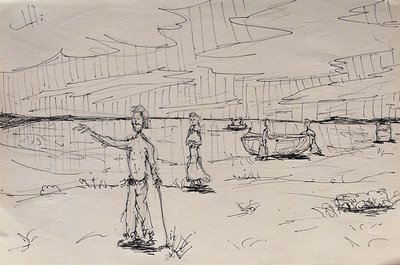
A small pen drawing made on location in Amsterdam, circa 1997–98, during Bolter's first solo travels through Europe. Canal street scene with loose mark-making, one-line figures, and reinforced perspective lines — drawn from a canal bench, before any formal art training. Mokum Straat is a small pen drawing made in Amsterdam around 1997–98, during Bernard Bolter's first solo travels through Europe from San Francisco. The title uses the old Jewish name for Amsterdam — a word Bolter encountered while there and kept, for the insider feeling of knowing a city by a name not on the map. The drawing was made on location, sitting on one of the canal benches Bolter returned to repeatedly. The whole composition was laid down loosely first — buildings, windows, figures — then anchored with heavier pen strokes along the perspective lines to offset the open mark-making. The one-line figures in the foreground, barely held together by a single continuous stroke, were a technique Bolter had been developing through this period of travel, and had also used in earlier oil paintings. The Stedelijk Museum visit during this same trip brought Bolter into contact with Karel Appel and the COBRA movement for the first time — work he hadn't previously known. The encounter produced recognition rather than influence: the loose, figure-dissolving energy of COBRA was already present in what he was making. A confirmation that the instinct was in the right place. The drawing was kept privately, passed around through the sketchbook rather than shown as a finished work. It enters the archive now as part of a group of drawings and small watercolours from this transitional period — connective tissue between the early self-taught San Francisco practice and the named series that followed formal training. What it holds, and what Bolter notes is no longer available to him after years of living in Europe, is the particular feeling of freedom in arriving somewhere new and absorbing its culture for the first time.

Direct inspiration

Amsterdam drew Bolter back repeatedly during his early European travels partly because of its parallel with San Francisco — a world-famous counterculture city with a long history, but compact and village-like, both cities around 800,000 people. Arriving from San Francisco, he found a European mirror: similar spirit, different geography, no hills. The drawing was made sitting on one of the canal benches he particularly loved.

Context of making

Initially described as funky and trippy with one-line figures. On reflection, the feeling that comes through is freedom — being in a new city for the first time and absorbing its culture. The looseness of the mark-making carries that openness rather than being a stylistic choice in itself.

In the practice

Made during Bolter's first solo European travels from San Francisco, before any formal art training. The drawing was kept privately — shown to people through the sketchbook rather than exhibited. Now being brought into the archive to document the transitional period between the early self-taught San Francisco practice and the later named series. Bolter notes it captures a feeling of wonder and excitement on first arriving in European cities that no longer exists in the same way after years of living in Europe.

Process

Drawn on location in Amsterdam, sitting on a canal bench. The whole drawing was laid down loosely first — including the windows and figures — then perspective lines were reinforced with heavier pen strokes to offset and anchor the loose mark-making. One-line figure technique used for the foreground characters, a method Bolter was developing during his early European travels and had also experimented with in earlier oil paintings.

What this isn't

The one-line figure technique and the loose travel sketchbook style were consciously set aside on arriving at the Utrecht art school. Bolter entered the first school deliberately as a blank slate, not wanting to carry in preconceived styles. The decision was more intentional at Utrecht than at the Rietveld, where he was older and more settled in his direction.

In the series

These travel drawings predate both the Utrecht art school period and the Gerrit Rietveld Akademie years. Made during Bolter's first solo travels through Europe from San Francisco, they document the transitional moment between his early self-taught practice and the formal training that shaped the later series. Alongside small watercolour paintings from the same period, they form the connective tissue of the archive — evidence of the practice forming in motion, before any named series existed.


During this period of European travel, Bolter was visiting museums extensively. The Van Gogh Museum made an impression, but so did the Stedelijk Museum in Amsterdam, where he encountered Karel Appel and the COBRA movement for the first time — artists he hadn't known before. The COBRA emphasis on loose, expressive mark-making and figures that resist resolution connects directly to the drawing style visible in Mokum Straat. These were not studied references but live encounters while travelling, feeding directly into the work being made at the same time.


COBRAExpressionismExpressive lineLoose mark-makingOne-line drawingGesturalAmsterdamcanalstreet sceneurban landscapefiguresarchitectureUrban sketchTravel drawingStreet scene1990sPre-formal trainingEarly workAmsterdamMokumtravel drawingone-line figurescanalurban street scenesketchbookfreedomcounter-cultureCOBRAKarel Appelpre-formal practicetransitional workEuropean travelsmark-making

Vision Analysis

The composition is a vertical page of pen drawing on textured paper, organized as a street scene tipping between observation and invention. The right half is dominated by a single tall building drawn in wandering, overlapping line: a narrow facade rising nearly the page's full height, crowned by a rounded, bell-like gable, its face filled with loosely stacked rectangles that read as windows drifting out of alignment, and its base hatched with short vertical strokes suggesting a fence, grate, or shadowed ground floor. The left half recedes: a cluster of angular high-rises sketched as jagged, faceted outlines, drawn with a straighter, more architectural line than anything else on the page, and between the two zones a road or canal curves back in an S from the lower left toward a knot of smaller gabled houses at the middle distance, where a tiny stick figure stands with arms raised. The page is populated by figures in a different linguistic register from the buildings: looping, continuous-line bodies with bulbous heads and rubbery limbs — a striding figure in the lower left, a smaller one behind it, a central figure caught mid-step with one arm bent, a squat walker at bottom center, and, in the lower right, a tangle of reclining or collapsed forms drawn in a single meandering line that never quite separates into distinct bodies, one small figure appearing to ride or fall over the mass. Along the curving road, a leaf- or eye-shaped pool holds a smaller shape inside it — boat, island, or reflection — and a row of short arcs beside the curb suggests parked bicycles or railings reduced to gesture. Tonally, the drawing is entirely line on off-white ground: no washes, no shading beyond hatching, the paper's grain and a few foxed spots part of the surface. Line weight varies from faint exploratory passes to darker, insisted-upon contours where the pen has gone over a decision several times — the big building's left edge, the gable's dome, the foreground figures' outlines. Perspective is present but elastic: the road obeys a rough recession while the large building stands almost flat to the picture plane, and the left-side towers lean at angles that owe more to energy than to structure. Several drawing modes coexist on one page without hierarchy: the ruled-feeling geometry of the left-hand towers, the organic wobble of the great gabled facade, the cartoon elasticity of the figures, and the pure abstraction of the lower-right tangle. These read as different speeds of looking — some passages observed, some remembered, some invented mid-line — held together by the single pen and the single sitting the page implies. The scene's architecture suggests two building cultures side by side: narrow gabled houses of an old European street and the faceted slabs of a modern skyline, coexisting across the drawn road as if the street ran between centuries. What resists confident description is the lower-right tangle: figures resting, wrestling, fallen, or simply the pen thinking out loud — the line commits to continuity but not to bodies, and no reading fully claims it. The pool in the road similarly floats between puddle, canal, and drawn hole in the page, and whether the raised-armed stick figure in the distance is greeting, hailing, or part of a signpost stays open at the drawing's smallest scale.

View all analyses →