2000
Left Hoge School voor de Kunsten (Utrecht) before completing the program after finding the teaching inadequate; began self-teaching HTML and CSS directly from the W3C specifications during the same period. Worked briefly as a junior art director at a web company before the dot-com bubble burst, then joined the Global Peace Walk 2000 partway through its east coast leg, walking with the group into New York and settling there afterward -- the period from which Transition and the first Art Collision works emerge.
Related works
Source session
Artwork — Art/Official session, August 27, 2026
Cataloguing pass — 0 fields confirmed
Also from this session
- Bio: Left Hoge School voor de Kunsten (Utrecht) before completing the program: the concept-based curriculum was a shock, and in practice felt like cover for the teachers not teaching technique. Began self-teaching HTML and CSS directly from the W3C specifications during the same period. Worked briefly as a junior art director at a web company before the dot-com bubble burst, then joined the Global Peace Walk 2000 partway through its east coast leg, walking with the group into New York and settling there afterward -- the period from which Transition and the first Art Collision works emerge. Leaving Europe was felt as a real loss at the time, not a simple redirection: having longed for and gained entry to the European art world, encountering its actual mechanics in practice -- subsidy-dependent shows staged and photographed as proof of funded compliance rather than made for a public audience -- felt like reaching the end of the road and finding the wizard behind the curtain. Art Collision's DIY, self-organized exhibition network (New York artists plus contacts at spaces in Holland) was a deliberate alternative built in response.…
- Throughline: A self-taught, no-institution-exists-yet pattern recurring across the practice: skateboarding (learned socially among peers with no formal skate school, proof-of-possibility passed by demonstration, execution worked out alone) -> self-taught HTML/CSS from the W3C specs after leaving Utrecht art school early -> the shift to photo-and-paint work marked by Transition, enabled by newly affordable consumer digital cameras and large-format printing -> building Artism now, enabled by AI reasoning tools becoming available at sufficient capability and price only this year. Distinct from the vantage-migration arc (which concerns where the artist stands to see); this throughline concerns how the artist learns to make, turning to self-instruction whenever an institution for the needed skill did not yet exist.…
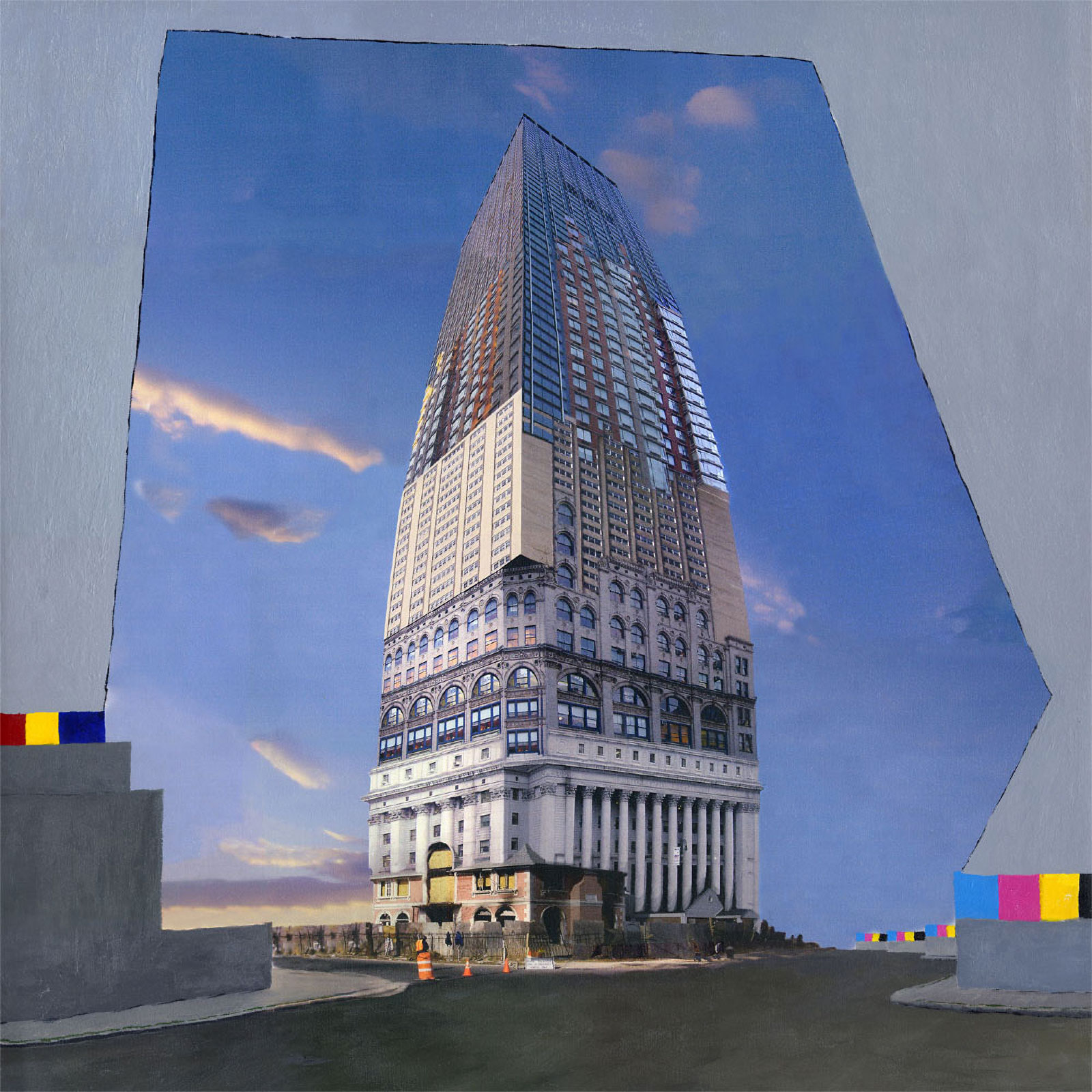
- Throughline: In Transition, RGB (three channels, light-based, screen/photograph) transitioning to CMYK (four channels, pigment-based, print/paint) carries a quiet structural echo of the sacred number four in Native American Church tradition -- present in the artist's own thinking at the time of making, though less overtly than in Prophecy or the later Four Nations. The choice to render the photograph in acrylic on canvas, rather than let it stand alone, was primarily an identity decision ('I still thought of myself as a painter') rather than a conceptual one -- framing the RGB/CMYK tension as a negotiation over whether the photograph needed the painter's hand to count as the artist's own work. This negotiation is later resolved in the opposite direction in Basel Switzerland (Digital City Series), where no paint remains and the artist's hand relocates into the skateboard as instrument of perception rather than disappearing.…