Prophecy
2002
Digital
Status & ownership
Private collection
If you own this work, get in touch. I'll add you to the record and officially connect you to its history.
Contribution
Prophecy occupies a precise hinge in Bolter's practice: it is the first work to combine digital print with painting on canvas, establishing a material logic that would evolve into the acrylic gel medium transfer technique of A Colorful History. Its surrealist register — the city as a living, rooted organism, prophecy embedded in urban form — is distinctive within the body of work, more associative and mythic than the later series, which move toward documentary and historical framing. The work also marks the origin of Bolter's sustained engagement with the photograph as a material to be painted with rather than painted over, a relationship that defines his practice across two decades. Its formal contribution is as a generative starting point: the question it opens — what the surreal can do within an urban photographic practice — remains, by Bolter's own account, unanswered and potentially still live.
About the work
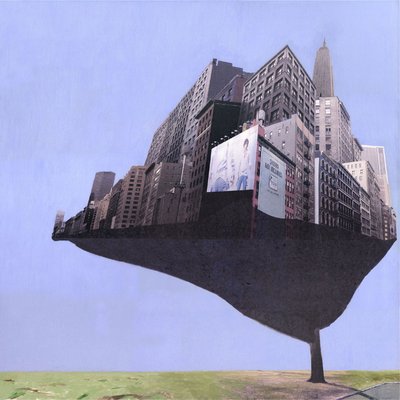
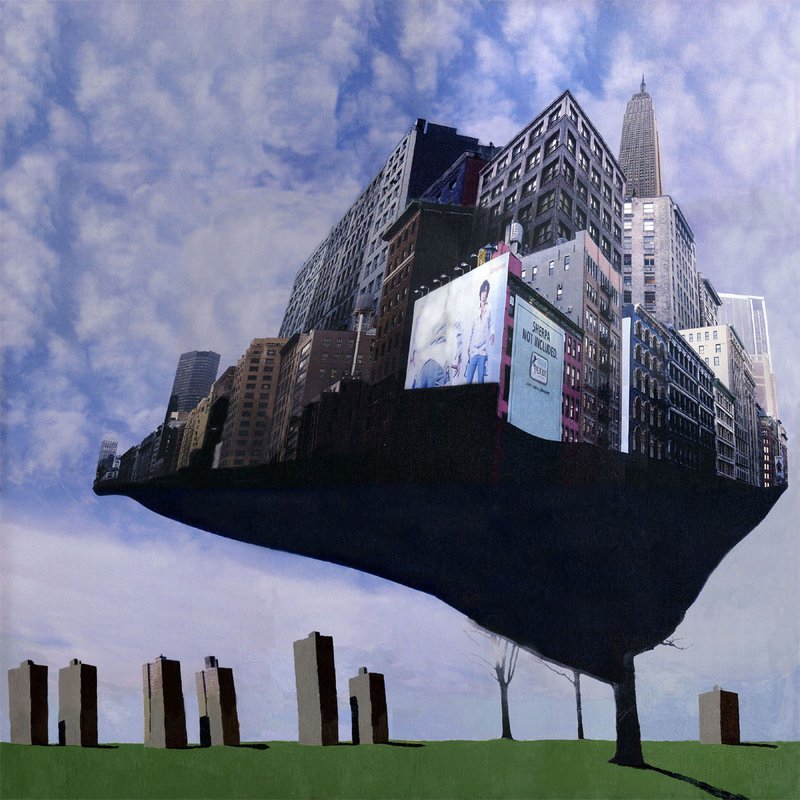
A digital print and acrylic collage on canvas depicting the New York skyline as a tree growing from the earth, with painted housing project pairs extending to the left — a visual translation of the Hopi prophecy, in which one figure grows and disappears. The first work in the Art Collision series, made in Fort Greene, Brooklyn, in 2002. Prophecy is the first painting in the Art Collision series — a self-organized body of work made by five Brooklyn-based artists who mounted their own shows across New York, Austin, Baltimore, Amsterdam, Leiden, and Rotterdam. Made in a Fort Greene apartment in 2002, it is Bolter's first experiment combining a large-format digital print with acrylic paint on canvas. The composition centres on a photographic collage of the New York skyline, inverted so that the city mass reads as a tree rooted into the ground — the Empire State Building rising as its canopy. To the left, pairs of housing project buildings, partly painted in dry-brush acrylic, diminish in scale toward the right, echoing the structure of a Hopi prophecy Bolter heard directly during the Global Peace Walk 2000: a cave painting depicting two figures standing side by side, one growing larger, then disappearing. The prophecy structure was not pre-planned — the source photograph already contained two building tops, and the repeating pairs were extended through painting as the idea emerged in the finishing stage. The surreal quality of the image — organic and urban, ancient prophecy and contemporary skyline — carries forward from Bolter's earlier oil paintings while pointing directly toward the photographic collage logic of the Digital City Series and A Colorful History. Made outside any institutional framework, with access to a 2mp digital camera and a large-format printer at a Manhattan shop, the work reflects a particular moment: the freedom of unlimited digital shooting meeting the excitement of New York after a year at art school in the Netherlands.
Intent
To translate the Hopi prophecy — a cave painting of two figures, one growing larger then disappearing — into a visual language rooted in the urban landscape of New York. The city becomes the organism: a tree growing from the earth, its skyline the canopy. The prophecy structure was not illustrated top-down but discovered within the source material during making.
Direct inspiration
Arrived in New York via the Global Peace Walk 2000, joining friends who walked from San Francisco to New York. The walk involved close contact with Native American chiefs, sweat ceremonies, and oral storytelling. The Hopi prophecy — a cave painting depicting two figures standing side by side, one growing larger then disappearing — was heard directly in that context, not encountered through a book or secondary source. This story became the conceptual seed for Prophecy.
Making
The source print already contained two building tops. The repeating pairs of housing project buildings to the left were extended through painting during the process — the prophecy structure wasn't pre-planned but emerged from what was already in the collage material. The composition was worked out through making rather than predetermined. This was the first experiment painting on canvas — the digital print wasn't fully protected beforehand, so everything was painted dry brush as a practical response to the surface. The painted areas (sky, grass, additional buildings) were added without certainty about what would stay or get painted over; the final idea came in the finishing stage.
Context of making
Revisiting the work through conversation, it still reads as a city-as-tree rooted in the earth, with the Hopi prophecy structure underlying the composition. But looking at it again now, it feels like a starting point for everything that followed — and also a door still open: the surreal quality of this early work is something Bolter wonders about returning to someday.
Where it went
Looking back, the work is interesting and clearly led directly to the later series. It reads as more surreal than the subsequent transfer paintings — a quality that carries forward from the original oil paintings. It sits at a hinge point between the early surrealist work and the more documentary urban language of A Colorful History and the Digital City Series.
In the practice
Made in a Fort Greene apartment, outside any institutional context. Bolter had left the Utrecht School voor de Kunsten after one year and arrived in New York through the Global Peace Walk 2000. The energy of New York — combined with the freedom of digital photography and access to a large-format printer at a Manhattan shop — created a feeling of wide openness that was deliberately different from the art school environment. The work was made for the Art Collision group's own self-organized shows, with no gallery brief or curatorial framework.
What this isn't
No explicit rejection of a prior style, but the work was made in conscious contrast to the art school experience in the Netherlands — the institutional framework was in the background but not being directly responded to. The excitement of New York and the freedom of digital photography pointed forward rather than against anything specific.
In the series
The Art Collision series emerged directly from access to two new tools: a first digital camera (around 2mp) that allowed unrestricted shooting, and a large-format printer at a Manhattan shop where Bolter was working at the time. The cityscape and landscape tendency was already present in the earlier oil paintings, but photography brought it into sharper focus. The series was the first experiment combining digital print with painting on canvas, predating the acrylic gel medium transfer technique of A Colorful History. The four base compositions were each painted twice — eight paintings total — plus two purely digital collage works, making ten in the series. Shows traveled to New York, Austin, Baltimore, Amsterdam, Leiden, and Rotterdam under the Art Collision group, a self-organized collective of five artists who lived on the same block in Brooklyn.
At the time of making, Bolter was absorbing New York's billboard landscape as a visual environment — the city itself read as assembled collage. Was also engaging with the work of Canadian photographer Jeff Wall, whose large-format staged urban photographs and lightbox scale were a reference point. The surrealist quality of the work connects back to the earlier oil paintings rather than to any specific contemporary art world influence. Richard Hamilton and Sigmar Polke, more central to the later transfer painting series, were not yet in the picture at this stage.
Visual Similarity
Works with similar visual structure, found by comparing image embeddings across the archive.
Explore visual embeddings →Related Patterns
Throughlines and bio events that include this work — the same connections shown on those pages, linked back here.
- In Transition, RGB (three channels, light-based, screen/photograph) transitioning to CMYK (four channels, pigment-based,
- Transition and Art Collision were made specifically against the version of the European, subsidy-dependent art system th
- An invented-to-lived Romanticism arc: Nature vs Nurture (1994) uses the cross as a generic, Dalí-derived symbol of belie
Vision Analysis
The composition is a square field dominated by a single surreal event: a dense photographic mass of city buildings floating in the upper two-thirds of the canvas, gathered into the shape of a colossal canopy and carried on the slender black trunk of a tree rising from the ground at lower right. The urban mass is assembled from many separate photographic building fragments — brick facades, cast-iron fronts, office towers, a spire unmistakably crowned like a skyscraper's pinnacle at the top edge — packed shoulder to shoulder at conflicting angles and scales, their rooflines forming the canopy's ragged upper silhouette and their street-level floors forming its rim. Below the rim, the mass resolves into a smooth, matte black underside that tapers like a hull or the underside of foliage down to the trunk, where a few thin painted branches reach up into the darkness and visibly fail to span it. A second, smaller bare tree stands beside the main trunk, silhouetted against the sky, holding nothing. The ground register is painted rather than photographic: a flat green lawn strip runs across the bottom edge, and standing on it are eleven simple rectangular slabs in greys and browns, arranged loosely like standing stones or graves, each casting a short painted shadow to the right — the only consistent light direction in the image. The slabs echo the proportions of buildings but are stripped of every feature: no windows, no doors, no photographic texture. The sky filling the rest of the field is painted in soft mottled blues with fields of small dappled clouds, denser and warmer toward the top, opening into clearer blue at the left and behind the ground plane. Two image regimes coexist and trade places here. The photographic material — normally the register of the real — is used for the impossible object: the airborne city, complete with legible billboards (a figure in jeans on one, a pale sign whose largest words read "SHERPA NOT INCLUDED"), fire escapes, and streetlamps along its rim. The painted material — the register of invention — is used for the plausible: lawn, sky, shadows, slabs. The billboards and signage inside the mass carry contemporary commercial photography, while several facades read as nineteenth- or early-twentieth-century construction, so the canopy also compresses different building eras into one grown object. The blank slabs below read as either the city's ancestors or its remains — before windows or after them — and the image gives no way to decide. Technically, the photographic fragments are cleanly cut and joined, their varied perspectives deliberately unreconciled so the canopy bulges with contradictory vanishing points; the transition from photographic rim to painted black underside is soft and seamless, which is what lets the mass read as one organism rather than a collage resting on a shape. Brushwork is visible in the clouds' dappling and in the slabs' dry, flat faces. The trunk and branches are painted with enough irregularity to read as wood, and the ground shadows are confident single strokes. What resists confident description is the structural relationship at the heart of the image: whether the tree carries the city, the city has grown from the tree, or the black mass is the tree's own canopy with a city colonizing its surface — the branches reaching into the dark underside touch nothing, so the support is asserted and withheld at once. The slabs on the lawn likewise hover between monument, model, and tombstone, and the single bare second tree — the same species as the carrier, holding no city — stands as either a before, an after, or a refusal, without the image settling which.
View all analyses →