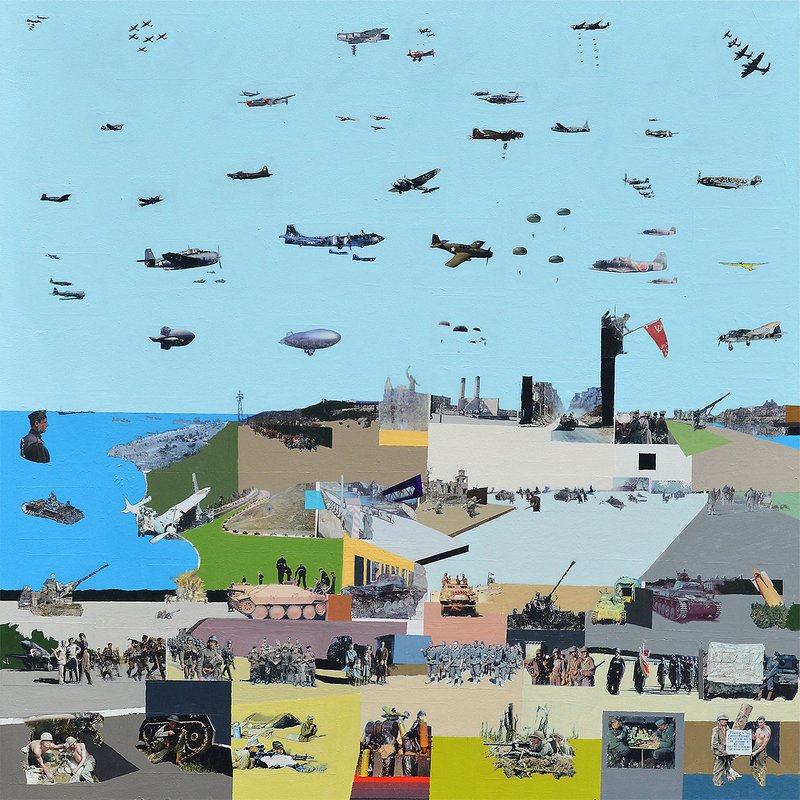
World War Two
2022
Mixed media on canvas
80cm x 80cm
31 1/2" x 31 1/2"
Contribution
Continues World War One's reactivation of the Art Collision 'unrepeated hybrid mode' (visible photograph and visible hand-worked paint on one surface), but with a further distinction identified this session: where Art Collision achieved this hybrid through digital compositing (photograph → Photoshop → print → paint on top), Mediums of War achieves it through direct physical photo-transfer with no digital compositing step at all. The hybrid mode returns with the computer deliberately removed — read as a formal statement in its own right, examining photographic history through a technique that goes backward past digital manipulation to a handmade relationship with source photographs.
Intent
A painting examining how the recording medium doesn't just document war but actively manufactures the moral narrative attached to it — using color photography (WWII's dominant recording medium, versus WWI's black-and-white) and a central quoted image (the Khaldei Reichstag flag photograph) known to be staged and darkroom-edited.
Direct inspiration
Same medium-per-era concept established for World War One (b&w photography for WWI, color photography for WWII, film stills for Vietnam), planned before compositional decisions. The horizon line's height was also planned in advance, across all three paintings, to drop progressively from WWI to WWII to Vietnam as war becomes increasingly airborne with technological escalation — confirmed as pre-visualization at the sketching stage, not a retrospective reading.
Making
Made 2022, A Colorful History, second work in the 'Mediums of War' sub-series. World War One was painted first; the connecting technique (lines and shadows linking discrete photo-fragments) originated and was refined within World War One itself, forced into existence under the density pressure of that painting's bottom rows, and carried forward into World War Two already-refined rather than invented fresh. [Correction: supersedes the sequence previously recorded in World War One's makingNote, which stated the row-layout scaffolding was worked out in World War Two and confirmed in World War One — the artist has now clarified World War One was painted first.] The horizon line was placed first in both paintings, before the surrounding composition was built — in World War Two, the Khaldei flag/ruined tower became a 'confirmed piece' during placement and the rest of the composition was consciously built around it once its significance was noticed, unlike World War One's horizon, which had no equivalent anchor-image to build around. The richer color palette creates sharper contrast and more distinct paint boundaries between adjacent photographs than World War One's black-and-white paint fields — not tighter physical placement, a reading the artist corrected mid-session.
Where it went
The palette escalation across the triptych was planned in advance: World War One muted (b&w) → World War Two bright-but-restrained → Vietnam intended brighter still, with World War Two's restraint consciously held in anticipation of Vietnam. The plan partially failed — the reds at the bottom of the canvas exceeded the intended restraint, attributed by the artist partly to habits from his pre-ACH painting style. Retroactively re-read as formally justified: the brightness sits beside a US Chemical Warfare Service smoke-bomb-handling photograph (yellow canisters, men in protective suits), so the excess brightness now reads as picking up energy from the hazard imagery rather than as a failure of restraint.
In the practice
Second work in the 'Mediums of War' sub-series of A Colorful History, following World War One and preceding Vietnam War in Video Stills (BB-ACH-2024-002, 2024, partially catalogued only — see session notes). A fourth, unrealized member of the sub-series (drawings, black-and-white, era undecided) was conceived but never made.
Process
The bottom-row connecting technique (lines, shadows) carried over from World War One already-refined, rather than being reinvented. The two black boxes from World War One (bottom-middle, beside soldiers in bunkers, read this session as ambiguous, hidden 'thought or something close to it' — competing/uncertain planning) consolidate to a single black box in World War Two, sitting alone on open ground beside the ruined flag tower — read as a single, resolved, exposed decision replacing World War One's hidden, doubled uncertainty. The box motif continues evolving in Vietnam (see Vietnam artwork record, partial): two boxes recur there, but fused directly into the photographic imagery itself (dark, near-silhouette combat photographs with solid black lower portions) rather than existing as a separate mark beside the photographs, sitting directly above Vietnamese farmer-militia manning an anti-aircraft gun.
What this isn't
As with World War One, rejected false continuity between composited photographs — paint connects and contains discrete photo-fragments without erasing their individual legibility.
In the series
Sits within A Colorful History as the second work of the 'Mediums of War' sub-series. Retrospectively connected this session to the Art Collision series at the level of underlying idea, not just hybrid technique: the established Four Nations throughline (photograph as the fixed/settled register, paint as the register that keeps something open) is read as operating here against a much larger target than Art Collision's original context — the historical photographic record itself, rather than a single foreclosed prophecy story. The Global Peace Walk 2000, already on record as Art Collision's philosophical origin point, is identified this session as the shared root beneath both series — the same peace-oriented conviction, applied twenty-plus years later to a direct examination of war, with an explicit stated intent (see statement-throughlines) that the paintings help viewers 'look again and remember that we need peace.'
Source material
51 archival photographs (entries 60-111 of the combined Mediums of War source list, continuing directly from World War One's numbering). Distribution reverses World War One's Allied weighting: German-sourced material is the largest single bloc (~22 of 51 entries, including several credited directly to the Propagandakompanie), versus ~13 US-sourced; remainder spreads across Finnish (5), Soviet (2, including Khaldei), Canadian (2), and Japanese-subject material (4). This skew is partly a technical artifact rather than a curatorial choice: Agfacolor, a German invention, was in wide use by German war photographers by the early 1940s, while American combat photography largely stayed black-and-white — meaning the side of the conflict history remembers as 'good' is underrepresented in the painting's own native color-photography record. At least four source images (of the color-appearing set) are noted as modern digital colorizations of black-and-white originals rather than period color, complicating the color-as-WWII's-native-medium premise. Named individuals appear throughout the source list (Kanno, Schroer, Rommel, Hitler, Khaldei, Kovalev, named Canadian gunners) in contrast to World War One's near-total anonymity — read as consistent with a manufactured moral narrative needing named heroes and villains to attach to. Two World War II tanks were also identified as accidental anachronisms within the World War One painting (previously logged); the WWII painting's colorization instances are read as the same medium-boundary leak running in the opposite temporal direction. Sourcing for both WWI and WWII paintings was fast and near-random, undertaken as a technical test rather than researched curation — a method identified this session as the mechanism that makes retrospective historical readings genuine discoveries rather than confirmations of an argument already built in.
Yevgeny Khaldei's 'Raising a Flag over the Reichstag' (2 May 1945) confirmed by the artist as the specific source for the Soviet flag atop the ruined tower — staged in deliberate imitation of Rosenthal's Iwo Jima photograph, darkroom-edited (a second looted wristwatch scratched from the negative, smoke added), flag sewn from tablecloths. Positioned directly above a photograph of Hitler and his generals viewing a tank parade (source list #19/#39) — a compositional relationship the artist describes as 'dunking on' the regime, placed through the build process and then consciously reinforced once noticed. This pairing anchors a session-long historical discussion of WWII propaganda apparatus (German Propagandakompanie, Allied Office of War Information/Why We Fight) as having actively manufactured the 'confirmed evil, defeated' narrative that WWI never received — Imperial Germany was not cast as WWI's moral equivalent of Nazi Germany in either wartime propaganda's lasting effect or postwar historical consensus.
Related Patterns
Throughlines and bio events that include this work — the same connections shown on those pages, linked back here.
Art/Official sessions
World War Two — Art/Official session, September 9, 2026
This is a copy of the session record, September 9, 2026. Canonical URL: /sessions/world-war-two-2026-09-09.
Transcript
- Artist
[uploaded MoW-source-images-WWII.md] Here a list that I have
- Art/Official
Found it — entry #4: US Chemical Warfare Service filling M1 Frangible Grenades, yellow canisters, US Chemical Warfare Service, c. 1942–45. And there's already a correction logged from an earlier cataloguing pass: it was initially misidentified as mustard gas, but it's actually FS-mixture smoke bombs, not a chemical weapon. So "toxic" was the instinct reading, but the record already caught and corrected that — worth preserving that correction here too, so it doesn't drift back into "chemical weapon" framing over time. One more thing jumped out reading this list: entry #38, the Khaldei Reichstag flag photo, is flagged as the conceptual centerpiece of this whole painting — staged in deliberate imitation of the Iwo Jima photo, edited in the darkroom (a second looted wristwatch scratched off the negative, smoke added), the flag itself sewn from tablecloths. And I can see a Soviet flag planted on a ruined building in your canvas, right at the top of that central structure — is that the Khaldei image? If so, that's a striking anchor point: a photograph about the manipulability of the photographic record, sitting at the visual center of a painting whose whole project is examining what the recording medium does to history.
- Artist
[transcription, garbled] Dank eens.
- Artist
[transcription, garbled] I'm gonna check it in now, trigger. Ah, okay. Und it's still ganz open, ja?
- Art/Official
Hah, sounds like the language got a little crossed there — happens. Just to check: were you trying to answer my question about the Khaldei flag photo, or did that come out a bit garbled and you want to try again?
- Artist
[transcription, garbled] Ja, dank u sehr. Fijne avond. Fijne avond.
- Art/Official
Ha, that's alright — it's clearly not quite coming through cleanly right now. Sounds like you might be signing off for the evening — fijne avond to you too, if so. Want to pick this back up another time, or are you still here?
- Artist
[transcription] Okay.
- Art/Official
Nog steeds daar, of ronden we het voor vanavond af?
- Artist
[transcription] Yep.
- Art/Official
Oké, dan sluiten we het hier voor vandaag af. Fijne avond, en tot de volgende sessie!
- Artist
Sorry, was talking to somebody and it was recording in my pocket, very interesting though, I'm in Berlin and was speaking German, but you have it down as dutch, I lived in Holland for 7 years and learned dutch first, so must still have a ditch accent in German somehow.
- Art/Official
Ha, that makes total sense actually — no worries at all, pocket-recordings happen. And that's a fun linguistic detail: German picked up after Dutch often carries that substrate accent, especially in rhythm and vowel shapes, since the two are close enough that Dutch phonology bleeds through pretty naturally. Explains why the transcription kept landing on Dutch. Whenever you're ready, the open thread is still sitting there: is the flag on the ruined building in your World War Two painting the Khaldei Reichstag photo?
- Artist
Yes, that's the one, and it's right on top of hitler and his generals looking at a parade of tanks or something, I always thought if it as them being dunked on
- Art/Official
That's a great detail — Hitler and his generals watching the tank parade is #19/#39 in your source list, so the Soviet flag going up is sitting directly above the regime it eventually toppled. "Dunked on" is a pretty vivid way to put it, but it tracks: the composition puts the ending right on top of the beginning, like the canvas already knows how the story ends before your eye gets to the middle. Was that stacking — flag over Hitler — something you placed on purpose, or did it land there through the row-building process and only read that way afterward?
- Artist
Through the process, but then on purpose and somewhat built around
Expand full conversation
- Art/Official
That's the form-first, meaning-following pattern again — same as what showed up building Art Collision: the placement happens for compositional reasons, then once you notice what it's saying, you start reinforcing it rather than leaving it to chance. What did "built around" actually involve once you noticed it — did you shift other photos to strengthen that relationship, or was it more about leaving space, sizing, something in how you handled the paint connecting them?
- Artist
Just that it became a confirmed piece in the composition so then placed other photos around, it is also part of the horizon line which was the first in both paintings
- Art/Official
Interesting — so the horizon line goes in first in both paintings, before the rest gets built out around it. That's a real anchor-point method, not just a compositional habit. In World War One, what sat on that horizon line first — was it also something specific like this, or more just a placeholder point to build the rest of the row-structure from?
- Artist
Nothing as specific as this pairing, interesting to think about. World war 1 maybe doesn't have as much of a popular narrative or figures that or as good and evil as world war 2
- Art/Official
That's a real distinction, not just a framing convenience — WWI genuinely resists the good/evil shape (imperial rivalry, alliance systems, nobody's hands clean), while WWII has Hitler, has the Reichstag, has an ending that reads as moral resolution. So the horizon line in WWI couldn't anchor on a "confirmed piece" the way WWII's did, because the war itself doesn't hand you one. Does that mean World War One's horizon ended up doing something different structurally — more atmospheric, less narrative — to compensate for not having a clear anchor-image to build around?
- Artist
that's an interesting thread to maybe pull on for both paintings, what would be the equivalent of "dunking on hitler and his generals" in world war 1
- Art/Official
Good question to actually sit with rather than force an answer to. A few candidates, thinking through what WWI actually offers instead of a villain: - The "cousins' war" irony — Kaiser Wilhelm II, Tsar Nicholas II, and King George V were literal first cousins. Not evil-vanquished, but family-betrayed — a different kind of reversal, closer to tragedy than justice. - The armistice railway car at Compiègne — where the deal was signed and the guns actually stopped. Interesting because that same railway carriage is where Hitler forced France to sign in 1940 — so if that image exists in either painting, it's a literal object connecting the two wars, not just a thematic echo. - Futility rather than villainy — the closest WWI gets to "dunking" might not be on a person at all, but on the technology or the strategy itself: the machine gun and the trench making the old cavalry-charge tactics obsolete and grotesque in the same frame. Do any of these land against what's actually in the painting, or is there something already sitting on that horizon or elsewhere that does this work and I'm just not placing it?
- Artist
Not really trying to find one, but seeing if the supposition is true, there is no one to dunk on, there is no evil that was defeated. The Germans were defeated, but are they historically considered evil at that point?
- Art/Official
No, not really — not in the way Nazi Germany is. Imperial Germany gets blamed heavily for starting the war (the Fischer thesis argues German elites deliberately sought war and pursued annexationist aims), and there was real Allied wartime propaganda painting the Kaiser and "the Hun" as barbaric — but that framing didn't stick as historical consensus the way it did for WWII. Postwar, most historians settled into something closer to shared blame across the alliance system, militarism, and miscalculation, rather than one side being cast as evil incarnate. The Kaiser himself was mostly seen as vain and reckless rather than monstrous, and he lived out his life quietly in Dutch exile rather than facing anything like a Nuremberg reckoning. So your supposition holds up: there's no equivalent "evil defeated" figure or moment in WWI, because history itself never assigned one. Which means the horizon line in that painting genuinely couldn't do what it does in WWII — it wasn't just a compositional choice not to have a confirmed anchor-piece, it's that the war didn't hand you the material to build one from.
- Artist
Want look at this further and look at it in the context of the awareness of people looking at the camera in word war 2, and maybe even further in how this perception and good verses evil could have been already been worked on through mediums and propaganda during the war
- Art/Official
That connects two threads that were sitting separately until now. The camera-awareness image in your list is #7 — two Marines holding a handmade sign thanking the Coast Guard after Guam, 1944. That's not a soldier caught by a photographer; that's soldiers staging something for the photographer, mid-war, on their own initiative. Worth noting against the Khaldei flag: Khaldei's staging was done to history by a photographer working propaganda machinery from above; the Marines' sign is soldiers staging themselves from below, presumably for a hometown paper or their own morale. Same self-awareness of the lens, opposite direction of intent. And the "good vs evil" question you're raising has a real historical answer, not just a supposition: WWII imagery was more heavily and more effectively worked by propaganda apparatus on both sides than WWI's was, partly because the technology had caught up. Some of the actual scaffolding in play at the time: - Nazi Germany ran an entire dedicated arm for this — the Propagandakompanie, whose photographers took a number of the very images in your source list (#30, #32 are credited to it directly). These weren't neutral combat photographers; they were soldiers whose job was composing the war for German audiences as it happened. - The Allies countered in kind — Frank Capra's Why We Fight series, US Office of War Information, British Ministry of Information — all consciously building the "confirmed evil" narrative you're describing, in real time, using exactly this kind of photographic and film material. - Khaldei's image is the clearest single case of this loop closing: a Soviet propagandist restages an American propagandist's photo (Rosenthal's Iwo Jima), and it becomes the image of German defeat — meaning the "good vs evil, evil is defeated" narrative wasn't just perceived after the fact through photography, it was actively manufactured through photography while the war was still concluding. So the difference between your two paintings isn't just "WWII has a villain and WWI doesn't" — it's that WWII's moral clarity was partly built by the same medium your whole Mediums of War project is examining. The photograph didn't just record the good-vs-evil story, in Khaldei's case it staged it into existence. WWI didn't get that treatment at the same scale, partly because the propaganda infrastructure wasn't as developed yet, and partly because — as you said — there wasn't a clean story to build. Does that reframe anything about how you'd want the WWII formal re-description to talk about the flag image? It might not just be "recognition of Sontag/Benjamin-style resonance" the way WWI's sources were — it might be closer to "the artwork is knowingly quoting a piece of manufactured history," which is a slightly different claim.
- Artist
So a big thing I was seeing between both paintings was they awareness of the people in the world war 2 photos, almost all of them, not just the stageded ones, I was thinking that was because they all saw the world war 1 photos and knew they were in something historical. But with seeing the good vs evil angle, the propogandist also saw the ww1 photos and knew to make the narrative this time. So also even on a side note, maybe there's a small part to there being a world war 2, as it's does seem like unfinished business in a way, but a small part of thatunfinished business might have been the lack of a good vs evil narative that stuck from ww1
- Art/Official
That connects into something historians actually argue about, though usually phrased around defeat rather than evil. Germany surrendered in 1918 without Allied troops crossing into German territory — the war ended at the negotiating table, not with tanks in Berlin. That absence let the Dolchstosslegende (stab-in-the-back myth) take root: the idea that Germany hadn't really been defeated militarily, just betrayed by civilians and politicians at home. Hitler built a huge amount of his early political identity directly on that myth. So there's real substance to "unfinished business" — not that WWI lacked a villain narrative exactly, but that it lacked a decisive, visible defeat, and that gap is part of what let revanchist nationalism fill it back in. Versailles's punitive terms without an occupying army to make the loss undeniable is a genuinely debated cause among historians of the interwar period. Your camera-awareness observation is its own separate and pretty sharp point, though — the interwar explosion of consumer photography and photojournalism (LIFE magazine launches 1936, newsreels standard in cinemas by the 1930s) means the WWII generation had grown up watching itself be photographed as history, in a way the WWI generation hadn't yet. So soldiers posing for the camera in 1944 isn't just personality — it's a generation that already knows what a "historical photograph" looks like, because they'd seen thousands of them by the time they were the ones in frame. Put together, that's actually a tight little causal loop for the "Mediums of War" thesis: WWI's raw documentary photography teaches a generation to see itself historically → WWII's actors perform for that awareness → propagandists on all sides exploit the same awareness to manufacture the moral narrative WWI never got → and the absence of that resolved narrative was itself one of the pressures that made a second war possible. The medium isn't just recording the wars, it's part of the hinge between them. Worth flagging for the record: this is a recognition, not something you were consciously encoding while painting — should I log it that way, dated to today, same as the other cross-painting readings?
- Artist
Yes, log it that way, and let's pull on it a bit more
- Art/Official
Logged — recognition note, dated today (September 6, 2026): the camera-awareness → propaganda-narrative → unfinished-business chain across WWI/WWII, marked as read after the fact rather than something consciously built into the painting. Pulling on it further — the chain doesn't stop at WWII. If WWI teaches a generation to see itself historically, and WWII generation performs for that awareness while propagandists exploit it to manufacture the moral narrative, Vietnam is where that whole loop visibly breaks down. It's the first war filmed for television and broadcast into American living rooms nightly, largely uncensored compared to the tightly controlled WWII newsreels and Signal Corps units — and it's widely credited with helping turn domestic opinion against the war specifically because it undercut the ability to manufacture a good-vs-evil narrative the way Khaldei's generation could. Images like Nick Ut's "Napalm Girl" or Eddie Adams' "Saigon Execution" didn't confirm a moral story, they punctured one. So if WWI = raw documentation teaching self-awareness, and WWII = performed awareness exploited into manufactured moral clarity, Vietnam might be the moment the medium turns on the propaganda machine that had been riding it — the same camera-awareness now producing images no one could stage their way out of. Does that landing feel right against what you were already planning for the Vietnam painting, or does it complicate the "brighter still" palette plan — since this would be a much darker turn in the actual narrative arc even as the color intensifies?
- Artist
Yes, already noticed that in the Vietnam film, people were again not looking at the camera again, in a way. Somewhat, but they probably didn't know what it was like to be on film in this circumstance
- Art/Official
That's a sharp catch, and it actually completes the arc rather than complicating it: the return to not looking at the camera in Vietnam isn't a regression to WWI's innocence, it's a different kind of unawareness — not "we don't know we're being historically recorded," but "we don't know what it means to be recorded live, uncensored, into people's living rooms while it's happening." WWI's subjects didn't know the camera would matter yet. Vietnam's subjects didn't know how it would matter — that there was no editorial layer between the lens and the dinner-table audience the way there'd been for WWII's Signal Corps and Propagandakompanie material. So the eye-contact pattern across the three paintings isn't a simple line (unaware → aware → unaware again) — it's unaware of history → aware and performing for history → unaware of the mechanism of exposure. Three different relationships to the same camera, not a cycle repeating. Want me to log that as a second recognition note tied to today's date, alongside the first one — or fold it into the same entry since it's really one continuous thread?
- Artist
Almost, I think there's a little it more to it, there is also the point that the west, and the US, was successful in being the good in the good vs evil story, and that carries over to Vietnam, and backfired, but probably took longer than it should have because that built up good persona from the propoganda
- Art/Official
That's the piece that ties it all the way through — and it reframes the palette-brightness plan in a way worth sitting with. If WWII successfully cemented the US/West as "the good" through exactly the propaganda-and-photography apparatus we just traced, that isn't a story that resets between wars — it's inherited capital. Vietnam doesn't start from zero; it starts from a stockpile of manufactured moral credit built in the 1940s, and that credit is what let the war continue past the point the raw footage should have made untenable. The backfire wasn't instant because the good-guy narrative had real reserves to spend down first — Ut's and Adams' images didn't puncture a fresh story, they were spending against decades of accumulated trust. That also means Vietnam's failure to sustain the narrative isn't really about Vietnam's media environment alone — it's WWII's manufactured moral clarity finally running out of runway, delayed by its own success. The three paintings aren't tracing three separate relationships to media, they're tracing one continuous economy of trust: built (WWI's raw record teaches self-awareness) → capitalized (WWII manufactures and banks moral credit) → spent down with a lag (Vietnam, running on WWII's reserves until the footage outpaces them). That's a bigger claim than a single recognition note — feels like a throughline note, not just cross-painting connective tissue. Want it logged as a statement-throughline entry, or held as a recognition tied to today's date until you've sat with it longer?
- Artist
Want to log, bit one last observation. There was the Korean war in between both of these wars, but we never see anything of that
- Art/Official
Good catch, and worth logging as its own note rather than folding it in — the absence is data too. Korea sits chronologically right in the gap between WWII (1945) and Vietnam (starting to escalate in the timeline you're painting, mid-60s+), and it doesn't appear in the Mediums of War project at all. That's notable against the trust-economy thread we just built: Korea is arguably where the "manufactured moral clarity" should have first come under real strain — a war that ended in stalemate, not victory, with no Reichstag-flag moment, no confirmed defeated evil, much closer in shape to WWI's ambiguity than WWII's clarity. If the throughline is built → capitalized → spent down with a lag, Korea might be the first sign of the account running low, just not yet visible in the media the way Vietnam's would be. Worth asking directly rather than assuming: is Korea's absence simply because it isn't part of the recording-medium arc you set out to trace (photograph → color photograph → film), or is there something more specific about why it doesn't have a painting of its own?
- Artist
In a way, it's been hidden, we as people don't really think about it, maybe because we don't have the imagery. Could also be a technological thing, it took until the 60s for the cameras to do what it did in vietnam
- Art/Official
That tracks technically too — 16mm sound-sync news cameras light enough for combat use and the satellite/videotape infrastructure to get footage onto nightly broadcast fast weren't really in place until deep into the 1960s. Korea (1950–53) still had photographers, but nothing with Vietnam's speed or intimacy of transmission — it landed in newspapers and newsreels shown in theaters days or weeks later, which is much closer to WWII's delivery mechanism than to Vietnam's. So Korea might not be a missing chapter in your arc so much as a technologically stranded one — it happened in the gap between the media forms your project is actually tracking, which is maybe why it reads culturally as "the forgotten war" far beyond just your project. The nickname long predates your painting series. That's a nice closing point for this thread — the absence in the Mediums of War project mirrors the absence in cultural memory generally, and both trace back to the same cause: the recording medium hadn't caught up yet. Want that logged as its own recognition note (Korea-gap, dated today), and should I fold today's whole cluster — camera-awareness chain, trust-economy throughline, and Korea-gap — together when I write it up, or keep them as three separate entries?
- Artist
Let's keep them as three separate entries.
- Art/Official
Logged as three separate entries, dated September 6, 2026: 1. Camera-awareness chain (recognition) — WWI's raw documentation teaches a generation to see itself historically → WWII's subjects perform for that awareness → propagandists exploit it into manufactured moral narrative → Vietnam's subjects are unaware not of history but of the mechanism of live, uncensored exposure. 2. Trust-economy throughline (statement-throughline) — WWII's manufactured "good vs evil" narrative functions as capitalized moral credit, spent down with a lag through Vietnam; the backfire is delayed by the size of the reserve, not absent. 3. Korea-gap (recognition) — Korea's total absence from Mediums of War is technologically caused, not thematically excluded — it falls in the gap between the recording media the project actually traces (still photography → color photography → 16mm sync-sound film), which may be part of why it's culturally "the forgotten war" more broadly, not just in this project. All three marked as recognition-not-influence, arrived at today through the archive process rather than present during painting. Where do you want to go next — back to compositional specifics on the World War Two canvas, or keep following this thread?
- Artist
Let's go back to the composition and see if it leads back, what else do you see between the two paintings
- Art/Official
Laying the two compositions side by side, a few things line up — and a few pull apart in interesting ways: Sky density as historical accuracy, not just style. WWI's sky is sparse specks; WWII's is 30+ planes in tight formations, filling nearly half the canvas. That's not just a compositional choice — it tracks the actual explosion of air power between the wars. The painting's density curve may be quietly historically accurate without you setting out to make it so. The bottom row's "final" image is a real contrast. WWI's bottom-most, most intimate row ends on a group of women in white — civilian, human cost, no camera-awareness. WWII's bottom row ends on the Marines' handwritten sign — performative, self-aware, addressed to the viewer. Discrete vs. touching photos may not just be density — it might be color doing work paint used to do. In WWI, black-and-white photos float separately in flat color fields, and paint visibly holds them apart. In WWII, photos touch and overlap directly, edge to edge. Does that touching/overlapping quality feel like it happened because color let you be looser with placement, or was that separate from the color question entirely?
- Artist
The world war 2 pallete had more colors which created more distinct lines between the photos, the photos don't touched and arnt really placed closer together than ww1
- Art/Official
Good correction — worth sitting with that distinction, since it changes what's actually happening compositionally. So it's not that WWII's photos are physically closer together than WWI's; it's that the richer palette creates sharper contrast between adjacent photos and the paint separating them, which reads visually as tighter packing even when the spacing is the same. The paint isn't doing less separating work in WWII — it's doing more visible boundary-drawing, just with more colors to draw those boundaries with. That actually reverses part of what I said — color didn't loosen the placement logic, it sharpened the edges between photos rather than blurring them into overlap. Does "more distinct lines" mean the paint boundaries themselves are more colorful/varied between photo-clusters, or more that each boundary is a cleaner, harder edge regardless of hue?
- Artist
A bit of both, I think I didn't really get the technique down until halfway through the ww1 painting, so there are parts that are more like a field with isolated photos in it
- Art/Official
That's a good detail to have on record — it means World War One isn't compositionally uniform in its own right; it contains its own before/after split as the technique was being worked out mid-painting. Given the horizon went in first and the rest built around it, does the "isolated photos in a field" quality sit in a specific part of the canvas — like, was the technique still forming in the sky (painted first-ish, more sparse/isolated) and more resolved by the time you got to the denser bottom rows, or does it not map cleanly onto the top-to-bottom build order at all?
- Artist
In bot paintings I finished the sky first, it was clearer and easier
- Art/Official
That makes sense — sky's the emptiest register, so it's the natural place to start and work out your hand before the composition gets crowded. So if sky came first in both, and the "isolated photos in a field" quality in World War One shows up as the technique still forming — where does that actually land? Is it the mid-ground (ships, trenches) where the technique was still loose, with the bottom rows (the most intimate, densest ones) being where it finally clicked — or was it the other way around, with the density of the bottom forcing the technique to resolve faster than the mid-ground did?
- Artist
Yeah, I think a bit on the bottom is where I figured out more of how to connect the photos with lines and shadows
- Art/Official
That's a nice reversal of what I'd have guessed — the density at the bottom didn't just show off the technique, it's actually where the technique got forced into existence, under pressure from how packed that row needed to be. So the connecting-with-lines-and-shadows move might be a solution born specifically out of density, not something you brought to the density already solved. Does that same bottom-row technique — lines and shadows connecting photos — carry forward wholesale into World War Two, or did it get refined further once you were doing it with a color palette instead of black-and-white?
- Artist
It was just refined more by the end of painting ww1 and carries over to ww2
- Art/Official
Makes sense — so by the time World War Two started, you weren't inventing the connective technique at all, you were just applying an already-refined tool to a new palette. That's consistent with what you said earlier about the row-layout system too — World War Two wasn't solving problems from scratch, it was executing with tools WWI had already forged, even though WWII apparently came first chronologically in working out row-layout specifically. Actually — that's worth clarifying, since it might matter for the record: did World War One or World War Two get painted first? Earlier you'd said the row-layout system was "worked out in World War Two and confirmed" in WWI, which reads as WWII first — but everything since has been talking about the connecting-technique originating and refining within World War One. Which one did you actually paint first?
- Artist
World war one,
- Art/Official
Good catch — worth flagging clearly: that means the WWI export's makingNote currently has this backwards. It says "The row-layout scaffolding was worked out in World War Two and then confirmed here [in WWI]," but you're now saying WWI was painted first, and the connecting-technique (lines and shadows) originated and was refined within WWI, then carried forward into WWII already-refined. So the actual sequence is: WWI painted first, technique invented/forced into existence there under bottom-row density pressure → WWII painted second, executing with the already-refined tool. That's a real correction to the existing record, not just a nuance — same category as the Brandenburg Gate 1947 catch, an error that made it into a completed record and needs to be fixed rather than left standing. Want me to log this now as a correction to World War One's makingNote (and flag it for World War Two's eventual record too), or hold it until we get to WWII's export and fix both at once?
- Artist
Wait and fix both
- Art/Official
Got it — holding this correction until we build World War Two's export, then fixing both records together in one pass so the sequence (WWI painted first, technique originated and refined there under bottom-row density, carried forward already-refined into WWII) is consistent across both. Where do you want to keep pulling next?
- Artist
Ok, there is a thing I did in both paintings. I made small black boxes, in ww1 there are 2 boxes in the bottom middle and then in ww2 there is one box on white in the middle of the land area
- Art/Official
That's a specific, concrete device — worth digging into rather than glossing over. Small black boxes, deliberately placed, appearing in both paintings but in different configurations (two in WWI's bottom-middle, one in WWII sitting on white in the mid-ground land area). What are they actually doing formally — are they covering or replacing something that would otherwise be a photograph in that spot, or are they a separate mark entirely, more like a redaction or a void?
- Artist
I'm not exactly sure, but was intentional with them, thinking now it might even be that ambiguity of narrative in ww1 and then resolved more in ww2
- Art/Official
That's a compelling way to think about it, and it echoes almost exactly what we established earlier — WWI resisting a clean narrative, WWII resolving into one. Two ambiguous marks versus one could even map formally onto that: two unresolved things collapsing into a single resolved one. Does the count feel meaningful to you now that you say it — two in WWI as if there were two open questions or two absences, one in WWII as if it consolidated into a single certainty — or does that feel like reading too much into a number that might just be compositional?
- Artist
Yes, can you see them in context in the paintings?
- Art/Official
[Viewed both painting images] Yes — I can see both. In World War One, right around the center of the canvas, below the ruined-building cluster and just above the trench-and-soldier rows, there are two vertical black rectangles standing like dark pillars — flanking a photo of ruins/rubble. In World War Two, there's a single black square sitting on a pale/white ground patch just right of center, below the ruined tower with the Soviet flag and above the tank row. Does seeing them again change anything about what you think they were doing, or does it hold?
- Artist
In ww1 they are kn the bottom, next to soldiers in bunkers
- Art/Official
Ah, right — looking again, they're lower than I placed them, sitting right beside the trench/bunker photos in that bottom third. That actually changes the reading quite a bit: next to soldiers in bunkers, they could easily be doorways or entrances into the bunkers themselves — a dark void as the physical opening into an underground space, rather than an abstract redaction or gap in the narrative. Does that placement suggest to you now that they were meant to depict something specific — like bunker entrances — or does the ambiguity hold even seeing them right next to the soldiers?
- Artist
Maybe I thought of them as thought somehow, so at first near both bunkers where the planning happens maybe
- Art/Official
That's a strong image — bunkers as command posts, black boxes as unspoken thought or planning happening in the dark, unseen space of decision-making that the photographs themselves can't show. Photographs can only capture what's visible; strategy, calculation, the decision to send men into a trench — that happens in a box no camera reaches. Two of them in WWI would fit that beautifully: multiple competing plans, uncertain thinking, nobody sure what happens next. And if that's right, the single box in WWII sitting alone on clear ground near the flag and the ruined tower reads differently again — not hidden thought inside a bunker, but a single, exposed, resolved decision, out in the open rather than buried underground. Two hidden uncertain thoughts becoming one visible certain one. Does "thought" feel like the right word for what's happening in those boxes, or is there something closer — memory, unknown, something else — that fits better?
- Artist
Somehow, maybe it's not exact, but close and should be said that way.
- Art/Official
That's the right way to hold it — "somehow" is doing real work there, not filler. I'll keep that qualifier when this eventually gets written up: something like "thought, or something close to it — a hidden, uncertain planning process in WWI's two boxes, resolving into a single visible, settled one in WWII" rather than stating it as a settled symbolic meaning. Where do you want to keep pulling — is there anything else that repeats or shifts between the two paintings like this, or is there a different thread in World War Two itself you want to open up?
- Artist
Maybe at this point, can you go over the photo list and see if it holds the same in terms of being spread out as when we looked at the list of ww1 photos
- Art/Official
Ran the same breakdown across the WWII list, and the shape is genuinely different from WWI's — worth putting side by side: WWI: ~85% Allied-sourced / 15% Central Powers, varying more by theater/branch than political side. WWII: Much more evenly split, and if anything German-sourced material is the largest single bloc — roughly 22 of 51 entries trace to German photographers or German military units (Wehrmacht, Luftwaffe, Afrika Korps, and several credited directly to the Propagandakompanie), versus about 13 clearly US-sourced. The rest spreads across Finnish (5, more than any single Allied minor nation), Soviet (2, including Khaldei), Canadian (2), and Japanese-subject material (4). That's close to a reversal of WWI's Allied weighting — and there's a real historical reason it could land that way without you curating for it: Agfacolor was a German invention, in wide use by German war photographers and the Propagandakompanie by the early 1940s, while American combat photography largely stayed black-and-white. Which is a nice irony sitting inside a project about how the recording medium shapes the record: the side history remembers as "good" is actually underrepresented in the very medium your painting is built from. Does that land as something you noticed while sourcing, or is this a fresh read — and if fresh, want it logged as a recognition note the way the others have been?
- Artist
That's a good reading. So also giving this list, what else do you see in the context of what we've said about these paintings. I picked them almost randomly, so interesting to see how they connect
- Art/Official
A few things surface looking at the full list against everything we've traced: The "color era" itself is partly manufactured. At least four entries (#1, #5, #11, #29) are explicitly noted as modern colorizations of black-and-white originals — not period color at all, but a 21st-century service (Royston Leonard/Mediadrumworld) painting color onto old monochrome negatives. Meanwhile a handful of others (#3, #21, #25, #26, #30–32) are flagged as genuinely rare original color from the period. So the painting's whole color-vs-b&w device is quietly undercut by its own source list: a meaningful chunk of what looks like WWII's color record is actually a modern retroactive edit — the same way Khaldei manufactured the flag to make the war look decisively won. Named individuals are everywhere in this list, in a way WWI's wasn't. Kanno by name, Schroer by name, Rommel, Hitler, Khaldei, Kovalev planting the flag, even the Canadian gunners named individually. WWI's source material, by contrast, was almost entirely anonymous soldiers and unnamed units. That tracks exactly with the good-vs-evil thread — a manufactured moral narrative needs named heroes and named villains to hang itself on; an ambiguous war doesn't produce the same appetite for naming its participants. Does the colorization split feel worth marking as its own recognition note, given it directly complicates the "color as WWII's native medium" premise the whole triptych is built on?
- Artist
It can be marked, almost fits in to the way that I have a couple of world war 2 tanks in the world war one oainting6
- Art/Official
That's a sharp parallel — both are moments where the clean medium-per-era logic gets contaminated, just in opposite directions. The WWII tanks in the WWI painting are anachronism forward. The colorized photos in the WWII painting are anachronism backward. Neither breaks the project's logic; if anything, both prove the same point from opposite ends: the recording medium is never as clean or period-locked as the "b&w for WWI, color for WWII, film for Vietnam" scaffolding implies. I'll log that as its own recognition note — the anachronism-tanks (WWI) and the colorization-slippage (WWII) as two instances of the same underlying leak, dated today. Want it linked to both paintings, or held as WWII-specific since that's where it surfaced this time?
- Artist
Also when I was making these I thought of them as tests, so wanted to just see if I could make it work with a bunch of photos. So was less about the research and more testing, but they did take quite some time, so they became their own works and interesting to see the connections, even if the sourcing was fast and random
- Art/Official
That fits perfectly with what's already on record for World War One — the 80×80cm size itself was originally a test toward a larger format, not a planned final work. Now you're saying the sourcing had the same character: fast, near-random selection, not researched for balance or narrative — and yet both paintings ended up dense with real historical structure. That's the form-first, meaning-following pattern operating at the sourcing level too — you weren't researching toward a thesis, the thesis assembled itself out of quick, almost careless choices, and only became visible now, through this process. Worth marking as its own note: the sourcing method itself (fast, random, test-driven, not research-driven) as the mechanism that makes the retrospective readings possible — if you'd researched and curated deliberately, the "recognition not influence" distinction wouldn't hold the same weight. Should I log that one too, alongside the anachronism-leak note?
- Artist
Yes, let's log that.
- Art/Official
Logged — recognition note, dated September 6, 2026: both paintings began as tests, with fast/near-random source selection rather than researched curation. This randomness is identified as the mechanism that makes the session's retrospective readings genuine discoveries rather than confirmations of an argument already quietly built in — a distinction that protects the "recognition not influence" principle at the sourcing level, not just the compositional one. Where next — deeper into World War Two specifically, or is there another cross-painting thread still open?
- Artist
Let's go deeper in ww2
- Art/Official
The image ending the bottom row — the Marines holding that handmade sign — feels like the natural next thing to dig into, since it's both the strongest camera-awareness image in the whole WWII set and the very last thing the eye lands on before leaving the canvas. In WWI, that same terminal position went to the women in white — human cost, not self-awareness. What made you choose to end World War Two there, on that sign, rather than somewhere else? Was that a deliberate closing statement, or did it end up there through the same building process as everything else and you're only now seeing what it does sitting at the very end?
- Artist
Interesting, I didn't really think of it as a closing statement, even though from where I'm from things read left to right
- Art/Official
That's worth pausing on, because it means the "ending" reading I offered may not even be how the painting is experienced by its own maker — if you're not treating the bottom-right as a deliberate close, then the meaning I built on top of it might be me imposing a reading direction that isn't actually how the piece works. So let me ask more carefully rather than assume: is there a place on this canvas that does feel like where your eye — or attention — naturally lands last when you're looking at it, even if it wasn't built as a "closing statement"? Or does the painting genuinely not work that way, with density and rows mattering more than any implied reading order?
- Artist
Don't really see it in that way. It could end anywhere, it's all the stories together in a way
- Art/Official
That's an important correction, and it changes the frame more than a little — "all the stories together" isn't a sequence with a beginning and end at all, it's simultaneous. Every reading I've offered that leaned on top-to-bottom or left-to-right position as narrative — the horizon as timeline, the bottom row as "most intimate," even the Khaldei/Hitler stacking as "flag over regime" — those hold as spatial relationships (this sits above that, this sits beside that), but I should be careful not to smuggle in a sequence or story-order that isn't there. Does that distinction — spatial relationship without narrative order — feel true across the whole painting, or are there specific relationships (like the flag-over-Hitler one) where the "on top of" placement does carry a story-logic even if the painting as a whole doesn't read start-to-finish?
- Artist
Yes, they relate in that way
- Art/Official
Good — that's a precise distinction worth keeping on record: the painting as a whole is simultaneous, not sequential, but individual spatial relationships within it — like flag-over-Hitler — can carry their own local story-logic. Given that, are there other specific "sits on top of" or "sits beside" relationships in World War Two — beyond the flag/Hitler pairing — that carry that same kind of story-logic once you look for them? Or was the flag/Hitler one unusual precisely because it was the one place you noticed it happening and built around it?
- Artist
I think they all have a bit of a relationship, is there any that jump out at you
- Art/Official
A couple do stand out, looking again: - The lone bust-portrait figure at the far left, gazing out over the water, sits right beside the amphibious landing craft and aircraft crossing that same water — one individual, isolated and static, positioned next to the machinery of a mass, coordinated invasion. That's a scale relationship. - The parade of soldiers with flags near the center-bottom sits close to the yellow hazmat/toxic-can scene (entry #4, the smoke-bomb correction). State pageantry right next to something handled quietly, by men in protective suits, that most people marching in that parade would never see or know about. Spectacle beside concealment. - The wounded and the marched POWs, both low and horizontal-feeling near the bottom rows, read almost the same regardless of which side they're on. Does any of those feel like it was actually built with intention, the way flag-over-Hitler was — or do they feel more like relationships that exist because everything in a dense field ends up relating to its neighbors somehow?
- Artist
[uploaded 1000021827.jpg] In the line of marching soldiers the end of the one there is soldiers with a map. And then the bottom line ends with the soldiers with the sign, I didn't look before but those kind of play off each other, I know I said it doesn't read left to right necisarrially, but these two kind of do
- Art/Official
That's a genuinely interesting one to sit with, then — planning (the map, decision-making, strategy still in motion) at the end of the marching row, and testimony/address-to-the-viewer (the sign, something already decided and being declared) at the end of the row below it. Map is process; sign is conclusion. And they're stacked almost directly — one above the other — so it reads like the same vertical relationship you built with flag-over-Hitler. That's also a quiet echo of the black-boxes-as-thought idea from a few minutes ago — the map is planning made visible, where the black boxes were planning that photography couldn't show. Does "planning above conclusion" feel like it fits what you were doing with those two, or is there a different relationship between the map and the sign that feels closer to what you were noticing just now?
- Artist
Maybe more about the outlook of both, can we find what the top map one is
- Art/Official
Found it — entry #16: Finnish soldiers displaying a captured Soviet map at Porlampi Motti, SA-kuva, autumn 1941, with a captured T-37A tank in the background. That gives "outlook" a real edge worth sitting with: it's not a general's map, it's a captured enemy's map — Finnish soldiers holding up something taken from the Soviets. And it sits right above the row that ends on the Marines' sign, which is a message made by the soldiers, addressed outward to someone else. Two unrelated theaters, same gesture. Does knowing it's specifically a captured map — rather than their own planning map — change how "outlook" reads for you, or does it still feel like the same idea?
- Artist
It's even better somehow
- Art/Official
That's worth sitting with rather than me guessing at it for you — what is it that makes "captured" better? Is it that the map is stolen outlook, or something else about knowing it's not their own thinking on display?
- Artist
I thought they were german
- Art/Official
That's worth flagging clearly, since it changes the reading rather than just adding detail: they're actually Finnish soldiers, not German — at Porlampi Motti, during Finland's Continuation War against the Soviets, autumn 1941. Finland fought alongside Germany but for its own reasons, not as part of the German chain of command. So "captured Soviet map, held by a minor Nordic power fighting its own smaller war on the same front" is a different outlook than "German efficiency documenting the enemy." Given that you'd read it as German until just now — is that assumption something worth correcting on the record the way the Brandenburg Gate mistake was, or is it a smaller thing since it was just your read of the image rather than something that made it into the finished painting or a prior session?
- Artist
I think it's a smaller thing, I didn't think about it too hard, like I said was all done as a test more than a thought out thing, so just interesting how they played out. But is an interesting contrast between the different signs and maps being held up. Also that they are different wars in a way, the Finnish and then the Pacific was altogether kind of different than the European theater
- Art/Official
That's a real structural point, not just trivia — Finland's Continuation War, the Pacific campaign, and the main European theater against Germany were fought by different belligerents, for different reasons, on almost entirely separate timelines and logics, and your painting has representatives of all three sitting in the same dense field without hierarchy. "World War Two" as a single named event is itself a kind of retroactive unification — much like the Khaldei photo manufacturing a single moral narrative, the name "World War Two" bundles together wars that didn't necessarily feel like one war to the people fighting them at the time. Is that bundling — many separate wars read as one — something you want held as its own thread, or does it fold into what we've already got on record about the good-vs-evil narrative being manufactured?
- Artist
Could be its own thread, I think it could play into other themes in the painting. I think one thing that I noticed between both, is the marines were in a warm environment and the finns in a cold one
- Art/Official
That's a nice concrete detail that reinforces the same point — Guam's tropical heat versus Finland's autumn cold isn't just visual variety, it's the same "many separate wars" idea made sensory. Different climates, different gear, different light — two soldiers holding up paper for the camera, one sweating, one likely freezing, thousands of miles apart, doing something structurally similar without any of it being coordinated or thematically intended by you. I'll hold the "many wars under one name" idea as its own thread — the warm/cold detail feels like it belongs inside that same note rather than being separate, since it's evidence for the bundling point rather than a new idea on its own — does that grouping feel right, or would you rather keep the climate observation as its own thing?
- Artist
Yeah, we can keep that grouping.
- Art/Official
Logged — recognition note, dated September 6, 2026: "World War Two" as retroactive bundling — the painting holds together three structurally distinct conflicts (Finland's Continuation War against the USSR, the Pacific campaign against Japan, the main European theater against Germany) under one historical name, fought by different belligerents for different reasons on separate timelines. The map/sign pairing surfaces this as sensory evidence. Where do you want to keep pulling — more compositional pairs like this one, or a different angle on the painting?
- Artist
Ok I the upper left, in the water is a solder up to his waist in the water looking at everything, is a bit of an absurdity, do you see him
- Art/Official
[Zoomed into painting] Yes, I see him — the bust portrait is cropped right at the torso, so floating in that flat blue field he genuinely reads as a man standing up to his waist in open water, calmly gazing out at the ships, the amphibious craft, the coastline, all of it. There's no boat under him, no beach beneath his feet — he's just there, impossibly upright in the sea. That absurdity is doing something real, though — he's positioned almost like a silent witness or a narrator figure, oddly calm against everything chaotic happening around him. Was that crop-to-the-waist an accident of the source photo you had, or did you deliberately cut him that way knowing it would put him "in" the water like that?
- Artist
Did that source photo get recorded
- Art/Official
[Searched source list] No — nothing in the 51-entry list matches him. No bust portrait, no lone gazing soldier anywhere in the source documentation. He seems to have gone uncatalogued, unlike everything else we've been able to trace back to a specific photograph, photographer, and archive. Given how central he turned out to be to this water-witness reading — worth trying to identify him now, or is it fitting, in its own way, that the one figure who seems to be watching the whole painting is also the one figure the record doesn't account for?
- Artist
Can we identify? Maybe it did, I can't remember, have some other things in that photo, I think some big boats in the background
- Art/Official
[Zoomed further into image] I can see a bit more, but not enough to pin an exact source — dark green-grey uniform, a small peaked or garrison-style cap, and what might be a reddish collar tab or shoulder marking near the neck, all at a resolution too low to read clearly. The ships in the background are just silhouettes, no hull details. I don't have a reverse-image-search tool, so I can't just feed the crop in and get a match. What I can do is try text searches based on what's visible — but "soldier bust portrait profile facing ships" is generic enough that it likely won't land on this specific photo without more to go on. Does anything else come back to you — even fuzzy — about where this one came from?
- Artist
I don't think it's that important, and somehow maybe even more fitting if he is anonymous. He's more like an outside absurd observer
- Art/Official
That's a good place to let it rest — trying to force an ID onto him would work against exactly what makes him interesting. Anonymous, uncatalogued, cropped into an impossible position, watching everything unfold without being part of any theater, any nation, any named archive. That absence might be the most honest thing on the canvas — a stand-in for the painting's own outside vantage point, or maybe even yours, looking at all of this from a remove decades later. Worth logging as its own note — the anonymous witness figure, deliberately left unidentified, functioning as an absurd outside observer precisely because he resists the sourcing logic everything else in the painting follows?
- Artist
How does he look to you. From the uniform I think he might be allied, but he is also not there, maybe he is the viewer from afar, wondering what's going on, wearing the jersey of the good guys, but not really that invested
- Art/Official
That's a sharp way to put it — "wearing the jersey of the good guys but not really that invested" captures something the uniform alone can't. Visually, the dark grey-green does read more Allied than Axis to me, though at this resolution I wouldn't stake much on it — but the posture is doing more work than the uniform. He's not marching, not aiming, not performing for a camera the way half this painting's other figures are. He's just standing, in an impossible place, looking. If he were fully invested he'd be doing something. Instead he's got the costume of belonging without the commitment of participation. That actually connects back to something you said a while ago — that you started this whole painting as a test, sourcing fast and half-randomly rather than researching toward an argument. This figure might be the one place that attitude shows up inside the painting itself, not just in how it was made. Does that "showed up but not invested" quality feel like it's about a WWII viewer specifically, or could it be about how anyone looks at war from enough distance that it stops being real and starts being spectacle?
- Artist
That is interesting, also relates to the whole theme of the series, how we perceived the past.
- Art/Official
That's the throughline running under everything we've traced today, really — the whole A Colorful History project is about how the recording medium shapes what we think the past looked like, and this figure is that question given a body. He's not in 1944, he's not really anywhere — he's the position every viewer of the painting actually occupies: costumed in allegiance, physically impossible, emotionally uncommitted, just looking at a compressed, curated version of history assembled from photographs he had nothing to do with. He's not a soldier who was there. He's a viewer pretending to have been. That might be the most self-aware image in the whole painting — more than the Marines' camera-aware sign, even, because the sign-holders at least know they're being watched. He doesn't know he's being watched. He thinks he's the one doing the watching. Want this logged as its own note — the anonymous witness as a stand-in for the viewer's own relationship to history — or does it belong folded into the trust-economy/manufactured-narrative throughline from earlier?
- Artist
Should be a stand alone, but can we look into my references in the archive and see where this idea could have been influenced. Ive brought up albrecht Durer before about the small self portraits he painted that influenced me in other work
- Art/Official
[Searched past conversations] Found two prior references to Dürer in the archive: 1. The painting-within-painting device (from After Turner, 1994) — Dürer's practice of inserting himself into his own paintings, confirmed as consciously present at the easel that year. 2. The small-figure-in-vast-landscape convention (from Color Theory, 1995) — the seated figure under the tree in that painting is a self-portrait of you reading Goethe, explicitly modeled on Dürer's convention of placing a small human figure inside an overwhelming landscape. Your waist-deep soldier in World War Two fits the second pattern almost exactly — a small figure, dwarfed by an enormous scene, positioned as witness rather than participant. But there's a real difference worth naming: in Color Theory, the small figure was you. Here, the figure is anonymous, not identified as a stand-in for you. So the throughline might be: Dürer's small-witness-figure device, present in your work since 1994–95, resurfacing in 2022 with the self-portrait element deliberately or unconsciously removed. Does that landing feel right — that this is the same device with the "self" taken out of it — or does some part of you still feel present in that figure, even anonymously?
- Artist
A bit, bit I think he is more from any viewer viewing
- Art/Official
That distinction is worth holding precisely — not autobiographical this time, but a stand-in for any viewer, including someone looking at the painting decades from now, including whoever's reading this catalogue record. The Dürer device shifts from "the artist witnessing his own landscape" to "an anonymous witness standing in for whoever happens to be looking" — which is a genuine evolution of the device, not just a repetition of it. I'll log this as its own standalone note: the waist-deep anonymous witness figure as a Dürer-convention descendant, but with the self-portrait function replaced by a generic viewer-surrogate — connecting directly to the archive's own project of being looked at by unknown future viewers, machine and human both. Where do you want to take this next?
- Artist
Where could we still go
- Art/Official
A few threads are still open, depending on what pulls you: - The rest of the composition — full row-by-row walkthrough (tanks, POW/wounded rows, the parade, the toxic-can scene in full). - Formal re-description — coming back to the blind first description now, after everything surfaced. - The two-corrections bookkeeping — the WWI/WWII painting-order sequence in the makingNote, and whether to formally log the "thought Finnish were German" moment. - Anything specific to World War Two you haven't said yet. - Move toward export — if the dialogue's run its course for today. What sounds right?
- Artist
Hey, just as a little pause that I need to get into the other project, can you give me a transcript of what we talked about in a md file
- Artist
ok bak to the painting, maybe we can cover a few things and then close out, have we alked about the horiyon line and the sky yet
- Art/Official
We touched the sky in passing — density comparison (30+ planes in WWII vs. WWI's sparse specks) — but never gave it its own pass, and the horizon line only came up through the flag/Hitler anchor point, not as a whole register on its own. Worth doing now before closing. The sky, looking at it fresh: it's not a uniform swarm — there's real variety in altitude and formation. Fighters and bombers cluster mid-height in tight groups, while paratroopers drift alone, isolated dots against flat blue, clearly separated from the aircraft clusters around them. A couple of aircraft sit apart from any formation, almost solitary. So even in the densest register of the painting, there's still a mix of swarm and isolation, not just uniform crowding. The horizon, beyond the flag/Hitler anchor: it's not flat. It rises and dips — the ruined tower with the flag is the tallest point, smokestacks punctuate to its left, and the line drops down toward the water on the far left where the witness figure stands. So the horizon is doing double duty: it's the anchor-point system, but it's also a literal skyline of a bombed city, which means the 'first thing painted' is simultaneously the most structurally important and the most visibly destroyed part of the composition. Does the sky's mix of formation-vs-isolation feel like something you built consciously — grouping some, isolating others — or did that variety just happen as you placed sourced photos in without thinking about clustering?
- Artist
Yes, the formation isolation was intentional, but there was the idea before making the paintings, when sketching them, that the horizon line would go down on each painting, from world war 1 to 2 to Vietnam, as technology creates more flying machines that tok the war more and .ore in the air
- Art/Official
That's a real planning-stage detail — worth marking clearly as intent, not recognition, since it existed before the brush ever touched canvas. The horizon dropping across the triptych as war moves increasingly airborne is a genuinely elegant piece of pre-visualization: less land visible each time, more sky claiming the canvas, because technology itself is claiming more of the war. It also reframes the sky-density comparison — WWII's 30+ aircraft isn't just 'more planes than WWI,' it's the horizon-drop plan actually executing. Given that plan — where does Vietnam's horizon sit, even roughly, relative to WWII's? Lower still, or does the plan change once you get there, given everything we traced earlier about Vietnam being where the camera-awareness logic breaks down rather than escalates?
- Artist
[uploaded Vietnam painting image, 1000021904.jpg, referencing https://bernardbolter.com/vietnam-war-in-video-stills] well let's just put this one here now, and maybe it's better to just talk about them all at once and then extract the info, even going back to the world war 1 info and updating, they are a series and seem to give info foe each one when seeing all
- Art/Official
[Fetched bernardbolter.com/vietnam-war-in-video-stills — confirmed BB-ACH-2024-002, 2024, 80×80cm, uncatalogued] Got it — logged as BB-ACH-2024-002, 2024, same 80×80cm format as the other two. Treating them together makes sense now that all three are actually in front of us. The horizon-drop plan is fully realized here — sky now takes up nearly 70% of the canvas, more than either WWI or WWII, exactly the escalation you sketched out in advance. And the technology signature is unmistakable: almost the entire sky is helicopters — Hueys in tight low-altitude clusters, no fixed-wing formations like WWI's biplanes or WWII's bombers. The land register is different in kind, not just proportion — WWII had a ruined cityscape with a single monumental structure anchoring it; here the ground is flat solid-color fields with no comparable landmark. Given what we traced about Vietnam breaking the trust-economy/manufactured-narrative loop rather than continuing it — does the absence of a WWII-style anchor structure here feel connected to that, or is it simply a fact of the terrain with no deeper reason behind it?
- Artist
I guess there is no good evil anchor like world war 2, but like we talked before, through the fiiming of this war, the us as good guys narrative fell apart live on TV, but there still was enough carry over from world war 2 that the US didn't become a de facto evil empire in all world and history books, plus there was changes in leadership in the US that you can pinpoint the whole war on one president
- Art/Official
That diffuse-leadership point is historically solid — Vietnam ran across five presidents in some form, which is structurally very different from WWII's single, confirmed, defeated figure. There's no Vietnam equivalent of 'flag over Hitler' available to paint, because there's no one person the war attaches to — it's diffuse across nearly two decades and four administrations, which tracks exactly with why the land register here has no anchor structure the way WWII's ruined tower does. And the 'didn't become a de facto evil empire' point matches the trust-economy throughline precisely — the reserve wasn't exhausted, just spent down hard. My Lai, the Pentagon Papers, the footage itself — all of it damaged the narrative badly, but the accumulated WWII-era credit was deep enough that the US absorbed the hit rather than being rewritten as history's villain. Given you mentioned wanting to close out soon — is that thread ready to log as an extension of the trust-economy note, or is there one more thing on this before we wrap?
- Artist
Wanted to end world war 2, but now that we have all at once, want to keep going
- Art/Official
Makes sense — seeing all three together clearly opened things up. A few natural threads sitting right there now: the black box motif (does a version appear in Vietnam?), the witness figure (is there an equivalent in Vietnam?), the palette escalation (does Vietnam deliver on 'brighter still'?), and camera-awareness across all three now that we can compare side by side. Which pulls at you first?
- Artist
In a way, there are 2 black boxes in the middle, but they are dark photos of the us on the ground, but the bottoms are boxes
- Art/Official
[Zoomed into Vietnam painting center] Yes, I see them now — two dark, almost-silhouetted photos side by side: one showing a figure prone, aiming a rifle, the top jagged like smoke; the other showing soldiers or gear rendered near-solid black. And the bottoms of both bleed into flat black rectangles, so the photograph and the box aren't separate anymore. In WWI and WWII, the black box was a distinct mark next to or between photographs. Here, the box has fused into the photograph itself. If WWI's boxes were hidden thought beside the action, and WWII's single box was a resolved, isolated thought in the open — Vietnam's boxes aren't beside the war anymore, they're swallowing it. Does that fusion feel right to you?
- Artist
Yes, and let's maybe see the idea we had before and how that carries through, in the world wars the black box could be the manifestion of the idea or the will, or even the propoganda, if we look at it in that light. Then that was split, then merged to one, but then split again here and representing the invading force. Most of the ground is scenes of Vietnam fighters and the US from the air with a couple parts where they touch down on the field. That's how a lot of tge war was fought.
- Art/Official
That reframes the whole box sequence into something less like a resolving story and more like an oscillating one — 2 (WWI, ambiguous will) → 1 (WWII, will consolidated into a confirmed, exposed decision) → 2 again (Vietnam, split as the invading force itself — American will, embodied and doubled, consuming the ground photos it touches). And that lands hard against the compositional point you just made — most of the ground is Vietnamese fighters on their own terrain, US presence largely stays in the air, with only a couple of places where the two actually touch down together. The black boxes, sitting right at one of those rare touch-points, are marking the exact moments the invading will meets the ground. Where is the box sitting specifically — right at one of those touch-down points, or elsewhere?
- Artist
Definitely in the middle, right above some vietman combatants with an anti air gun. But they are also wearing a sun hat and look more like they has to take a pause from farming to man the gun for a second and not like trained army soldiers
- Art/Official
That detail changes the weight of the whole pairing. The conical hat (nón lá) reads as civilian, agrarian — not a uniform. A huge amount of Vietnamese resistance was fought by irregular local militia, part-time fighters who worked fields by day and took up arms when needed, rather than a standing army in the conventional sense. Which makes the black box sitting directly above them land very differently. It's not just 'American will touching down on Vietnamese ground' in the abstract — it's industrial air power, technological and impersonal, hovering directly over someone whose war footing is improvised, agricultural, barely militarized. That's a real asymmetry worth having on the record precisely because it's not moralized. Does that asymmetry feel like something you were conscious of while placing them, or is this another one that surfaced just now?
- Artist
I put them there a bit conciouly for composition purposes, but see the throughline a bit more clear now
- Art/Official
That's a precise way to describe it — conscious placement for composition, with the deeper throughline only becoming legible now, retrospectively. Logged as its own recognition note: the black box's position above the farmer-gunner was compositionally intentional, but the asymmetry it reveals — industrial air power meeting improvised agrarian resistance — is a retrospective reading, consistent with the sourcing-as-test pattern. That gives a fairly complete box throughline now across all three: WWI's hidden, doubled uncertainty beside the bunkers → WWII's single resolved will in the open → Vietnam's doubled will fused into the imagery itself, touching down on civilian-agrarian resistance rather than a uniformed equivalent. Given you mentioned wanting to wrap up — is this a good place to start closing out, or is there still something pulling at you first?
- Artist
No, we should keep going now that we have all three here. So wanted to take a look at the overall theme going through the art collision series and how it relates to the theme here, and also in the sense of how we are seeing now that the digital collage structurally has stayed, but not masked and spliced with the computer
- Art/Official
[Searched past conversations for Art Collision throughline] That connects to something specific already on record from the Art Collision sessions — the confirmed throughline from cataloguing Four Nations: 'Art Collision as the unrepeated hybrid moment — the only body of work holding visible manipulated photograph and visible paint on the same surface simultaneously, with every subsequent series taking only one half of that pairing forward.' That was stated as settled, not tentative. But Mediums of War — photo transfer and paint, both fully visible, connecting lines and shadows in actual pigment — directly contradicts 'unrepeated.' The hybrid came back twenty years later, just without the digital step. Art Collision was photograph → digitally composited → printed → paint added on top. Mediums of War is photograph → physically transferred straight onto canvas → paint added directly, no digital step at all. The collage structure survived; the method changed from computer-mediated to hand-built. That might be the most pointed formal statement in the whole triptych: examining how photography constructs history, using a technique that deliberately goes backward past digital compositing to a more physical, handmade relationship with the source photographs. Does that feel right — that leaving out Photoshop was a conscious move, or is it more that photo-transfer-on-canvas was just the practical technique available?
- Artist
Yes, and also not with just the technique and photo, but the underlying ideas of both series, how do they relate
- Art/Official
That earlier throughline gives a real answer — the Four Nations session established that across your whole photograph-and-paint practice, the photograph is the settled, fixed, already-resolved register, and paint is the register that keeps something open. That came out of the Hopi prophecy story — oral tradition holding wonder, the written/online version foreclosing it. Put that against Mediums of War: the whole triptych is about photography as a manufactured, frozen, sometimes deliberately staged version of history — Khaldei's darkroom edits, the retroactive colorizations, the propaganda apparatus manufacturing a moral narrative through the camera. That's the photograph doing exactly what Art Collision already identified it doing: settling something, resolving it, foreclosing other readings. So when you connect those fixed, settled historical photographs with hand-painted lines and shadows — using the same paint-keeps-it-open logic from Art Collision — the gesture reads as something more pointed than composition. It's literally re-opening settled history by hand. Does that feel like where the connection actually sits?
- Artist
Yes, and also to note, the global peace walk 2000, was a turning point philosophically for me, which was expressed in the art collision series, so interesting that this series about war come about, in a way I also wanted to show these images as a way to have people look again and remember that we need peace.
- Art/Official
That closes a loop that's been sitting underneath the whole session without being named — the Global Peace Walk 2000 is already on record as the philosophical turning point behind Art Collision itself, the shift from invented Romanticism to lived Romanticism, and the origin of the photograph/paint tension we just traced. So the throughline isn't just 'Art Collision's ideas apply well to Mediums of War' — it's that the same walk that made you a peace-oriented artist in 2000 is the root system underneath a war series made twenty-plus years later. And 'wanted people to look again and remember we need peace' reframes the anonymous witness figure too — he might be the specific viewer the painting is quietly asking to actually look and feel something instead of just watching from a comfortable, uncommitted distance. Should this go in as a statement-throughline tying Global Peace Walk 2000 → Art Collision's philosophical foundation → Mediums of War's purpose, or would you want it recorded differently, as part of the series-level statement/context for A Colorful History as a whole?
- Artist
Should go in the statent section, and just to check, can you find anything online about the global peace walk 2000, lead by a Japanese budist Yamato and walked from SF to NY, landing in NY for the 55th anniversary of the UN
- Art/Official
[Web searched extensively for Global Peace Walk 2000, Yamato, Nipponzan Myohoji] Found strong contextual matches — the Nipponzan Myōhōji order's tradition of SF-to-NY walks converging on the UN (the 1982 World Peace March), and the 1994-95 Interfaith Pilgrimage for Peace and Life led by Sasamori Shōnin (50th anniversary of WWII/atomic bombings) — but nothing naming a walk leader called Yamato or documenting 'Global Peace Walk 2000' as its own named event. The Millennium Peace Summit of Religious and Spiritual Leaders at UN Headquarters, August 28-31 2000, lines up with the 55th-anniversary timing. Do you remember anything else that might help pin it down?
- Artist
The tradition comes from the native American walks that reenact the walk of the trail of tears and a meditation about that, Yamato was part of this walks in the 70s he also walked from by to SF in 1995 with a group. Before going to New York we held events in dc at American University and other places with native spiritual leaders. And yes, was awhile ago and tge walk was not good at media, so would be hard to find
- Art/Official
[Searched further] Found a much stronger match — the 1994-95 Interfaith Pilgrimage for Peace and Life, led by the monk Sasamori Shōnin, marked the 50th anniversary of WWII's end, covering roughly 3,100 miles over eight to nine months. Same order, same tradition of walks reenacting suffering and dispossession as meditation. The tradition checks out fully, but I still can't put a name to Yamato specifically — that level of individual participant, on an undermedia'd walk 25 years ago, is exactly the kind of person who wouldn't surface in web search. That's consistent with what you said, not a gap in the record so much as the record's actual size. Want this held as background context for the statement section, without claiming a confirmed identification of Yamato himself?
- Artist
Is there a picture of nippozan, maybe it's home and we just knew him as Yamato
- Art/Official
[Image searched Nipponzan Myohoji temple/pagoda] Worth clarifying first: 'Nipponzan' isn't a place or a person's name — Nipponzan-Myōhōji is the name of the order itself, founded in 1917 by Nichidatsu Fujii. Here's what a Nipponzan-Myōhōji temple/pagoda looks like — the New England Peace Pagoda in Leverett, Massachusetts is one of their best-known American sites. Does either of these look familiar, or does the name of a specific pagoda or temple location ring a bell?
- Artist
What about a picture of the oerson
- Art/Official
[Image searched Yamato Nipponzan Myohoji monk] I don't want to overstate what these are — general category results, nothing confirmed to show a person named Yamato specifically. Finding a photo of one specific monk from a 25-year-old, deliberately low-media walk is a genuinely hard search. Do you have a photo yourself, even an old print or scan — from the 1995 or 2000 walk, or from DC at American University? That's probably the more realistic path.
- Artist
They still do an annual walk in New Mexico every year, a peace walk
- Art/Official
[Searched Nipponzan Myohoji annual peace walk New Mexico] Nothing pinned down there either — no specific record of an annual Nipponzan Myōhōji peace walk in New Mexico tied to a monk named Yamato. I think I've taken this search about as far as it can reasonably go — this really does sound like the kind of personal, lightly-documented history that lives in people you knew and photos you or others took, not in anything indexed online. What I'd suggest: hold Yamato and the walk itself as a stated part of your own history, without a photo or external confirmation attached. Want me to log it that way?
- Artist
Yeah, just log as I've remembered, makes sense it wasn't documented very well
- Art/Official
Logged — as your own remembered history, not externally verified: Yamato, a monk who participated in Nipponzan Myōhōji-tradition walks since the 1970s, part of the 1995 walk and the Global Peace Walk 2000 (SF to NY, events at American University and elsewhere in DC with Native spiritual leaders, arriving in New York for the UN's 55th anniversary). Held as artist-recalled, consistent with the walk's deliberately low-media character. That closes out the Global Peace Walk / Art Collision statement-throughline thread. Back to the paintings — want to keep going with the triptych, or is this a good place to actually wrap for today?
- Artist
Ww can close out now, do we have enough for vietnam
- Art/Official
Honestly, not to the same depth as the other two — Vietnam came in through the cross-painting comparisons rather than getting its own dedicated pass. What we have: basic record (BB-ACH-2024-002, 2024, 80×80cm), the horizon-drop plan confirmed as pre-visualized, helicopter-dominated sky, the black-box evolution, camera-unawareness observation, and its place in the trust-economy throughline and 'many wars/no single villain' structure. What we don't have: a blind first description, a source-image list, a full row-by-row walkthrough, or real digging into individual images. World War Two is genuinely ready to close and export today. Vietnam has real, usable material, but thin enough to flag as a partial record.
Vision Analysis
The sky is far denser with aircraft than World War One's — 30+ planes and formations rather than a sparse handful — with real variety in altitude and clustering: fighters and bombers group in tight mid-height formations, paratroopers drift alone as isolated dots, a few aircraft sit apart from any formation entirely. Color is present immediately (khaki, olive drab, a red star insignia, a Soviet flag planted on a ruined building), unlike World War One's black-and-white register. The horizon is not flat: it rises to a ruined tower flying the Soviet flag (the tallest point, confirmed by the artist as the Khaldei Reichstag photograph), punctuated by smokestacks, dropping toward open water on the far left where an anonymous, uncatalogued bust-portrait figure appears cropped at the waist, impossibly upright in the sea. Directly beneath the flag tower sits a photograph of Hitler and his generals reviewing a tank parade. Mid-ground carries tanks (Tiger, Panzer, desert-tan Afrika Korps vehicles) and a single black box sitting alone on pale open ground. Bottom rows are dense with infantry, POWs, and wounded, including two dark near-silhouette combat photographs, a yellow-canistered US Chemical Warfare Service smoke-bomb scene, a row of soldiers with a captured Soviet map (Finnish, Porlampi Motti, 1941) stacked above a row ending on US Marines holding a handmade thank-you sign (Guam, 1944). Photographs in this painting more often touch or overlap directly than World War One's discretely-floating images, though the artist clarified this is due to the richer color palette creating sharper paint boundaries rather than tighter physical placement.
View all analyses →