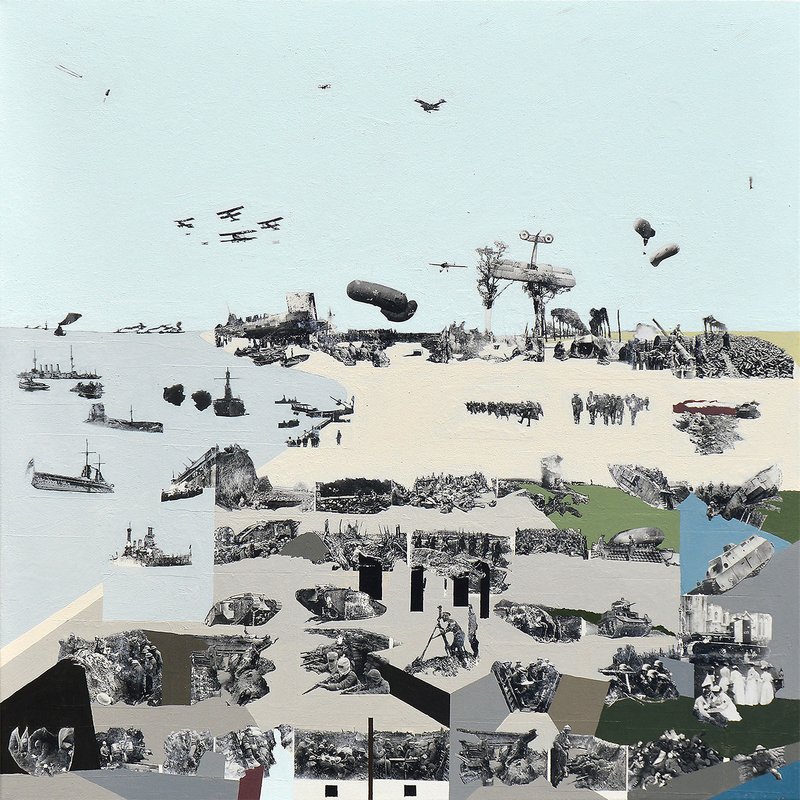
World War One
2022
Mixed media on canvas
80cm x 80cm
31 1/2" x 31 1/2"
What runs through this work
Claims that include this work, and the other works they connect.
Throughlines
- The hybrid mode returns
World War One (2022), and by extension World War Two and Vietnam, mark the first documented return of the Art Collision 'unrepeated hybrid mode' — visible composited photograph and visible hand-worked paint coexisting on one surface — in over 20 years.
Read the full claim
Where Art Collision's digital compositing erased seams to create a false continuity that never existed, the Mediums of War paintings keep every photo-fragment discrete and legible: paint does the coherence-work that Photoshop once did, without hiding the seams. Recognized only now, through the archive process itself, not at time of making.
4 works
- From hidden seams to open record
A confidence-and-transparency arc runs from Art Collision's seamless digital compositing (a younger, less confident Bernard, inclined to obscure) through World War One's visible-seam paint-compositing (increased confidence, showing the work rather than hiding it) to the archive's own radical transparency — raw unedited transcripts, honest-failure logging — as the fullest expression of that same growth.
Read the full claim
This is a process-dependent discovery visible only now, not a claim about original 2022 intent.
1 work
- Fatalism, prophecy, and spectacle
A personal fatalism traced to the Hopi prophecy heard at the Global Peace Walk (2000) resurfaces in World War One (2022) and is independently, unconsciously echoed in Walter Benjamin's writing on war as aesthetic spectacle.
Read the full claim
Logged as a coincidence/resonance across three unrelated paths — Peace Walk, painting, critical theory — not as a lineage.
2 works
- Learning to perform for the camera
Camera-awareness chain across the triptych: World War One's raw documentary photography teaches a generation to see itself historically.
Read the full claim
World War Two's subjects perform for that awareness (soldiers staging themselves for the camera, propagandists exploiting the same awareness to manufacture a moral narrative WWI never received). Vietnam's subjects are again not looking at the camera, but this is not a return to WWI's innocence — it is unawareness of a different mechanism (live, uncensored broadcast exposure) rather than unawareness that the camera would matter at all. Recognition, not present during painting.
3 works
- Moral credit spent down
The trust-economy across WWI, WWII, and Vietnam: WWII's manufactured 'good vs evil' narrative (built through propaganda apparatus on both sides, exemplified by the staged Khaldei Reichstag photograph) functions as capitalized moral credit for the US/West.
Read the full claim
Vietnam spends that credit down with a lag rather than starting from zero — the backfire of raw, uncensored Vietnam War footage was delayed by the size of the reserve built in the 1940s, and further diffused by the war spanning multiple US presidents rather than attaching to a single confirmed figure the way WWII attached to Hitler. The credit was badly dented (My Lai, the Pentagon Papers) but not exhausted, which is why the US was not rewritten as history's villain the way Nazi Germany was.
3 works
- Anachronism leaks both directions
Anachronism leaking across the medium-per-era scaffolding: The medium-per-era logic (b&w for WWI, color for WWII, film for Vietnam) is never as clean as the triptych's own scaffolding implies.
Read the full claim
Two WWII tanks appear as accidental anachronisms within the World War One painting (anachronism forward). At least four source images used in World War Two are modern digital colorizations of black-and-white originals rather than period color (anachronism backward) — undercutting the premise that color is WWII's native recording medium. Both read as the same underlying leak from opposite temporal directions.
2 works
- Random sourcing protects discovery
Sourcing method as the mechanism enabling genuine discovery: Both World War One and World War Two began as tests (compositional test toward a larger format for WWI; a 'can I make this work with a bunch of photos' test for the sourcing method itself), with fast, near-random source selection rather than researched curation.
Read the full claim
This randomness is identified as the mechanism that makes the retrospective readings surfaced during cataloguing (Allied/German color-technology skew, named-vs-anonymous framing, cross-painting anachronism leaks) genuine discoveries rather than confirmations of an argument already quietly built in through deliberate curation — protecting the 'recognition not influence' principle at the sourcing level, not just the compositional level.
2 works
- The Peace Walk as root
Global Peace Walk 2000 as the shared root of Art Collision and Mediums of War: The Global Peace Walk 2000 (San Francisco to New York, events at American University and elsewhere in DC with Native spiritual leaders, arriving in New York for the UN's 55th anniversary) is already on record as Art Collision's philosophical turning point.
Read the full claim
Stated this session as also underlying Mediums of War, made twenty-plus years later: the same peace-oriented conviction turned toward a direct examination of war. Explicit stated intent: the paintings exist in part to make people 'look again and remember that we need peace.' Background: the walk followed the Nipponzan Myōhōji tradition of walks reenacting the Trail of Tears as meditation; a monk named Yamato, who participated in walks since the 1970s and in a 1995 walk, is recalled by the artist as involved, held as artist-remembered history without external documentation (the walk was deliberately low-media).
7 works
Vision analysis
A description of the work written by an AI looking at the image, kept separate from the artist's account so the two can be compared.
claude-sonnet-5 · 5 September 2026
The canvas reads almost like geological strata. A pale flat sky at top, dotted with tiny archival photos of planes, biplanes, and zeppelins — some barely more than specks, drifting free in the color field rather than sitting in a clear "photo" frame. Below that, a wide band of flat painted terrain (sand, pale green, grey, a wedge of teal) that acts as a stage rather than a real landscape. Scattered across that terrain, dozens of small black-and-white photo-transfers: ships and naval wreckage on the left, then a shift into trench warfare — soldiers, artillery, ruins, wounded — moving down toward the bottom edge, where the photos get denser, smaller, more intimate (a group of women in white, close groupings of soldiers). Unlike the single-transfer intimacy of Gates of Perception, this is dozens of images arranged almost like an index or field of specimens, held apart by the flat painted ground — many images organized by paint rather than one image interrupted by it.
claude-sonnet-5 · 5 September 2026
The canvas reads almost like geological strata. A pale flat sky at top, dotted with tiny archival photos of planes, biplanes, and zeppelins — some barely more than specks, drifting free in the color field rather than sitting in a clear "photo" frame. Below that, a wide band of flat painted terrain (sand, pale green, grey, a wedge of teal) that acts as a stage rather than a real landscape. Scattered across that terrain, dozens of small black-and-white photo-transfers: ships and naval wreckage on the left, then a shift into trench warfare — soldiers, artillery, ruins, wounded — moving down toward the bottom edge, where the photos get denser, smaller, more intimate (a group of women in white, close groupings of soldiers). Unlike the single-transfer intimacy of Gates of Perception, this is dozens of images arranged almost like an index or field of specimens, held apart by the flat painted ground — many images organized by paint rather than one image interrupted by it.
Contribution
The first return, in 20+ years, of the Art Collision 'unrepeated hybrid mode' — visible composited photograph and visible hand-worked paint coexisting on one surface. Where Art Collision's digital compositing erased seams for false continuity, here paint takes over the *function* (not the method) of digital collage: connecting and containing many discrete photo-fragments into a landscape-like reading. Recognized only now, through the cataloguing process itself, not at time of making.
Intent
This is a painting about medium hidden in the fog of war — using the physical density and chaos of compositing dozens of photographs to make the recording medium itself, not just the war it depicts, the subject.
Direct inspiration
The concept of rendering each war in the recording medium dominant to its era (b&w photography for WWI, color photography for WWII, film stills for Vietnam) came first, before any compositional decisions.
Making
Made 2022 at the Markgrafendamm studio, Berlin. First ACH work to composite dozens of source photographs onto one canvas rather than a single transfer. Conceived first as a black-and-white/color/film idea, then built by physically printing and trial-and-error laying out photos until a compositional plan emerged — the paint plan came after, not before. Composition rises from a sparse sky (aircraft/balloon photos) through a horizon line to a dense mid-ground (ships, trenches) to the most intimate, densest photos at the bottom (faces, wounded). The horizon deliberately drops top-to-bottom as a literal timeline. [Corrected 2026-09-06: previously stated the row-layout scaffolding was worked out in World War Two and confirmed here — the artist has since clarified World War One was painted first. The bottom-row connecting technique (lines and shadows linking discrete photo-fragments) originated and was refined within this painting itself, forced into existence under the density pressure of the bottom rows specifically, then carried forward into World War Two already-refined.]
Where it went
Originally intended as an 80x80cm test toward a larger, more spaced-out format (~120x180cm, using leftover stretcher bars). The test became its own finished series instead — the resulting density and closeness, rather than being a limitation, became a deliberate evocation of war's chaos. Meaning followed from a practical/material constraint, not the reverse.
In the practice
First work in the planned 'Mediums of War' sub-series of A Colorful History. A fourth, unrealized member (drawings, black-and-white, era undecided — candidates considered: Napoleonic, Civil War, Seven Years' War) was conceived but never made.
Process
Perspective and scale mismatch across sea-level, ground-level, and sky-level source photographs was the main compositional problem; paint was used to connect and contain photo-clusters into a landscape-like (not pure-collage) reading rather than to decorate around them.
What this isn't
Rejected letting the composited photographs achieve false continuity (the Art Collision digital-compositing move of erasing seams to create something that never existed). Every photo-fragment here stays discrete and legible — paint does the coherence-work without hiding the seams.
In the series
Sits within A Colorful History as the founding work of the new 'Mediums of War' sub-series, and is retrospectively read as the reactivation of the Art Collision hybrid mode after two decades in which every intervening series took forward only one half of it (either photograph or paint, never both visibly at once).
Source material
Approximately 55 archival photographs, primarily WWI-era. Roughly 85% Allied-sourced / 15% Central Powers by national origin, but varied more meaningfully by theater and military branch (Western Front, Eastern Front, Gallipoli, open sea/Jutland, air war) than by political side; no Austro-Hungarian or Ottoman-sourced material, Gallipoli shown only from the British Navy side. Two accidental anachronisms present — a WWII M3 Stuart tank (Fort Knox) and a WWII M4A3R3 'Ronson' flamethrower tank (Iwo Jima) — acknowledged by the artist as unintentional and preserved as-is for their ironic resonance with the work's theme of photographic reliability.
Two resonances identified as retrospective, not influences at time of making. Susan Sontag's Regarding the Pain of Others: WWI photography's aftermath-only character reflects period camera limits; Sontag's own use of a color combat photograph to argue color can intensify rather than distance violence complicates Bernard's black-and-white-equals-distance instinct — this tension is logged as preserved, not resolved. Walter Benjamin's The Work of Art in the Age of Mechanical Reproduction: the aura/reproduction concept was already consciously known; the postscript's argument that fascism aestheticizes politics ('Fiat ars — pereat mundus') was not consciously known, and its resonance with Bernard's own longstanding fatalism is logged as an unconscious coincidence.
Art/Official sessions
Every work in this archive is catalogued through a recorded conversation between the artist and an AI. The record above was written during this session — the transcript is where it came from, kept whole so any claim on this page can be checked against what was actually said.
World War One — Art/Official session, September 9, 2026
- Artist
Would like to catalogue bernardbolter.com/world-war-one
- Art/Official
Found it — **World War One** (BB-ACH-2022-007), 2022, acrylic photo transfer on canvas, 80cm × 80cm, large-scale, A Colorful History series. Not yet catalogued. Let's start the session. First orientation question: When you made this piece in 2022 — where were you working, and was it part of a run of ACH pieces at the time, or a standalone piece that came up on its own?
- Artist
Was working at the Berlin studio at markgraffendamm, and a bit it tge vein of ACH, but was the first time using many photos on one canvas
- Art/Official
Got it — Berlin studio at Markgrafendamm, within the ACH vein, but a departure in method: the first time working with multiple photos composited onto a single canvas rather than one. Before I bring up the image — give me a blind description. What's actually on the canvas, from memory, before you look at it again?
- Artist
We are skipping the first 3 questions
- Art/Official
Understood — moving straight to interpretive dialogue. You said this was the first time putting multiple photos on one canvas, still in the ACH vein. Two things I want to pull apart: What photographs did you use — how many, and where from? And why "World War One" as the title — is that literally what the source photos depict, or something else driving the name?
- Art/Official
Okay — got it. Here's what I'm seeing: The canvas reads almost like geological strata. A pale flat sky at top, dotted with tiny archival photos of planes, biplanes, and zeppelins — some barely more than specks, drifting free in the color field rather than sitting in a clear "photo" frame. Below that, a wide band of flat painted terrain (sand, pale green, grey, a wedge of teal) that acts as a stage rather than a real landscape. And scattered across that terrain, dozens of small black-and-white photo-transfers: ships and naval wreckage on the left, then a shift into trench warfare — soldiers, artillery, ruins, wounded — moving down toward the bottom edge, where the photos get denser, smaller, more intimate (a group of women in white, close groupings of soldiers). It's not one photo transferred once, like the Gates of Perception works — it's dozens, arranged almost like a index or a field of specimens, held apart by the flat painted ground. Given everything else you've catalogued — the vantage work in Megacities, the single-transfer intimacy of Gates of Perception — this feels like a different kind of move: instead of one image interrupted by paint, it's many images *organized* by paint. Was that arrangement — air at top, sea and trenches through the middle, faces at the bottom — a decision you made, or something that emerged as you kept adding photos?
- Artist
I made this and the world war 2 right next to each other and planned out the painting. The main idea is that the world war one photos are in black and white and the world war 2 photo are in color, so the painting are about the way we see history is the through the medium that was used to document that history
- Art/Official
That reframes the whole piece — it's not really about World War One as a subject, it's about *how the record itself looks*. Black-and-white as the visual signature of "history," color as the signature of "recent" — and you're pointing at how much of our sense of pastness comes from the photographic medium available at the time, not from any distance in time itself. A few threads I want to pull on: Are World War One and World War Two meant to hang as a pair — same size, same composition logic, displayed together? And when you say you "planned out" the painting with that idea in mind, did the black-and-white/color distinction come first, and the trench-to-sky composition follow — or did you already have the compositional idea (sea/land/air, dense at bottom) and then realize the b&w-vs-color concept fit onto it?
- Artist
There is a third one, the Vietnam war, that uses all film stills as the images that are transfers. In the begining I evisikned a forth that would be before word war one that would have been all drawings and in black and white, but didn't make that one and never really fully decided which war that would have been.
- Art/Official
A war-media triptych, then — with a fourth conceived and dropped. That's a striking progression: photographs (WWI, b&w) → photographs (WWII, color) → film stills (Vietnam) → drawings (the one that didn't happen). Each war is represented by whatever recording medium *was actually dominant* for that war — which makes the series less "wars in sequence" and more "media in sequence," with war as the constant subject running through the escalating technology of witness. That's a strong conceptual spine. Two questions, take them in whichever order: Was there a war era you were actually circling for the drawings piece — early industrial warfare, Napoleonic, Civil War, something else — or did it stay genuinely undecided? And separately: the earlier orientation question about the b&w/color idea coming first vs. the composition coming first — do you remember which came first here?
- Artist
Yeah, thought about the napolianic war and the civil war, and maybe the 7 years war, but never comited to one. The idea of the black and white vs color came first and then I printed many small photos for both paintings, then for world war one spent a lot of time laying then out on the canvas until I came up with plan. Wasn't sure how I would work this all out with paint.
- Art/Official
That's useful — concept first, then a real physical process of laying out the printed photos until a plan revealed itself, with the paint problem still unresolved at that point. So once you had the photos arranged — sea and wreckage on the left, trenches through the middle, faces dense at the bottom, planes scattered through the sky — how did you actually work out what the paint needed to do? Was it about tying those disparate photo-islands into one continuous ground, or something more specific — like the flat sky, or that wedge of teal breaking into the terrain?
- Artist
I did work the world war out first on its own, but did know that I wanted the horizon line to move down through the painting, the wars became more in the sky as time went on.
- Art/Official
So the composition is doing double duty — it's not just organizing photos by density, it's a literal timeline: the horizon dropping as the painting reads top-to-bottom means the *sky claims more of the picture* the further into the war you go, tracking the real historical shift of combat moving upward — reconnaissance balloons, then biplanes, then zeppelins entering the sphere that used to belong only to weather. That's a strong echo of the vantage-migration thread running through your other work — sky as the register that expands as the century's relationship to altitude changes. A few things I want to understand about the paint itself, since that's what you said was unresolved going in: That wedge of teal cutting into the tan/grey terrain, and the patches of green and grey elsewhere — are those meant to read as literal geography (sea, field, mud), or are they more like abstract zones holding the photo-clusters apart from each other?
- Artist
Yes, meant to read as landscape, but yeah still a bit abstract, I think it was using the paint to content the photos to each other. Perspective was the main concern and problem in the work
- Art/Official
Perspective as "the main problem" makes sense — you've got sea-level ships, ground-level trenches, and sky-level aircraft all needing to occupy one coherent picture plane, when the source photos were shot from wildly different vantages and distances at the time they were taken. What was actually hard about it — getting the photo-clusters to sit at a believable scale/depth relative to each other on the flat ground, or something more about where the "eye" of the painting is supposed to be standing?
- Artist
First in the layout and how it would read, there was the sky and then the horizon, but then below that, I think I worked it out in WWII into a system of rows which worked and this one does too, but I didn't know how well it would work until this one was painted. So its there but not as decided as later. I didn't want it to look like a collage all over the place, so wanted to keep some level of a landscape to the image. In the end I think it worked out easier than I thought it would before I did even one
- Art/Official
That's a good resolution — the row-system as scaffolding, worked out first in WWII and then confirmed here, giving you enough structure that it doesn't collapse into collage, but not so rigid that it forecloses the layout decisions each piece still needed on its own. You said the paint was "connecting the photos to each other" — was that mainly about color relationships between adjacent clusters (a grey field next to a grey ship, say), or more about literally bridging space so the eye moves from one photo-island to the next without a hard seam?
- Artist
It felt like a puzzle in a way, I wasn't sure what I wanted to paint, but knew the pallet would be muted for the world war one and get brighter for the next 2
- Art/Official
So the muted-to-bright palette is a second axis running parallel to the b&w-to-color photo device — the paint itself following the same escalation the photographs are already tracking, rather than just neutral connective tissue. You called it a puzzle you didn't have a plan for going in — once you started laying paint, was it trial and error you could undo/rework as you went, or did each color decision commit you and narrow what the next area could be? And separately: were WWII and Vietnam painted right after this one, same year, or did time pass between them?
- Artist
The trial and error could not really be undone too much, but used all the techniques from the single ACH paintings to work with the photos in this one, just didn't know how they would connect, the single photo paintings the color would extend to the edge and not to another photo, but worked out easier than I thought. So the world war paintings were done right after each other, although they took a lot of time, so maybe a year altogether for both and the the Vietnam painting was done a year or 2 afterwards.
- Art/Official
That's a good technical detail — in the single-photo ACH works the paint runs out to the canvas edge uninterrupted, but here it had to stop and start around dozens of photo-islands instead, so the same vocabulary had to solve a much more constrained problem. And a year for the WWI/WWII pair, with Vietnam following a year or two later — so the "fourth, undecided" drawings piece would have come after that, if it had happened. Where did the WWI source photographs actually come from — a specific archive, book, personal collection, or general internet research? And relatedly: is there a personal thread pulling you toward WWI specifically, or was the war chosen purely as the anchor point for "this is when photography became the war record"?
- Art/Official
That list is a great addition to the record — 55 of the 59 logged entries reconstructed, with the licensing flags and the two anachronistic tanks noted (the M3 Stuart and the Ronson flamethrower — both WWII, both accidental). I'd keep those in the record as-is rather than "fixing" them retroactively; an unintentional slip in a piece about the reliability of photographic history-telling has its own irony worth preserving as a documented fact of the work, not smoothed over. The Covid context reframes the piece for me. What started as a formal idea — how the *medium* of documentation shapes our sense of pastness — was actually made under a live, specific dread: coming out of lockdown and feeling like the next war wasn't hypothetical. That's not incidental to the piece, that's the thing that pulled you back to these images in the first place, and gives the black-and-white/color device its stakes — the fear that what's "then" and what's "now" might be closer than the palette makes it feel. Did that anxiety shape anything in the physical making — pace, how long you spent on it, how many images you kept pulling in — or was it more the reason you picked up the subject at all, with the making itself staying methodical and separate from that feeling?
Show the remaining 76 turns
- Artist
I don't even know if that thought is coming from anxiety. I don't want to see a world war, but I also somehow believe, or came to peace with it all, that if we as humans are stupid enough to destroy our planet through nuclear war, then somehow I'm a bit fatalist about it and if that's the case, then we were always going to do this, and it's somehow out of our control somehow, it's just our fate. So I don't feel that's anxiety, and I wasn't working on the pieces in an anxious way. But in a way with that idea or feeling in mind.
- Art/Official
Fair correction — that's a distinct thing from anxiety. Fatalism, or something closer to acceptance: if we're capable of choosing this, in some sense we were always going to. That's a different relationship to the subject than dread would be — steadier, maybe even calmer, going in. Does that fatalism show up anywhere else in your work, or is World War One / World War Two the first time that particular feeling — humans being fated to repeat this — found its way into a piece? And going back to something you said earlier about your practice generally, that form tends to arrive before meaning: did that hold true here, or did the idea (medium shapes memory, paired with that fatalism) come first this time, with the form worked out to carry it?
- Artist
Hard to say, it a general view I've held for sometime and it must have come up in work before. I think it would have come into its own as a belief or outlook sometime after the peace walk in 2000, maybe some year after. A have some friends that could be called prepers, so they have a lot of supplies and want to do what they can to survive after a nuclear war or whatever tgey think might happen, and I wasn't to into that and later became to just think that I don't want to survive in that world or whatever that is anyways, we had it good and we messed it up, that's how it is, and if we do, then that's jist was meant to be. And we dont even know, this could even be a cycle that has been haoeing for milions of years too.
- Art/Official
That's a striking outlook to hold that steadily — not resignation exactly, more like a kind of peace made with scale: if it's a cycle bigger than us, the guilt and the urgency both loosen their grip a little. The peace walk in 2000 is a detail I don't think has come up before in the catalogue. What was that — where, and what happened there that you can trace this outlook back to, even loosely?
- Artist
Look up bernardbolter.com/prophecy and the three realates paintings
- Art/Official
That's the thread. Prophecy is literally built on a Hopi story you heard directly on the Global Peace Walk in 2000 — a cave painting of two figures standing side by side, one growing larger, then disappearing. And the record already notes the vision analysis picking up on exactly that unresolved tension: whether the tree carries the city or the city consumes the tree, whether the blank slabs on the lawn are monuments, models, or tombstones — "before windows or after them," with the image refusing to decide. That's the same structure as what you just described with World War One and the fatalism: growth and disappearance as the shape of things, not something you're anxious about averting but something you witnessed described as fact, twenty years before you painted a room full of trench photographs with that feeling in mind. The peace walk gave you the prophecy in 2000; Prophecy translated it into a tree/city hybrid in 2002; and the fatalism it carried surfaces again, twenty years later, in a very different visual language — dozens of small archival photographs organized by media instead of one surreal composite image. Worth noting: Growth and End — the two other paintings visually linked to Prophecy — aren't fully catalogued yet, so that's a thread to pick up in its own session. But for World War One's record right now: do you want this connection — Peace Walk 2000 → Hopi prophecy → the fatalism in World War One/WWII/Vietnam — logged as a confirmed artist connection between the two works, or does it feel more like a personal throughline than something Prophecy and World War One are in direct dialogue with each other?
- Artist
Did you read the other ones bernardbolter.com/transition and bernardbolter.com/four-nations
- Art/Official
Yes — read both. A few things worth flagging back to you: **Transition** is fully catalogued and it deepens the peace-walk thread further than I'd realized: the RGB (three channels) → CMYK (four channels) shift in that painting is recorded as a *quiet, structural* echo of the sacred number four in Native American Church tradition — something you noticed at the time of making, not just in hindsight. The record itself says that thread "surfaces more overtly in Prophecy and Four Nations." **Four Nations**, though — the record shows it as **not yet fully catalogued**. Just a stub: title, medium, year, dimensions, no dialogue content. So the throughline text on Transition's page is referencing a connection to Four Nations that hasn't actually been built out yet on Four Nations' own record. That's a real gap between what's cross-referenced and what's catalogued — worth a session of its own. So where this leaves things: the fatalism running through World War One traces back through a real, documented lineage — Global Peace Walk 2000 → Hopi prophecy heard directly from elders → Prophecy (2002) → the number-four echo in Transition (2002) → apparently meant to surface "more overtly" in Four Nations, which was never finished being catalogued. Given all that's surfaced — do you want to stay with World War One and log the Peace Walk / fatalism connection into its record now, or pause this session and open Four Nations properly, since it seems to be the missing link in a thread that's clearly still active for you?
- Artist
Check bermardbolter.com/four-nations it's is catalogued on the live site
- Art/Official
You're right — my earlier fetch caught a stale cached version. This one's fully built out, and it strengthens the connection even further. The checkerboard's four colors (white, red, black, yellow) are confirmed as the four sacred colors of the Native American Church — but notably, that meaning attached *after* the formal decision, not before. The checkerboard came from empty canvas space needing a response; the symbolism registered only once it existed. That's your form-before-meaning principle, confirmed here explicitly by you as typical of all four founding Art Collision paintings. And there's a line in "Context of making" that's exactly the model for what you're describing with World War One: Four Nations was made from the same starting point as Prophecy and Transition, but the record is explicit that this isn't "a progressive deepening of the Walk's influence" across the three paintings — it's "the same undercurrent surfacing to different degrees depending on each painting's own formal problem." That's precisely the shape of what you're telling me now, twenty years later — the fatalism isn't a straight line from the Peace Walk to World War One, it's the same undercurrent showing up again because the formal problem (organizing war photographs by medium) gave it an opening. Given that pattern is already named and confirmed in the archive, want me to log this as a new instance of it — the Peace Walk undercurrent resurfacing in World War One / WWII / Vietnam — connected to that existing throughline, rather than treating it as a fresh, unconnected observation?
- Artist
Ok have the bernardbolter.com/four-corners catalogued now, also take a look, the interesting thing is that you pointed out to the similarity of this painting to the art collision series, and had me thinking about the conversation for four corners where I talked about having the digital collage and paint in that series, but not doing it again
- Art/Official
Read it — and yes, I see exactly the thread you're pulling. The throughline on Four Nations names Art Collision as "the unrepeated hybrid moment" — the only body of work where a manipulated/composited photograph and visible hand-worked paint coexist openly on the same surface, each declaring itself as itself. Everything since has taken one half and run with it alone: DCS and Megacities keep the photo manipulation but drop visible paint; A Colorful History keeps paint-on-photograph but applies it to historical images rather than your own composites. The record even says explicitly that recombining both has occurred only as a passing thought since Art Collision — never as active intent. But World War One isn't quite either of those. It's not one historical photograph painted over (that's the rest of ACH). It's dozens of photographs *composited by you* — arranged, laid out, decided into rows — with paint doing real connective work between them. That's structurally much closer to the founding four than to the rest of A Colorful History: a manipulated/composited photographic arrangement and hand-worked paint, both declaring themselves, on one surface. So the question worth putting to the record: is World War One quietly the first real return of that "unrepeated hybrid" — twenty years on, and not consciously intended as a return, the same way the checkerboard wasn't consciously symbolic until it existed?
- Artist
I think it is now looking at it and having catalogued the art collision series.
- Art/Official
That's a real find — worth stating plainly in the record rather than leaving it implicit: World War One (and by extension WWII and Vietnam, if they share the same multi-photo-plus-paint structure) becomes the first documented return of the Art Collision hybrid mode in over twenty years, recognized only now, retroactively, through the archive process itself — the same way the "unrepeated hybrid" language in the Four Nations throughline was written before this connection existed to complete it. A few things to pin down before I draft this into the record: Do WWII and Vietnam share that same structure — many composited photos plus connective hand-painted ground — or is World War One actually the one that's closest to the founding four, with the other two doing something different? And should this be written as its own new throughline, or as an addition/update to the existing "unrepeated hybrid moment" throughline on Four Nations — since that one predicted the possibility and this confirms it happened?
- Artist
They both do and should be a new throighline. One thing to add, is these war paintings are 80x80 and quite dense with the photographs. But I originally started to make these as a test for larger paintings, like 120x180 and more spaced out. So that hasn't been done, but these became a series of its own, I just had stretcher bars and canvas at 80x80 on hand. In a way for the war series I like that tgel photos are close together and ond of busy and hectic, that's what war could have been in a way.
- Art/Official
That's a good addition — and another instance of the same instinct: the size wasn't chosen for what it means, it was what was on hand, and the meaning (density as evocation of war's chaos, closeness as claustrophobia) only became legible to you after the fact, looking at the finished density. Practical constraint first, interpretation following — same shape as the checkerboard, same shape as the pixel-grid sky in Four Corners. There's a schema field for exactly the other half of what you described — the 120x180, more spaced-out version that never got made. That can be logged as a planned/unrealized work tied to World War One as its origin point, rather than just living as a note in this session's transcript. Want me to add that as a formal planned-work entry — larger format, wider spacing between photo-clusters, still untitled/unmade — connected to World War One as the test that spawned the idea?
- Artist
Yes we can add that, not sure when they will get made. But like I talked before, the archive cataloging is not only about finding the throughlines to the past, but also the throughlines going forward, what will I make next. Somehow the war theme can be a bit too much for people and the medium theme gets lost a bit. So was experimenting with making tryptichs with just a bulding and one photo that would show the medium over time in a more simple way. But now seeing this throughline to even the art collision series, it's interesting to think about how to continuw you that. When i catalogued the art collision works i syraight up said I never combine the two thing again. But here we are now lookomg at that combination now, not exactly, but more tgan i ever thoighy before.
- Art/Official
That contradiction is worth keeping exactly as it happened, not smoothing over — you said it plainly when cataloguing Art Collision: never combining paint and composited photograph again. Then the war paintings did it anyway, more fully than you expected, and it took cataloguing Art Collision itself to even see that you'd done it. That's precisely the kind of thing the archive is supposed to hold onto rather than quietly correct — a stated intention overtaken by the actual practice, visible only in hindsight. And the building triptychs are a good forward thread in their own right — stripping the device down to its cleanest form (one building, one photo, medium-shift as the whole content) specifically because the war subject was carrying too much weight and burying the actual idea. That's a deliberate simplification, made in response to a felt problem with the earlier work — worth logging as its own planned/in-progress direction, connected back to World War One as the thing it's reacting against. Where are the triptychs actually at — do you have a building or buildings in mind, is any work started, or is it still at the concept stage?
- Artist
I finished one for the fruenmirche in munich and halfway through making a tryptich for the beroiner schloss - palast der republik - Humboldt forum
- Art/Official
Two real works, not just concept then — good. That's a lot to log properly. The Berlin one especially carries its own medium-history problem baked into the subject: Berliner Schloss (demolished), Palast der Republik (its GDR replacement, also demolished), Humboldt Forum (the current reconstruction) — three different buildings on the same site, which almost forces the "how we see history through the recording medium" idea to extend into "how a place itself gets rebuilt into different political meanings" over time. Start with the finished one — the Frauenkirche Munich triptych. When was it made, and what are the three panels actually showing? Is it the same building at three different points in time (like Berliner Schloss would be), or three different photographic/media treatments of the same moment?
- Artist
Let not go into these painting in detail too much. We should keep the cataloging with the world war one, and I'll think more about my direction later
- Art/Official
Good — back to World War One. Two things left to pin down before this is ready to write up: Where is it now — still in the Berlin studio, or has it shown anywhere? And for the record: knowing everything now — the medium/memory concept, the fatalism, the row system, the hybrid-mode connection — how would you describe the painting in a sentence or two, compared to how you'd have described it walking in today before we started?
- Artist
Leta not end now, there is more to uncover, the painting is in my Berlin studio at CANK building now
- Art/Official
Good call — my mistake, jumping toward wrap-up too soon. Staying with it. CANK building is a location that hasn't come up before — is that a different studio from Markgrafendamm where it was made, or the same space under a different name? And separately, in your source file the images are labeled with a "MoW" prefix — is that shorthand for something like "Medium of War," or does that abbreviation mean something else? If it's the former, that might actually be the working title for the whole triptych-plus-dropped-fourth idea, worth capturing as the umbrella concept tying WWI/WWII/Vietnam together as one project rather than three unrelated paintings.
- Artist
Yes mediums of war is the tryptich, plus maybe more, title. And the CANK building is where my studio is after markgraffen damn, it's next to rathaus neukolln in berlin
- Art/Official
"Mediums of War" as the umbrella title is worth locking in — it names the whole project precisely (medium as subject, war as the constant it's applied to) and ties together WWI, WWII, Vietnam, the dropped drawings piece, and the planned larger/spaced-out version under one conceptual roof rather than three loose paintings that happen to share a theme. The studio move — Markgrafendamm to CANK, near Rathaus Neukölln — when did that happen? Was it before or after World War One was made, or has the painting physically traveled with you between studios?
- Artist
After, 1 and half year ago, I think Vietnam war was the last painting I made there
- Art/Official
Good — so the Markgrafendamm studio housed the whole "Mediums of War" project except its tail end; Vietnam was the last painting made there before the move to CANK, about a year and a half ago. There's a classification question worth raising now, given what we've established: World War One's ID is BB-ACH-2022-007 — filed under A Colorful History. But everything we just worked out says it's structurally closer to the Art Collision hybrid mode (your own composited photographs plus connective paint) than to the rest of ACH (paint applied to a single historical photograph). Do you want the series field to stay as A Colorful History with a strong cross-reference to the Art Collision throughline, or does "Mediums of War" deserve to exist as its own series/sub-series in the schema — separate from both ACH and Art Collision, given it's really its own project with its own logic?
- Artist
It's still a sub series of a colorful history and will go on the colorful history website
- Art/Official
Good — sub-series of ACH, feeding the colorful-history website alongside everything else. That settles the classification question. Given "Mediums of War" is a sub-series now, worth defining its membership properly rather than leaving it implicit: World War One, World War Two, Vietnam — confirmed. Does the dropped fourth (drawings, era never decided) get logged as a planned/unrealized member of this same sub-series, or does it stay a separate idea that predates "Mediums of War" as a named concept? And has this sub-series — any of the three — ever been shown together, or exhibited at all individually?
- Artist
Can stay as an unrealized painting in the log, the world war ones have been exhibited together a couple of times and all three at the hotel Berlin fkkb gallery and then next week at the moterwerk fabrik
- Art/Official
Good — that gives us two exhibition events to log properly: the past showing of all three together at Hotel Berlin (FKKB gallery), and the upcoming one at Motorwerk Fabrik next week. For the FKKB show — do you have roughly when that was (month/year is fine)? And for Motorwerk Fabrik next week — is that a group show or solo, and do you know the exact opening date so I can get it right for the exhibition record?
- Artist
The fkkb was may 2025 and was a duo show with Edina picallo, can't remember the last name, but the info is on the front page of the hotel-berlin.de website still
- Art/Official
Found it: **FKKB Edition #22, "Chromatic Journeys: Rural and Urban Narratives"** — a joint show with **Edina Picco**, at FKKB Gallery / Hotel Berlin, Berlin, Lützowplatz 17, April 2025 (you'd said May — the listing has it as April). Two things to confirm before I log it: does "April 2025" match your memory better than May, or do you recall it landing right at the edge of the month? And for Motorwerk Fabrik next week — group or solo, and do you have the exact opening date?
- Artist
.just be April then, and the show next week is a group show
- Art/Official
Good, April 2025 it is. For Motorwerk Fabrik — do you have the exact opening date next week, and do you know who's curating or what the group show is called?
- Artist
Opening Sept 9 through Sept 13
- Art/Official
Noted — September 9 through 13 at Motorwerk Fabrik, with all three Mediums of War paintings shown together. Worth flagging: September 9 is also the date you've set for the first annual archive snapshot. Nice coincidence, or did you plan the opening around that on purpose? Do you know the show's title or who's curating, or should I log it without those for now and you can fill them in later?
- Artist
I'll fill in later, let's get back to the painting, take a look again and think about the context more and what does it say to you about war and black and white photography
- Art/Official
Here's my own reading — separate from what you've told me, not a paraphrase of it: The thing that strikes me most is how *gentle* the paint is. Pale sky blue, soft sand, mint, a hit of teal — these are almost nursery colors, decorative and calm, completely unbothered by what's happening in the photographs sitting on top of them. That gap between the muted tenderness of the painted field and the violence documented in the photo-fragments is doing more work than a straightforwardly grim palette would. It's not illustrating horror — it's showing you the *cushion* that lets horror become viewable, and eventually forgettable, at all. That connects to something particular about black-and-white as a medium, not just as an era-marker: monochrome photographs of violence read as less immediate than color ones almost by design — the desaturation itself is a kind of built-in distance, which is part of why so much historical atrocity photography still gets reproduced today when equivalent color images wouldn't be. Your piece isn't just saying "this looks old because it's black and white" — it's showing that black-and-white *photography of war specifically functioned as an early technology of bearable distance*, and your gentle paint is doing the same distancing work a second time, on top of it. And the layout reinforces it — dozens of small photo-specimens pinned in rows like a taxonomy, getting smaller and more crowded as you move down toward the human cost, while a single plane drifts large and isolated in open sky at top. The technology of killing gets room to breathe; the people being killed get compressed into a grid of tiny grey rectangles you have to lean in to actually see. Does that land, or does it flatten something you experienced differently while making it?
- Artist
That lands, and wanted to know if there is documentation or writings about the black and white photos being published more than color ones
- Art/Official
I found genuinely relevant material, though nothing that states your exact framing as a settled research finding — worth being honest about that distinction. The strongest source is Susan Sontag's *Regarding the Pain of Others* (2003), which deals with almost exactly this question. On WWI specifically: photographs of the Crimean War and the American Civil War were largely devoid of combat because of technical limitations of the camera, and First World War images were largely aftermath photographs — epic in style, tending toward battlefields, trenches, and ruined villages rather than combat itself. So part of what reads as "distance" in WWI photography isn't just monochrome — it's that the technology of the time couldn't capture the moment of violence at all, only its aftermath. That's a real, documented technical constraint feeding directly into your painting's subject matter. On color specifically making violence feel *more* real rather than less: one discussion of the book references a photograph of a wounded Taliban soldier begging for his life, published in color in the New York Times, and notes the photograph's realness is heightened by the knowledge that the man photographed had a family who might one day see it — Sontag using that color image specifically to argue against the idea that photographed violence is safely distant. So the honest answer: I don't have a study that directly proves "black-and-white gets published more because it's more palatable" as an empirical finding. What's documented is closer to what you're already doing in the painting — that the *medium itself* (not just the color/monochrome choice) shapes what could even be captured, and that Sontag's broader argument is skeptical of the idea that any of this makes violence safely distant at all. That's actually a productive friction for your record — the painting can hold your own instinct about black-and-white as buffer, while noting the strongest available source pushes back against buffer-of-distance as too simple an idea. Want this logged as a confirmed reference in the record — Sontag, cited with the tension noted — or does it feel like it complicates your point more than it supports it?
- Artist
Yes, it's is interesting
- Art/Official
Good — logging Sontag as a confirmed reference, with the tension you flagged intact rather than smoothed into agreement. One more thing worth doing before we wrap this into the record: the formal re-ask. Knowing everything we've covered now — the medium concept, the fatalism traced back to the Peace Walk, the accidental WWII tanks, the row system, the hybrid-mode return to Art Collision, Sontag — how would you describe this painting in a couple of sentences, right now? Not an inventory of what's in it — more what it actually is, having sat with all of this.
- Artist
Let's not wrap up, I spent a long time making this painting, we can catlogue it longer
- Art/Official
Good — plenty more to dig into. A few threads I haven't asked about yet: The row system you mentioned — sea/wreckage on the left, moving into trenches, faces dense at the bottom. Within a single row, how did you decide the *order* of the photos left to right? Chronological within that stretch of the war, visual/compositional balance, something else?
- Artist
I didn't really research the photos at all, I found and printed a lot and just took a lot of time placing them so that they could make visual sense. That was a lot of trial and error. I wonder if it could have been a more researched process, but have found it quite interesting the connection that I've found when I've gone back and itentified each photo
- Art/Official
That's a nice tension to sit with — the placement was pure visual instinct, not historical logic, and yet going back afterward to identify each photo turned up real connections you hadn't consciously placed there. What are some of the connections you found, going back through the list? Anything where two photos ended up next to each other and turned out to be from the same battle, same year, or otherwise linked in a way you hadn't known while arranging them?
- Artist
Can't pinpoint now, did find out that two photos were actually from world war two
- Art/Official
Right — the two you flagged in the source list, the M3 Stuart and the Ronson flamethrower, both actually WWII hardware that slipped into a WWI painting. Given everything the piece is *about* — how the recording medium shapes what we believe about a moment in history — that error becomes almost self-demonstrating: even you, working from real archival photographs with real intent to keep the wars separate, still had the visual language of one war bleed into the other. The boundary between "photograph as reliable evidence" and "photograph as vibe" turned out to be porous even in your own hands. Does knowing that change anything about how you look at the piece now, or does it just confirm something you already suspected about how thin the line is?
- Artist
I find it interesting, also that I did end up with a good mix from all sides, I tried, but could have been lopsided in representation
- Art/Official
That's worth pinning down concretely — when you say a mix from all sides, do you mean Allied versus Central Powers, or something more specific — different nations' forces, different fronts (Western vs Eastern), civilian versus military, different branches (navy, infantry, air)? And when you say it could have been lopsided — was there a specific side or perspective you were consciously trying not to let dominate, or was that more a concern you had looking back at the source list later, not something you were actively balancing while placing photos?
- Artist
Yes mixes from all side of the war, thought it could have been allied dominated
- Art/Official
That's a good thing to check against the record rather than leave as just a feeling — looking at the source list now, does it actually confirm an Allied lean, or does it turn out more balanced than you'd worried?
- Artist
Can you check the list
- Art/Official
Checked it — the worry holds up. Roughly 8 of the ~55 logged images are German-sourced or German-subject (the two MG08 crews, the Fesselballon, the Drachenballon, SMS Kaiser, the Fokker Eindecker, the observation balloons, the haystack-concealment image). That's the entire Central Powers representation. Everything else — British, French, Russian, Italian, Belgian, Indian (colonial), Australian, and American naval — sits on the Allied side. And there's no Austro-Hungarian or Ottoman material at all, despite both being major combatants — Gallipoli shows up only from the British Navy's side of the landing, nothing from the Ottoman defenders. So it's not evenly split — it's roughly 85/15 Allied to German, with two of the war's major combatant empires absent entirely. That's worth stating plainly in the record as an honest limitation of the piece rather than something to soften: the internet-sourced, unresearched selection process you described earlier produced a real skew, visible now, that wasn't apparent while you were placing photos by eye. Want that logged as-is — an acknowledged imbalance — or does it change how you'd want to describe the piece's claim to "a mix from all sides" going forward?
- Artist
Maybe I didn't mean exactly allied vs the others but just from all theaters and parties
- Art/Official
That reframes it more fairly — and by that measure it does hold up well. The list spans Western Front, Eastern Front (Russia), Gallipoli/Dardanelles, open sea (Jutland, the Mediterranean, dazzle-camouflage ships), and the air war (balloons, biplanes, the first fighter with a synchronized gun) — genuinely varied theaters and branches, not just repeated trench imagery. Colonial troops show up too — Indian Army at Fauquissart is the clearest instance. So: broad and honest across theaters and military branches, narrow and skewed across nationality/political side. Worth logging both readings rather than picking one — "varied theaters, Allied-weighted sourcing" is a more accurate description of the piece than either claim alone. Anything else on World War One before we start pulling this together, or does it feel like we've reached the bottom of what's here today?
- Artist
No let's keep going. One thing I really did notice between world war one and world war 2 is that the subjects in world war 2 were way more conscious of the camera and often looked at it. Could be technology being able to capture the moment more, or what I think is the pictures from world war one were circulated and seen by all in world war two that they knew they'd been seen like that too
- Art/Official
That's a sharp observation — and it's actually visible in your own source list. Several WWI images are specifically flagged as "unawareness" candidates: the soldier asleep near Thiepval with comrades smiling behind him, the troops asleep on Boulogne Quay, the mix of aware and unaware Russian soldiers in the same frame. You were already noticing and selecting for that quality at the sourcing stage, before this reflection even happened. Your second explanation — that WWII subjects had *seen* WWI photographs circulate and knew that's what happens to a moment like theirs — is the more interesting claim, because it's not really about camera technology at all. It's about photography becoming self-aware as a historical institution between the wars: by 1939, "being photographed at war" already meant something, carried its own visual grammar you could perform for, in a way it simply didn't in 1914 when combat photography as mass-circulated record barely existed yet. That would mean the shift you're pointing at isn't really WWI-photo versus WWII-photo — it's pre-mass-photography versus post-mass-photography, and WWI happens to be the hinge sitting right on that line. Which loops back to the whole premise of "Mediums of War" — the piece you're describing right now is really about the *first* moment soldiers becomes aware they're being turned into history's raw material as it happens, not just about black-and-white versus color. Is that self-awareness something you'd want to try to show visually in a future piece in the series, or is it staying as a conceptual observation for now?
- Artist
Could be, but an observation for now. Just wondering how this idea might tie into walter benjimins writings about mass reproductions
- Art/Official
That connects more directly than you might expect. Benjamin's central claim is that mechanical reproduction strips the "aura" — the presence, the here-and-now uniqueness — from an image or object, shifting art (and by extension the photograph) from something ritually singular to something built for circulation and display from the start. Once a photograph exists to be copied and seen by many, being photographed already means entering that condition of endless reproducibility — which lines up closely with what you're describing: a WWII soldier posing for the camera already understood, in a way a 1914 soldier couldn't yet, that this image belonged to mass circulation, not to a single unrepeatable moment. The sharper and more unsettling connection is in the essay's ending, written while Benjamin was in exile from Nazi Germany. His argument there is that fascism responds to the political crisis of the era by aestheticizing politics rather than politicizing art, reaching a point summarized by the phrase "Fiat ars—pereat mundus" — let art be created, though the world perish — where humanity can experience its own destruction as an aesthetic pleasure. That's Benjamin, in 1936, describing mass-reproduced imagery of war and violence as something that can turn catastrophe into spectacle rather than warning — which sits uncomfortably close to the fatalism you described earlier, and to a painting made from photographs found by scrolling. I wouldn't push that connection into the record as something you consciously had in mind — but it's a real enough resonance that it's worth having on file as a critical-theory reference alongside Sontag, distinct from your own stated intent. Want it logged that way — noted as a resonance the archive process surfaced, not a stated influence?
- Artist
Yes not conscious, I was aware of his idea of mass reproduction, but not that last part. And is a strange coincidence to my fatalism standing
- Art/Official
That layering is worth sitting with rather than resolving: you knew the aura/reproduction half of Benjamin consciously, encountered the war-as-aesthetic-pleasure half only now through this conversation, and it turns out to already share the shape of a fatalism you arrived at independently, twenty years earlier, on a peace walk that had nothing to do with critical theory. Three separate paths — Hopi prophecy, Benjamin's postscript, your own accumulated outlook — landing on structurally the same idea about humanity and its own destruction, none of them derived from each other. That's exactly the kind of thing worth recording as a coincidence rather than a lineage — the archive holding it open rather than manufacturing a tidy influence chain that didn't happen. Logging it that way. Is there more you want to sit with on World War One itself, or does this feel like a natural place the session settles — not because we're wrapping up, but because the thread's actually run its course for today?
- Artist
Actually while we're here would like to pull on the art collision - this series thread a bit. And how art collision was digital collage, and this was just multiple photos, and you saw the connection right away, and I see it now too. But in my mind for a long time they were different
- Art/Official
That's worth slowing down on, because "digital collage" versus "multiple photos" might actually be two different axes you were conflating for twenty years without realizing it. Art Collision's collages are single, invented, seamless images — Transition's tower doesn't exist anywhere, it's built in software from fragments to look like one continuous building. World War One doesn't invent anything: each photo stays a discrete, separate, real historical image, never blended into a false continuity. So structurally, they're almost opposites in how they treat the photograph — one erases the seams to create something that never existed, the other keeps every seam visible and lets each fragment stay exactly what it was. What made them feel like the same category to you, then, when you were making World War One — was it simply "more than one photograph on a canvas," regardless of whether they're fused or kept separate? Or was there something else about Art Collision specifically that you were thinking of and consciously moving away from or back toward?
- Artist
In a way the paint became the digital collage
- Art/Official
That's a precise way to put it — and it reframes the whole hybrid-mode question we were circling earlier. It's not that World War One brought back digital collage's method; it's that paint took over digital collage's *job*. In Transition, software did the work of making disparate photographs cohere into one surface — vantage receding at each height so the seams disappear. In World War One, paint does that same coherence-work — the row system, the horizon dropping, the color fields holding each photo-island in relation to its neighbors — except it does it while leaving every seam visible instead of hiding them. So the throughline isn't "photo-compositing returned." It's something sharper: the *function* of compositing — taking separate images and making them read as one coherent field — moved from software to hand, and from invisible seams to visible ones. That's actually a stronger, more specific claim for the record than "hybrid mode returned," and it explains why you didn't recognize it as related for twenty years — it doesn't look like Art Collision at all on the surface, because the one thing that stayed constant is the least visible part: what the paint is *for*, not what it looks like. Does that match what you meant, or is there a next layer under "the paint became the digital collage" you're still working out?
- Artist
I think that is it pretty much, but what could one layer deeper be?
- Art/Official
One layer deeper might be about what kind of unity is being made, not just who's making it. Software compositing in Art Collision can erase a seam completely — it can make a tower out of fragments and the result looks like it was always one building. That's a coherence that hides its own construction; the final image asserts itself as simply *true*, even though nothing like it exists. What you're doing with paint in World War One does the opposite: it creates coherence — a horizon, a row-system, a sense of one landscape — while leaving every photograph legibly separate, still declaring "I am a fragment, sourced from somewhere real." The unity is real, but it's an honest unity. It doesn't pretend the seams aren't there. That's not just a formal difference — it's the same principle running underneath the whole archive project you're building right now: open records over curated ones, uncertainty kept visible rather than smoothed into a clean narrative. World War One was doing that in paint in 2022, years before "honest, open records" became something you'd name explicitly as a founding value for bernardbolter.com. The seam-keeping in the painting and the transcript-keeping in the archive might be the same instinct, just showing up in two very different mediums four years apart. Does that go somewhere real, or does it feel like I'm reaching past what the painting actually is?
- Artist
The first connection is strong, I see the second, and could be a reflection of how I'm making the archive now, and what I might have made the archive back then if that was possible
- Art/Official
That's a sharper version than what I offered — not "the archive already reflects an old instinct," but "the instinct was already there, and the archive is the first time you've had the tools to actually build what that instinct wanted." Seam-keeping in 2022 paint was the same impulse as open-record archiving in 2026, just without a home for it yet. The Payload CMS, the tier system, the raw transcripts — those didn't create the value, they finally gave it somewhere to live. That's worth logging as its own kind of throughline — not "World War One anticipated the archive" exactly, but "an instinct present in World War One found its full expression only once the archive became technically possible." Worth naming as its own entry, distinct from the paint/collage throughline?
- Artist
Yes, that is a throughinw, bit I was pointing at something a little bit different. That the Photoshop collage could maybe have been the reflection of how I would have made the archive back then, when I was young, would have been without the transparency. I was young I I think I would have obscured more, I was less confident than I am now with how thing turned out, so looking at the reflextion that way, doesthat make sense
- Art/Official
Yes, that makes sense — and it's a cleaner and more honest version of the connection than what I was reaching for. It's not that the archive instinct existed all along waiting for tools. It's that the *hiding* itself was a younger man's choice — Art Collision's seamless compositing as the artifact of someone less sure of himself, someone who'd have built an archive (if he'd built one at all) that smoothed over doubt and presented something more finished-looking than true. And the paint in World War One, twenty years later, showing every seam without needing to resolve them into one clean image — that's not a technical evolution, it's confidence. You could only leave the fragments visibly separate once you didn't need the result to look more certain than you actually felt. Which means the throughline runs: less confidence → hide the seams (Art Collision) → more confidence → show the seams (World War One) → full expression of showing the seams, now with actual infrastructure to do it at scale (the archive, the raw transcripts, the honest-failure logging). That's a real arc about you, not just about method — worth logging as its own entry, distinct from both the paint/collage-function throughline and the general "archive as extension of practice" one. Should I write it up as its own confirmed throughline connecting confidence-and-transparency across Art Collision, World War One, and the archive itself?
- Artist
Yes, as its own, and it's an interesting one in terms of how this archive works. Maybe not an ultimate truth realization, but one that could only could have come through this process.
- Art/Official
Exactly right — and worth stating that qualification directly in the record too: not an "ultimate truth," but a reading that could only surface through the process itself, at this specific point in the practice, looking back with the confidence the observation is partly *about*. That's a good instance of the standing distinction between recognition and influence — this wasn't there to be found in 2022, it became visible only now, from where you're standing. Logging it as: **Confidence and transparency arc** — Art Collision's seamless digital compositing read, in retrospect, as reflecting a younger, less confident relationship to obscuring versus revealing; World War One's visible-seam paint-compositing as the shift toward showing the work; the archive's radical transparency (raw transcripts, honest-failure logging) as the fullest expression of that same shift, arrived at with actual infrastructure behind it for the first time. Framed explicitly as a process-dependent discovery, not a retroactive claim about original intent. Where do you want to go from here — deeper on World War One still, or has this Art Collision detour opened up something else you want to follow?
Copy of the session record (September 9, 2026). Canonical: /sessions/world-war-one-2026-09-09