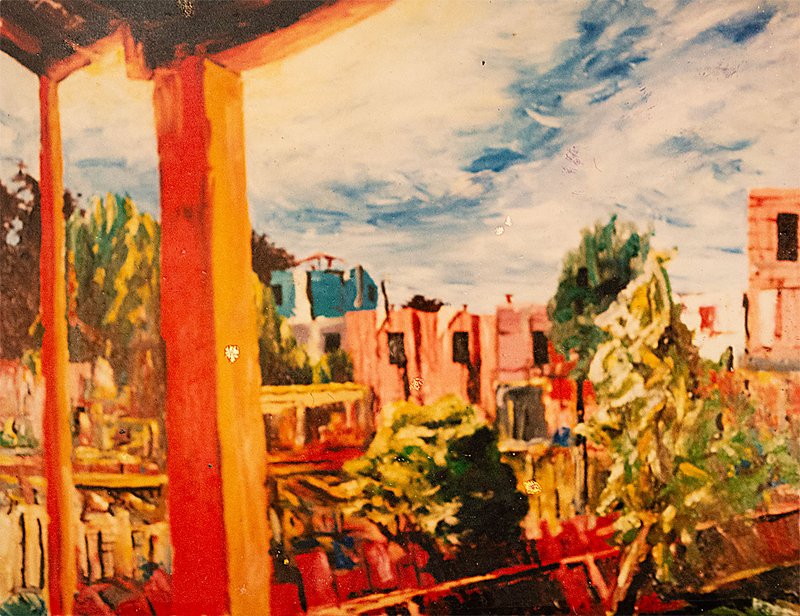
The Sunset
1994
Mixed media on canvas
26" x 20"
66cm x 50.8cm
Intent
A painting of the actual backyard view in the Sunset District of San Francisco where all the OG oil paintings were made — the vantage point itself, not an invented scene. Painted from underneath a bedroom that jutted out from the house, which offered shelter from the rain.
Direct inspiration
The literal view available from the painting spot — the backyard, seen from underneath the bedroom overhang that sheltered the artist while working.
Making
An early breakthrough in the series — the brushwork loosened for what the artist identifies as the first time, particularly visible in the gestural sky and the slashing verticals on the porch posts. The color, however, stayed intentionally embellished rather than freed — familiarity with the real scene gave permission to loosen the hand, not to loosen the truth of what was depicted.
Context of making
Painted under the overhang of a bedroom that extended out from the house, used as shelter from rain. This backyard was the working site for the entire OG Oil Paintings series, 1994–1996. A shed now stands in the same spot as the current studio.
Where it went
Wasn't approached as documentary record-keeping, but the familiarity of the scene allowed a freedom in brushwork that the artist hadn't let himself use before — an unlock that happened early in the 1994 work and, by the artist's account, precedes and informs the looser handling visible across the rest of the series.
In the practice
The only painting in the OG Oil Paintings series that depicts the actual vantage point the series was painted from — every other work in the series looks outward from this spot at invented or composed scenes; this one turns around and paints the site itself. Positioned early in the 1994 sequence.
What this isn't
Despite close familiarity with the real backyard, the artist did not aim for a faithful, literal rendering — color was deliberately pushed and embellished beyond what was actually there.
In the series
Functions as the origin-site record for the OG Oil Paintings series (1994–1996) — the only work depicting where the series was physically made. The early loosening of brushwork identified here is a candidate technical hinge point for the series, though it did not develop into sustained looseness; the same freedom resurfaced only intermittently afterward (notably in later palette-knife experimentation) before combining with precise, established technique in the 2022 A Colorful History piece Berlin 1911-2011 ("glitch style").
J.M.W. Turner — Artist cites a longstanding preference for expansive, dramatic skies in the tradition of Turner and Constable, independent of and predating engagement with Goethe's color theory. John Constable — Artist cites a longstanding preference for expansive, dramatic skies in the tradition of Turner and Constable, independent of and predating engagement with Goethe's color theory.
J.M.W. Turner · J.M.W. Turner
Artist cites a longstanding preference for expansive, dramatic skies in the tradition of Turner and Constable, independent of and predating engagement with Goethe's color theory.
John Constable · John Constable
Compositing method — separately observed sky studies assembled into a finished landscape, structurally close to this work's transfer-first/paint-reactive process.
Visual Similarity
Works with similar visual structure, found by comparing image embeddings across the archive.
Related Patterns
Throughlines and bio events that include this work — the same connections shown on those pages, linked back here.
Art/Official sessions
The Sunset — Art/Official session, August 17, 2026
This is a copy of the session record, August 17, 2026. Canonical URL: /sessions/the-sunset-2026-08-17.
Transcript
- Art/Official
Good — I've got the live record for The Sunset (BB-OGP-1994-010), oil on canvas, 26" x 20", OG Oil Paintings series, not yet catalogued. Where does this painting physically live right now — do you have it in front of you, or working from memory/photo? Does the title "The Sunset" feel literal to you, or is there irony/distance in it?
- Artist
This is an old photo that I have of the painting, not sure where it is now, was probably given away as a present to someone in the late 90s. The title the sunset is that the painting is of the backyard view where I was painting back then in the Sunset district of San Francisco
- Art/Official
Give me your blind first description — whatever comes to mind about this painting, from memory, before you look at the image again.
- Artist
This is a painting of the view from the backyard where is use to paint back in the day, it uses a colorful pallette
- Artist
[uploaded image: 1000021060.jpg]
- Art/Official
Vision observations: a view looking out from under a covered porch or deck structure, two vertical wooden posts framing the composition, dark overhang/roofline across the top, a wild billowing sky dominating the upper two-thirds, San Francisco rooflines below including a teal building and salmon-pink stucco, dense foliage in the lower half. Does the porch/overhang read as accurate to what was actually there?
- Artist
Well there was a bedroom that came out from the house, so I would painting from underneath it, so that protected from the rain when it happened
- Art/Official
Did you paint other pieces from that same spot under the bedroom overhang, or was this the one time you worked from there? How long were you working at this house in the Sunset District?
- Artist
This is where I made all the og oil paintings from 1994 to 1996, but there is now a shed in the backyard where the current studio is
- Art/Official
On the sky — does the vortex-sky pattern we've traced in the '93–96 oils feel true here, or does this sky feel like something else? On the buildings — was that palette accurate to the actual neighborhood, or did you push the color heavier than what was really there?
- Artist
I can't remember, but liked big skys like turner and constibale, the building in the neighborhood are quite bright, but I definitely embellished then with the color.
- Art/Official
Looking at it now, how do you feel about this painting — does it hold up, or feel dated? And do you know roughly when this photo was taken, and is it the only visual record left?
- Artist
I've always liked this painting, the colors came together even before reading georthe. For the oil paintings I didn't paint too many from the scene, but went on to paint a lot of water colors of scenes on my travels, you can check the SFAI watercolor painting.
- Art/Official
Give me your second description of the painting now — knowing everything we've talked about.
- Artist
Let's pull tge full SFAI record it's been catalogued. And I think this painting is more pivotal and we should go further
- Artist
https://bernardbolter.com/sfai
Expand full conversation
- Art/Official
Let's go deeper on The Sunset. What is it about this painting, sitting with it now, that feels more pivotal than the other OG oils we've catalogued?
- Artist
Want to think this out, it is the only painting of the view from where I painted all the oil paintings, I also feel it was a bit of a breakthrough working with the oil paint itself. I think I let myself go a bit free for a first time in the brush strokes and tge color
- Art/Official
Two separate claims: documentary — the only painting of the origin vantage point itself — and technical breakthrough — a first loosening in brush and color. Do you think there's a real link between the two, or did they just happen to arrive together?
- Artist
I think they could be connected, I was definitely very familiar with the view, but still didn't look to represent it as is, but made embelishments
- Art/Official
Does this breakthrough feel like something that happened early in your process at that backyard, or a one-off you didn't sustain?
- Artist
Happened early in the process
- Art/Official
Is it the visible brushstroke — the sweeping sky, the slashing verticals on the posts — that you mean by loosening, or something less visible, like pressure, speed, confidence?
- Artist
Yes, mostly the brush strokes but also a bit the color
- Art/Official
Give me your second description now — the full picture, everything we've covered.
- Artist
Let's pull just a bit more on this thread
- Art/Official
A few threads still open: the unlock itself, downstream effect on later work, or the site itself. Which direction do you want to pull?
- Artist
Tge downstream angle is probably a bit interesting, hard to say the actual style was there, in way later painting where I experimented all the way to some recent colorful history paintings, but maybe face me more confidence in the brush when i tries to be more precise again
- Art/Official
Does a specific painting come to mind, from A Colorful History or elsewhere, where you can point to that confident-precise quality and feel the line back to this one?
- Artist
[uploaded image: 1000021061.jpg] So recently in like 2022 i started doing a then and now series, with one historical photo and a photo I took, but when doing this series I really let the painting stroke be more free and bold, here is an example of a Berlin painting photo from 1911 on tge left and photo from 2011 on the right
- Art/Official
Which painting is this, so I can link it properly? And is the confidence quality visible specifically in the black-and-white historical half, or across both halves equally?
- Artist
https://bernardbolter.com/berlin-1911-2011 the precise was still being worked out, this was one of the first with this kind of work it quite some time, but was just learning it again in a way
- Art/Official
Does that distinction feel right — the 2022 piece is you relearning precision, with the 1994 loosening more as proof it could be done than as a skill that stayed dormant and ready?
- Artist
It's not precise representational, it's more freestyle brush strokes, at the studio we were calling it glitch style
- Art/Official
Does that gap between 1994 and 2022 feel real — like the loose-brush impulse actually went away for decades and had to be found again? Or were there other moments of that freedom scattered in between?
- Artist
There were some experiments in between a lot with pallette knife painting, but this was the first time to combine with the precise colorful history painting that came before
- Art/Official
That's a solid, accurate thread now. Ready for your second description?
- Artist
Second description. A portrait of the original oil painting spot
Also mentioned in
Vision Analysis
The composition is viewed from beneath a covered porch or overhang, looking out into a backyard. Two vertical wooden posts, painted in hot red-orange with a band of yellow-gold catching direct light, frame the left third of the image and anchor the foreground; a dark, loosely brushed roofline or beam cuts across the top edge, confirming the vantage point is sheltered rather than open. Beyond this framing structure, an expansive, turbulent sky dominates the upper two-thirds of the canvas — sweeping, calligraphic strokes of white, cream, and pale blue describe a large cloud formation in motion, handled with more gestural freedom than the architecture below it. Below the sky, a dense, cluttered urban backyard unfolds: rows of San Francisco rooflines and building facades in salmon-pink stucco, a distinctive flat-fronted turquoise/teal building holding the eye at center, and a smaller reddish structure with a scalloped or arched roofline lower in the frame. Foliage — rendered in yellow-green and darker saturated green, with real textural variety between trees — crowds the lower half of the composition and partially obscures the built environment, giving the scene a lived-in, overgrown density rather than an open vista. The palette runs hot in the foreground structure (reds, oranges, yellows in the posts and roofline) against a cooler sky (blues, whites, creams) and pockets of saturated green in the trees, with the pink and teal buildings acting as secondary color notes in the middle distance. Brushwork is not uniform across the canvas: the sky and the posts show the loosest, most gestural handling, with visible directional strokes and some scumbling; the buildings are treated with somewhat more contained, blockier strokes; the foliage sits between the two registers, loose but built up in layered daubs. What resists confident reading in this photographic reproduction: fine surface detail is difficult to assess given the condition and lighting of the source photo, and the exact boundary between painted shadow and photographic artifact (visible spots/marks on the surface) is ambiguous in places, particularly in the lower-left foreground.
View all analyses →