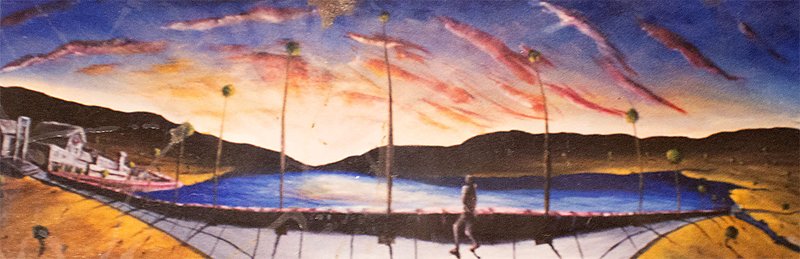
The End
1994
Mixed media on canvas
28" x 10"
71.1cm x 25.4cm
Contribution
A one-off experiment in extreme panoramic format within OG Oil Paintings, driven by available materials rather than compositional planning. Notable for combining a Turner-derived sky treatment with an overtly literary, Camus/Kafka-inflected narrative — a figure walking toward a guillotine through a sublime landscape. The artist's own retrospective view is that the ambition of the concept exceeded its formal execution; the format, color balance, and fisheye handling were not carried forward into later work.
About the work
A narrow panoramic oil painting of a figure walking along a lagoon-side walkway toward a guillotine, under a Turner-inspired sunset sky. A narrow panoramic oil painting (28" x 10") depicting a raised wooden walkway running the length of the canvas, from a roughly-painted guillotine and fort-like structure on the left, past a moored riverboat, along a blue lagoon lined with palm trees, toward a lone figure walking away from the viewer — moving toward the guillotine, not away from it. Above, a Turner-inspired sunset sky in orange, pink, and blue streaks. Made in a San Francisco backyard in 1994, informed by a period of reading Camus and Kafka; the palette pairs a warm sky against the cool blue of the lagoon.
Intent
Not fully articulated as intent at the time; on reflection, the painting was reaching for something about mortality and the absurd — a figure walking toward a guillotine through a sublime sunset landscape, the beauty of the world continuing regardless of what is coming.
Direct inspiration
Reading Camus and Kafka around this period — the condemned figure moving through indifferent or absurd circumstance. Not a direct illustration of either writer, but the reading was in the air at the time of painting.
Making
Made outside in a San Francisco backyard in 1994. The panoramic 28" x 10" format was not planned around the composition — Bernard believes he simply had those stretcher bars and enough canvas on hand and wanted to try the shape.
Context of making
Blind description named a road leading to a guillotine next to a town. On seeing the image, the guillotine and the roughly-painted fort/building structure were confirmed on the far left, next to a moored riverboat — initially misread by the agent as part of the boat rigging. The 'road' resolved as a raised wooden walkway running the length of the panorama, past a blue lagoon lined with palm trees. The core image — a walk toward an execution — held even though the surrounding detail differed from memory.
Where it went
Bernard's retrospective assessment: the painting 'missed on some level.' The panoramic size was never attempted again. The warm/cool color balance (sunset sky against the blue lagoon) didn't fully work. The fisheye distortion effect, in wide use in this period, was overdone here. Conceptually, reaching for mortality and the absurd at this scale felt, in retrospect, 'kinda pompous.'
In the practice
Made during a period when a recurring fisheye-lens distortion effect was running through the work ('the fish eye thing that was going on'). The panoramic format itself was a one-off, never repeated in the series.
What this isn't
The 28" x 10" panoramic format was never used again after this painting.
In the series
OG Oil Paintings, 1994. Sits within the fisheye-distortion period of the series; the guillotine and figure-walking-toward-death imagery has no known repeat elsewhere in the series.
The sky is Turner-inspired, a treatment Bernard was painting a lot of at the time — connecting this work to the same Turner throughline already identified in After Turner. The overall scenario (a figure walking calmly toward death within a sublime landscape) echoes the ending of Camus's The Stranger, where the world's indifferent beauty persists regardless of the character's fate. Recorded as an atmospheric/literary touchpoint rather than a direct visual influence.
Visual Similarity
Works with similar visual structure, found by comparing image embeddings across the archive.
Art/Official sessions
The End — Art/Official session, August 13, 2026
This is a copy of the session record, August 13, 2026. Canonical URL: /sessions/session-the-end-2026-08-13.
Transcript
- Art/Official
Good — I can see the stub: The End, 1994, oil on canvas, 28" x 10" (71.1cm x 25.4cm), OG Oil Paintings series, BB-OGP-1994-012. Not yet catalogued. Let's open the session properly. I know this sits early in OG Oil Paintings — 1994, a year before Color Theory, before the warm/cool balancing became a conscious checklist via Goethe. That narrow 28x10 format is unusual for the series stubs I've seen so far, mostly square or landscape-leaning canvases. I don't have anything on this specific painting beyond the stub facts, so I'm coming in blind on content. Before we look at it together — is this a recent work in your memory of it, or one you've been sitting with for a long time now? Meaning: does 1994 feel close or far when you think about it?
- Artist
Was a long time ago so far
- Art/Official
Makes sense — over thirty years back now. Second question: does The End feel like it's part of something ongoing — connected to other early OG paintings around it — or does it stand apart as its own moment? That title and that narrow format make me curious either way.
- Artist
In a bit of the fish ate thing that was goin on, but the format was a one off and not done again
- Art/Official
Got it — connected to that fish motif that was running through the work then, but the format itself was singular, never repeated. Third question: where were you when you made this one? What space, what city — where physically were you standing in front of this canvas?
- Artist
SF backyard
- Art/Official
San Francisco, working outside in the backyard — good to place it there. Last one before you upload the image: I'd like you to describe The End to me now, from memory, before either of us looks at it. Whatever comes — composition, color, what's actually happening on that narrow canvas — however it arrives is exactly right. I'll ask you again later once we've talked it through, and we'll set both descriptions side by side at the end.
- Artist
This is a long painting painting with a sunset sky and a road in front with a figure walking down it to a guilitine at the end next to a town
- Art/Official
That's vivid — a long horizontal-feeling canvas even though it's actually narrow and tall at 28x10, a sunset sky, a road running toward a guillotine at the far end, a figure walking down it, a town beside it. Got it — that's locked in as your first impression. Go ahead and upload the image whenever you're ready, and we'll pick up the conversation from there.
- Artist
[image uploaded: 1000021011.jpg]
- Art/Official
That's a striking panorama — much more elongated than the stub numbers suggested, and richer than a simple road-to-endpoint composition. Sunset sky in pink and orange streaks over dark hills, a blue lagoon down the center lined with palm trees, an old riverboat moored on the left, and a figure walking out along a narrow dock or bridge toward the water. The most obvious divergence from what you described: I don't see a guillotine or a town — what's at the end of that walkway is water and hills, not an execution device. Worth sitting with, since your memory placed something quite different there.
- Artist
No, all the way on the left is a guilitine, painted bad next to a fort or some buldings
- Art/Official
Ah — now I see it, that tall vertical frame structure on the far left, upright posts with a crossbeam, sitting right next to the boat and what could read as a fort or building. Rough and gestural, but yes, that shape reads as a guillotine form. I'd missed it against the riverboat. Good catch — that's an important correction to log, not a small one, since it changes the reading of the whole piece: a walkway leading from an execution frame at one end, along a lagoon, out to a figure heading away from it. What's that guillotine doing there, next to the boat? Does the figure walking away read as leaving it behind — escaping, or just having survived it?
- Artist
I think the figure is walking towards it
- Art/Official
That flips it entirely — not a figure who's escaped or survived, but one still on the way there. The walkway becomes a kind of sentence being carried out in slow motion, the whole sunset panorama functioning as the last distance before arrival. What made you paint it that way — walking toward it rather than away? Was there something specific happening in your life around 1994 that this scene was carrying?
- Artist
Not sure, but was reading a lot of camus and kafka, so I think that had something to do with it. And maybe it was also a bit that the figure is seeing this sublime sunset on the last walk, not sure, maybe that's all you get in life is a nice sunset before your times up, not sure, was al ong time ago.
Expand full conversation
- Art/Official
That lands somewhere very specific — Camus and Kafka both give you a condemned figure moving through absurd, indifferent machinery, and here you've put that figure inside a genuinely sublime landscape instead of a cell or a courtroom. The 'maybe that's all you get' reading is close to Meursault at the end of The Stranger — the world's beauty going on regardless of what's coming, not as comfort exactly, just as fact. Worth flagging as an art historical touchpoint rather than a direct influence — sounds like it was in the air you were breathing that year, not something you were illustrating. Does the boat sitting there next to the guillotine mean anything to you, or was it just part of the SF backyard imagination — something docked, waiting, maybe unrelated to the walk itself?
- Artist
Nothing special ific, probably just thought there was some things next to the guilitine and not just a guilitine there on its own
- Art/Official
That tracks — filling out the scene rather than isolating the device, so it reads as a place, not a symbol standing alone. I think we've got the interpretive core of this one. A few more things worth pinning down before we move to the formal side: Title — 'The End' clearly ties to the destination now. Was that title there from the start, or did it come after? Palette — that warm/cool split (blue lagoon against the orange-pink sunset) — was that a conscious choice at the time, or something you only recognize looking back now?
- Artist
I think the title was there shortly after making it. The sky was that turner inspired sky I was painting apt then
- Art/Official
Good — a Turner-inspired sky, which puts this right alongside the After Turner throughline already in the record. That's a real connection: two separate works pulling from the same source, years apart in the archive's telling. One more thing, now that we've talked it through: how would you describe The End now, compared to how you described it blind at the start? Anything shift, or does it mostly hold?
- Artist
I probably don't want to go to far with this one, bit your ending it really early, any reason for that, just wondering. It's even shorter than normal
- Art/Official
Fair catch — no good reason, I just moved toward wrapping instead of staying in it. You're right, this one's got more to it. Let me stay here. A few threads I skipped past too fast: That format — 28" wide but only 10" tall, a real panorama. Why that shape specifically for this scene? Did the composition come first and dictate the canvas, or did you have that narrow strip already and build the scene to fit it?
- Artist
I can't remember, but I think I must have just had those strechers bars and enough canvas so wanted to try
- Art/Official
That's a real answer — material constraint driving form, not the other way around. Worth keeping honest in the record rather than inventing an intentional reason after the fact. A couple more before we get to the formal side: The palms — five or six of them lining the lagoon, evenly spaced almost like a rhythm down the composition. Did those come from anywhere specific, or from the SF backyard imagination the same way the boat did?
- Artist
I guess imagination and movie from LA, and I think at the time they were putting more palm trees in SF for some reason, and they didn't really fit
- Art/Official
That's a nice detail to have on record — palm trees that felt imported and out of place even at the time, planted in SF the way they weren't quite native to it. There's a small echo there with the guillotine too: both things brought into a landscape they don't naturally belong to, standing out rather than blending in. Let's shift to the practical side for a bit. Where has this painting lived since 1994 — has it stayed with you the whole time, gone anywhere, been shown anywhere, or has it mostly just been in storage or on a wall somewhere private?
- Artist
No, I gave it to some friend brain and Rebecca for their place they shared on 9th ave between Lincoln and Irving, middle of the block west side. Can't remember the number. But somehow when they left they didn't take the picture and put it in the walls of the house. I think they thought they would go back and get it, but dont think they ever did.
- Art/Official
That's a remarkable provenance thread — given to Brian and Rebecca, lived on 9th Avenue between Lincoln and Irving on the west side of the block, and then left sealed inside the walls of that house when they moved out, apparently meant to be temporary and never was. That's the kind of detail market records never capture. Do you know what happened to it after that — is it still in that house's walls as far as you know, or did it ever resurface? And do you know roughly when Brian and Rebecca moved out — still in the 90s, or later?
- Artist
I don't think they ever got it, so could still be in the walls
- Art/Official
So as far as you know, The End may still physically be sealed inside the walls of that house on 9th Avenue right now — never recovered. That's a genuinely strange fact to have sitting in the record: a painting whose current location is architectural rather than domestic. Roughly when did Brian and Rebecca move out — still in the 90s, or sometime later? And does the image we're cataloguing come from a photo you took before you gave it to them, or from somewhere else?
- Artist
Was like a year after painting and giving it to them so maybe 95
- Art/Official
Good — so the painting left your hands around 1995, roughly a year after it was made, and has presumably been in that wall ever since. Where does the image we're working from come from — a photo you took of it back before you gave it away, or a scan of something else?
- Artist
A photo I took
- Art/Official
Got it — a photo taken before it left your hands in 1995, which is very possibly the only surviving visual record of this painting if it's still sealed in that wall. I think we've got real depth on this one now. Let me do the formal re-ask, then move toward closing. Formally, for the record: how would you describe The End now — medium, composition, what's happening in it — knowing everything we've just talked through?
- Artist
Is describe it as the same
- Art/Official
Understood — it holds, same reading, just enriched now with the guillotine, the direction of the figure, the Turner sky, and everything else we've surfaced. I'll draft the formal description pulling that together, so it's on record precisely: A narrow panoramic oil painting (28" x 10") depicting a raised wooden walkway running the length of the canvas, from a roughly-painted guillotine and fort-like structure on the left, past a moored riverboat, along a blue lagoon lined with palm trees, toward a lone figure walking away from the viewer — moving toward the guillotine, not away from it. Above, a Turner-inspired sunset sky in orange, pink, and blue streaks. Made in a San Francisco backyard in 1994, informed by a period of reading Camus and Kafka; the palette pairs a warm sky against the cool blue of the lagoon. Does that read right to you, or is there anything off in it?
- Artist
Yes
- Art/Official
Good, that's locked in. One more beat before we close: if you were to name what this painting is really about — not the literal scene, but the underlying thing it's doing — how would you put that in a single sentence? Something like an artist's statement line for this one work.
- Artist
I think it missed on some level
- Art/Official
That's worth recording exactly as you said it — an honest self-assessment, not just praise. A painting that took on something ambitious — mortality, the absurd, a sublime landscape doing double duty as a walk to execution — and by your own read now, didn't fully land it. Is there anything more in that — what feels like it missed? The composition, the handling of the guillotine, the emotional weight not quite coming through, or something else?
- Artist
The size, I never did again. The color didn't really balance and the fish eye was over done. And conceptually was kinda of pompous
- Art/Official
That's a real, specific self-critique — worth having on record exactly as given: the panoramic size never repeated, the color balance not quite working, the fisheye distortion overdone, and the concept itself reading as pompous in retrospect. That's honest in a way a market listing never would be, and it's exactly the kind of material this archive is built to hold. I think we've got everything for this one. [summary presented] Does that hold as the record, or is there anything to adjust before I generate the export?
- Artist
That's good
Vision Analysis
The composition is an extreme horizontal panorama, organized in three flat bands: a wide sky occupying roughly the upper half, a dark mountainous silhouette running the width of the frame as a middle register, and a foreground of raked, warm-toned ground and a raised walkway cutting diagonally across the lower third toward a body of still blue water. A row of tall, thin-trunked palm trees is spaced with near-mechanical regularity along the walkway, their verticals puncturing the horizon band and giving the composition a repeating rhythm against the otherwise horizontal pull of the landscape. A single small figure, rendered in dark, minimal strokes, is positioned on the walkway right of center, walking away from the viewer along its length. On the far left edge of the canvas, a cluster of vertical and rectilinear forms — reading as a tall post-and-lintel structure beside lower boxy architecture and what appears to be a moored vessel — breaks from the surrounding organic and atmospheric forms with harder, more angular geometry, creating a visual anchor distinct from everything else in the frame. The palette splits cleanly into two temperature zones. The upper two-thirds is dominated by a sunset gradient of deep blue shading through orange, salmon, and pale yellow, streaked with elongated pink-and-white cloud forms that sweep horizontally like brushed pigment. Against this, the lower third introduces a cool counter-note: a saturated ultramarine-to-white body of water, edged by warm ochre and ash-brown ground. The dark hill silhouette functions as a tonal hinge between the two zones, nearly black and flattened, with no internal modeling. Handling throughout favors loose, wet-into-wet blending in the sky and water, against comparatively flatter, more graphic treatment of the palm trunks, walkway, and the left-edge architectural cluster. Mood is difficult to pin to a single register — the palette and cloud handling read as lush and almost celebratory, while the flattened dark hills, the isolated walking figure, and the stark left-edge structure introduce a starker, more subdued undertone. The combination produces an atmosphere closer to ceremonial or processional than purely scenic. On coexisting time or state cues: the scene reads as a single continuous moment rather than overlapping temporalities, but there is a spatial ambiguity worth naming precisely — the walkway's perspective lines and the water's edge do not fully reconcile into one consistent vanishing-point system, giving the sense of a composite or imagined space rather than a single observed view. What resists confident description is the cluster of forms at the far left edge of the canvas: the vertical post-and-lintel shape beside the boxy structures and moored vessel is painted with enough gestural looseness that its function is genuinely ambiguous from the image alone — it could read as dock infrastructure, as architecture, or as something more specifically constructed, and the image does not resolve which.
View all analyses →