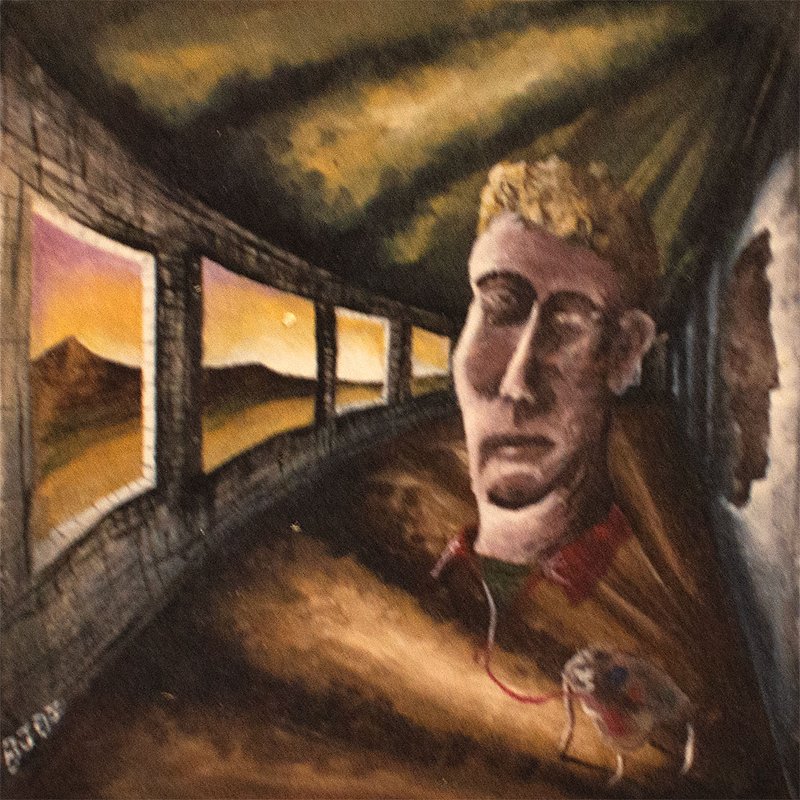
Self Portrait 1994
1994
Mixed media on canvas
18" x 18"
45.7cm x 45.7cm
Contribution
The second in a three-year birthday self-portrait ritual, and a technical and conceptual turn from Self Portrait 1993. Where '93 held the self as two separate objects — a head and a hand — still reaching toward a window, '94 fuses them into one figure and removes the reaching altogether: a red cord ties the head directly to the palette it came from, and the head is rendered as openly, admittedly paint. The curved hallway's repeating windows — each one ambiguously either a real opening or a painted depiction of the same view, distinguishable only on close looking by the window's cut edge against the painting's raised frame — stage a Magritte-derived interior/exterior device the artist arrived at while reading Plato, Berkeley, and Kant on the nature of reality and perception. That device, quiet and largely undetected at the time, resurfaces over a decade later as the structural method of the Digital City Series and Megacities: composited, blurred scenes of real places that read as real until closer inspection reveals the seams. The artist identifies this painting as the first instance of that operation — the moment 'the blur became the art' — done in confession rather than disguise, before the technical means existed to build it at scale.
About the work
A self portrait about the blurry line of existence. Oil on canvas, 18" x 18", painted in a San Francisco backyard on the artist's birthday in 1994 — the second of three consecutive birthday self-portraits. A face emerges from a curved, architecturally impossible hallway lined with a repeating sequence of openings that alternate, subtly, between real windows onto a sunset landscape and painted depictions of the same view hung on the wall. A red cord runs from the figure's neck down to a small, worn palette near the chest, tethering the self physically to the material it was made from. A faint shadow of the head is pressed into the wall on the right. Where Self Portrait 1993 split the self into two separate objects in a grey room — a watching head and a disembodied hand reaching toward a window, still longing for something outside — this painting collapses that back into a single figure that no longer reaches outward, because it has admitted there is nothing outside to reach for: the head is, in the artist's words, 'just an invention of the paint.'
René Magritte — Artist-confirmed device — the window/painting ambiguity along the corridor wall is a direct Magritte-derived interior/exterior logic, named explicitly by the artist during the session ('a bit like a magritte thing').
René Magritte · René Magritte
Artist-confirmed device — the window/painting ambiguity along the corridor wall is a direct Magritte-derived interior/exterior logic, named explicitly by the artist during the session ('a bit like a magritte thing').
Visual Similarity
Works with similar visual structure, found by comparing image embeddings across the archive.
Related Patterns
Throughlines and bio events that include this work — the same connections shown on those pages, linked back here.
Art/Official sessions
Self Portrait 1994 — Art/Official session, August 17, 2026
This is a copy of the session record, August 17, 2026. Canonical URL: /sessions/self-portrait-1994-2026-08-17.
Transcript
- Art/Official
Good — this one's already stubbed in the archive: Self Portrait 1994 (BB-OGP-1994-008), oil on canvas, 18"x18", OG Oil Paintings series, not yet catalogued. Before we look at it together — is this a recent work, or something you've been sitting with for a while?
- Artist
All is right, this is an older painting, the second self portrait I made on my birthday
- Art/Official
Second birthday self-portrait — noted, that's a specific ritual marker worth holding onto. Is this part of something ongoing, or does it feel more like a standalone moment?
- Artist
Was ongoing in the self portrait series, made three of them in a row and then one or two later in life
- Art/Official
Three in a row, then a couple more later — a return to the same mirror at intervals rather than one continuous run. Where were you when you made this one?
- Artist
SF backyard
- Art/Official
San Francisco backyard — good, hold that. Before you upload — I'd like you to describe this work to me first, before either of us sees it. I'll ask you again later, once we've talked it through, and we'll look at both together at the end. There's no right way to do this — however it comes is exactly right.
- Artist
This is a self portrait painted for my birthday, on my birthday, the figure come out of a color palette on a table and the figure is inside a curved hallway, where there are windows to the outside and paintings of the outside on the wall, one after another
- Art/Official
That's vivid — the figure emerging from the palette itself, and that hallway doing double duty with real windows and painted windows side by side. Holding onto all of that. Whenever you're ready, upload the image and we'll look at it together.
- Artist
[uploaded image: 1000021075.jpg]
- Art/Official
The curved hallway is exactly as described — that repeating rhythm of windows, each one showing the same mountain-and-water view in a different light, real and painted alternating down the wall. The face dominates the right side, tethered by a red cord down to what reads as the palette itself, small and worn, sitting low near the chest rather than up on a table. There's also a second, fainter face pressed into the wall on the right — ghostly, almost bas-relief — that didn't come up in the blind description.
- Artist
That's the shadow of the head
- Art/Official
Got it — the shadow of the head, not a second figure. That makes sense with the light source pouring down from that streaked sky above. Let's get the small facts settled: 18"x18", oil on canvas, 1994, second of the three birthday self-portraits. Anything on those basics you want to correct before we go deeper?
- Artist
That's right
- Art/Official
Good. Then let's go into it. That red cord running from your neck down to the palette — it reads almost like an umbilical line, or a leash. Was that a conscious choice, tying yourself physically to the palette that way, or did it arrive on the canvas without you deciding it?
- Artist
That was intentional in the painting
Expand full conversation
- Art/Official
Say more about what it meant to you — what were you tying yourself to when you tied yourself to the palette?
- Artist
I think the whole painting is a reflection on painting itself, my head come from the color pallette and the wall has windows and then painting of the outside on it, a bit like a magritte thing
- Art/Official
That Magritte reference is useful — the window/painting ambiguity, where you can't quite tell if you're looking through an opening or at a depiction of one, is very much his territory (the false window, the painting that continues the view behind it). So if the whole piece is a reflection on painting itself — the head born from the palette, the wall alternating real windows and painted windows — where do you see yourself in that? Are you the thing being painted, or the one doing the painting, or does the painting resist that distinction on purpose?
- Artist
I'm both, in a constructed reality
- Art/Official
Both, in a constructed reality — that's a strong way to put it. The self isn't outside the painted world looking in, it's made of the same material as the painted windows and the real ones — no privileged position to stand in. You mentioned this is the second of three made in a row, then more later in life. Does Self Portrait 1994 feel like it's answering or building on the first one — or was each birthday a fresh reckoning, independent of what came before?
- Artist
Building upon technically, but I think subjec wise was a new approach
- Art/Official
Technically building, but a new subject each time — so the how carried forward while the what you were reaching for reset. What was new about the approach this time, compared to the first one?
- Artist
Can you look at the other self portrait, this one had more realistic painting than the other head, but was still raw
- Art/Official
[fetched Self Portrait 1993 record] Good, that's the full record — mixed media on raw canvas, the head and disembodied hand as separate objects, Dalí/Magritte/Tanguy/Klee/Picasso as the direct references. So in 1993 the head was one of two competing objects in the room, painted more like carved or sculptural form. In 1994, the head takes over almost the whole right side of the canvas, and it's rendered with more real flesh modeling — the tethering line does the work the second object used to do. So the shift reads like this: 1993 splits the self into two separate objects in a room. 1994 collapses that back into one figure, tied by a cord to the thing that made it. Does that land?
- Artist
[uploaded image: 1000020019.jpg] Yes, that is right, but looking at the other one, there is a throighline in the space constructed by the space
- Art/Official
That's a good catch — both rooms are built the same way: grey, boxy, architecturally impossible, with the perspective doing something slightly wrong (the tapering walls in '93, the curved corridor in '94). Neither room could actually exist as painted. What do you see as the throughline in that constructed space specifically?
- Artist
In The first one there was a gloomy green outside from the space and in the new one the window and then painted sunset in both
- Art/Official
Right — so the throughline isn't just 'there's a window,' it's that in both, the room itself stays grey and inert while the window is the only saturated, alive part of the composition. In '93 it's one window, one gloomy green view. In '94 you've multiplied it — a whole repeating sequence of windows, and you've blurred whether each one is really a window or a painting of one. Does that feel like a fair way to put it, or is there something about the gloom-to-sunset shift in mood that matters on its own?
- Artist
Somehow the first one had more longinger for what's outside, the finger touches the window and in the new on even the head is just an invention of the paint
- Art/Official
That's a real distinction — in '93 there's a body still reaching, a finger actually touching glass, longing outward toward something separate from the room. In '94 there's no reaching left because there's nothing separate to reach toward — the head admits it's paint looking at paint. Does that match how you'd describe where you were at, at twenty going on twenty-one, or is it more that the idea got sharper without your state of mind necessarily following it?
- Artist
Maybe not so intentional, there were other paintings that had the longing in them, but this one turns to the paint itself
- Art/Official
That distinction matters — so the longing didn't disappear from the practice, it just isn't this painting's job. Let's shift to where this painting has actually lived since 1994 — is it still with you?
- Artist
Yes, still at the SF studio
- Art/Official
Good — still at the SF studio, same as the family-home pattern with '93. Now let's do the formal re-description. Looking at it now, with everything we've talked through — how would you describe this piece, in a few sentences, differently than you did at the start?
- Artist
Think there might be more to this one, let's pull a little bit more
- Art/Official
Good — trust that instinct. What feels unexplored to you?
- Artist
Yes. The meaning in relation to today and what I have painted
- Art/Official
That's a rich thread to pull — a painting about paint admitting it's paint, made thirty-two years before you started building an archive that is, in its own way, the practice looking at itself from outside. What connection are you seeing between this painting and where you are now?
- Artist
Maybe something about the window and the painting blurring, then look a tge digital city series where street scenes are blurred, and the megacity series where things are blurred again between cities
- Art/Official
That's a strong line to draw — the 1994 window/painting ambiguity as the first instance of a blurring operation that resurfaces formally in DCS's blurred street scenes and again in Megacities' blur between cities. Say more about what connects them for you.
- Artist
Maybe more about that I came to a place where the blue became the art, can you look up Basel Switzerland from the DCS and Deutsche stadt from megacities
- Art/Official
[searched past conversations] Basel Switzerland is the founding work of the Digital City Series — assembled from skateboard-shot photography, with the skateboard itself later understood as 'the instrument of perception.' Deutsche Stadt compresses multiple cities into one composite where the river reads as the compositional spine. So tell me what you mean by 'the blue became the art' — is that about the process itself becoming the subject?
- Artist
Tgw blur became the art
- Art/Official
Ah — the blur, not 'blue.' So the throughline is: in 1994, the paint stops representing you and starts admitting it's paint. In DCS, the blur between photographed street scenes becomes the actual subject. In Megacities, the blur between cities does the same at a bigger scale. Self Portrait 1994 is the first time that happened. Is that the shape of it, or is there something more you want to pull on before we close this out?
- Artist
No let's keep going, there is something there we haven't found yet. Both the dcs and megacities are made up scenes of real places but not real, they are places so as the blur between that is not obvious, the dcs looks like a real scene until you get into it more and the megacities too
- Art/Official
That's the distinction — DCS and Megacities disguise the blur; they read as real places at first glance, the seams only reveal themselves on closer looking. Self Portrait 1994 doesn't disguise anything — it announces its own unreality from the first look. Does that ring true — that what changed isn't the presence of the blur, but whether it announces itself or hides?
- Artist
More to look at the wall, where a window of the outside alternates between a painting of the outside
- Art/Official
Right — let's stay with the wall itself. Each opening down that curved hallway shows the same view, but you can't tell, opening to opening, which are real windows and which are painted depictions of the same view. Is that closer to what you're circling?
- Artist
You can tell between painting and window, the window has an edge to the outside and the paintings come off the wall, it's sublte
- Art/Official
Ah, that's subtler than I had it — there is a tell, it's just quiet: the windows cut an edge straight through to the outside, while the paintings sit proud of the wall. The corridor isn't erasing the distinction between real and depicted, it's showing how little most looking cares about that distinction. Does that feel like where this was heading?
- Artist
It's a slight throughline, but interesting that I was painting this distinction that early, with the magritte influence and then it becomes a major theme in two of my later series
- Art/Official
That's worth marking clearly: the real/depicted distinction — present but quiet in 1994 — becomes structural, load-bearing method in DCS and Megacities more than a decade later. Recognition, not a plan you were executing at twenty-one. That feels like a good place to let this thread rest unless something else is still pulling at you.
- Artist
Let's try a bit more, I think that's an interesting one, but let's see if we can find a level deeper
- Art/Official
A level deeper, then — not just that the theme recurs, but why it would show up at twenty-one before you had the language or the method for it. What was it about looking at Magritte specifically, at that age, that gave you access to something you didn't consciously understand yet?
- Artist
Was reading a lot of philosophy and mentioned the platos cave before, but also berkley and kant, so questioning reality
- Art/Official
That connects the dots properly — you weren't just picking up a painterly device from Magritte, you were reading Plato's cave, Berkeley, Kant, actively working through whether what we perceive is reality or a representation of it, and Magritte gave you a way to paint that question rather than just think it. That reframes the whole throughline: the 2007+ series aren't a new idea; they're the equipment finally catching up to a question you were already asking. That feels like real bedrock. Anything further underneath it, or is that the floor?
- Artist
I think that's pretty good for it
- Art/Official
Good — that's a strong place to land. Let's close it out properly. Formal re-description — how would you describe this piece now, after everything we've pulled up?
- Artist
A self portrait about the blurry line of existance
Also mentioned in
Vision Analysis
The composition is a square scene organized around a large head occupying the right two-thirds of the frame, set against a curved architectural passage that sweeps in from the left. The head is rendered close to life scale relative to the frame, in three-quarter view, with the gaze directed downward and to the right, away from the corridor. Below and in front of the head, tethered by a thin red line running from the collar area down and out of frame at the bottom edge, sits a small worn palette-like form loaded with dabs of colour. The corridor itself is built from a repeating sequence of framed rectangular openings receding along the left wall, each one showing a landscape of low mountains, a body of water, and a warm sky in tones of purple, orange, and gold — the openings appear identical to one another at a glance, though a close look shows some are flush apertures cut through the wall (their edges continuous with the wall's own plane) while others sit slightly proud of the surface as separate framed objects hung against it. The upper portion of the frame is filled with a dark, streaked sky-like field in deep olive and blackish greens, banded with lighter diagonal strokes that fan outward, suggesting either an interior ceiling painted as sky or an exterior canopy pressing down into the corridor. On the right edge of the canvas, set into a narrow grey-toned wall segment, a second, fainter face is visible in low relief — same profile as the main head but desaturated and flattened, reading as a cast shadow or afterimage rather than a second figure. The palette splits between the cool, muted greys and blue-greens of the architecture and the warm flesh, ochre, and gold tones of the head and hair. The head's flesh is built from scumbled pinks and warm greys, with a mop of curly gold-orange hair catching more saturated colour than the face itself. A band of deep maroon-red sits at the collar, the point of origin for the tethering cord, providing the only hard warm accent at that scale outside the window sequence. The recurring window/opening sequence carries the richest colour in the piece — violet-to-orange gradients suggesting either dawn or dusk light — repeated with slight variation in hue and value from opening to opening, giving the corridor a rhythmic, almost musical colour pulse against the otherwise desaturated architecture. The mood is contemplative and inward rather than dramatic — the head's downcast gaze and closed mouth read as self-absorption or quiet scrutiny rather than address to a viewer. The repeating identical-seeming openings and the tethering cord together produce a sense of enclosure despite the corridor's implied length; the eye is pulled down the receding windows but the head anchors attention in place, resisting the pull outward that the architecture sets up. On temporal or state coexistence: the recurring windows present the same landscape motif multiple times with only minor value shifts, which reads as either the same view repeated in sequence or the same moment held across several instances at once — the image does not resolve whether time is passing along that corridor or standing still and reiterating. The secondary, fainter face on the right functions as a visible trace of a prior or alternate state of the same head — a residue or echo rather than a discrete second subject. What resists confident description: whether the small tethered object beneath the head is a container of paint, a functional artist's tool, or simply an abstracted anchor-point for the cord is not visually resolvable — its form is loose and worked, more gestural mark than legible object. Likewise, the exact material logic distinguishing the flush openings from the raised ones along the corridor wall is only intermittently legible; in several instances the evidence for either reading (aperture versus applied object) is genuinely ambiguous even on close inspection, and the painting does not appear to want that ambiguity fully resolved.
View all analyses →