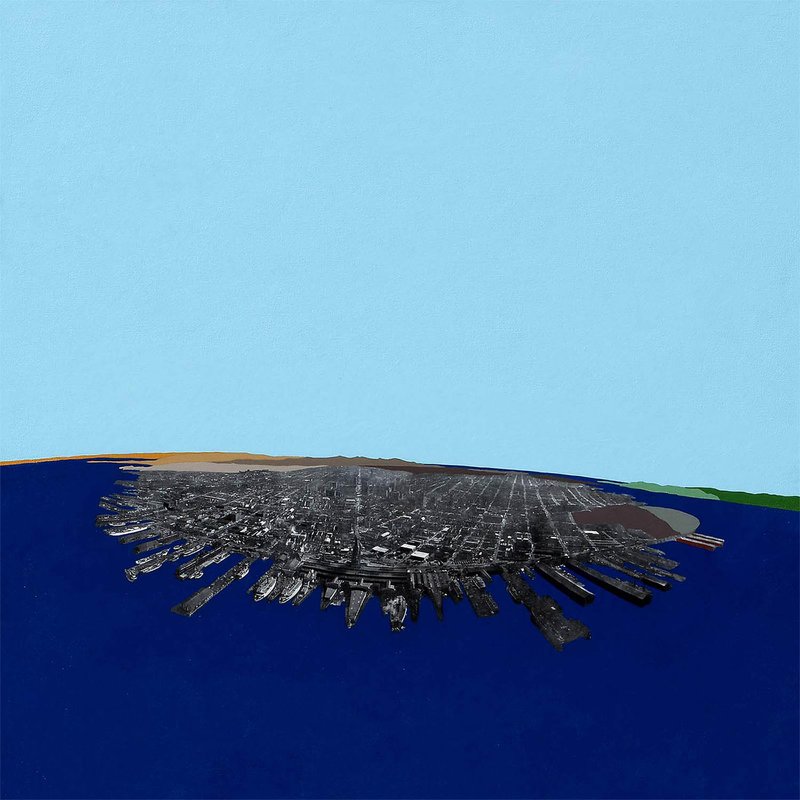
San Francisco City 1906
2017
Acrylic on canvas
30" x 30"
76.2cm x 76.2cm
Status & ownership
Currently on loan
If you own this work, get in touch. I'll add you to the record and officially connect you to its history.
Intent
Uses the century-long gap between the source photograph and the painting to make a wider argument: that beauty and horror aren't opposites, only separated by time; that Lawrence himself was likely more captivated by the new aerial vantage point than by the disaster it happened to record; and, ultimately, a holistic view onto the human condition on this planet rather than a record of one city's tragedy.
Direct inspiration
Came across the Lawrence panorama during general research into old San Francisco photographs — it kept surfacing because it's on Wikimedia Commons. Had avoided earthquake-disaster photographs since the series' 4th and 5th paintings, but the idea of curving the horizon was strong enough to break that rule for this one.
Making
Made at the 27th Ave studio during an active production run for City Art Gallery — five motifs total, each produced as a small/large pair to restock the gallery wall as pieces sold (three small paintings hung above, two large below, a shelf of prints beneath). One of roughly ten canvases in progress at once during that period.
What this isn't
Held a personal rule against using earthquake-disaster photographs after Grant Street 1906 and Market Street 1906 (the series' 4th and 5th paintings) — uneasy about setting bright colour against a real tragedy. Broke that rule for this painting specifically because the curved horizon reframed the source image as a view of a place on a globe rather than a disaster scene.
In the series
Made in 2017 at the 27th Ave studio during an active production run for City Art Gallery. Sits mid-series, after the shift from t-shirt-transfer paper to a blended acrylic transfer method, but before the more conceptual series-thinking that developed later in Berlin.
Rather than the series' more typical references (Rauschenberg, Richter), this painting sits in direct relation to the original photographer, George R. Lawrence. Lawrence chased a new aerial vantage point and monetized it, selling prints of the panorama repeatedly; a century later, a structurally similar act — remaking the same image, in multiple sizes, for different buyers. Both, per the artist, were likely more drawn to the view itself than to the wreckage it happened to depict.
Visual Similarity
Works with similar visual structure, found by comparing image embeddings across the archive.
Vision Analysis
The composition sits on a hard horizontal division roughly two-thirds down the canvas, the flat pale sky-blue above meeting a solid ultramarine-navy below at a horizon that bows gently upward at center — a curve added deliberately beyond what the source aerial photograph showed. The transferred photograph occupies the middle third of the width, a dense grayscale field of grid streets and radiating piers, its edges dissolving unevenly into the surrounding blue rather than reading as a hard cutout. The piers extend down into the navy like a burst of rays, giving the mass a radial, almost solar structure against the flat water. Two narrow colour bands break the horizon — warm tan/brown toward the left, cooler sage green toward the right — placed less as topographical accuracy than as a deliberate complementary counterweight, needed because sky and water otherwise dominate the frame. Dominant palette: pale cyan-blue, deep ultramarine, warm ochre/tan, muted sage green, and the full grayscale range of the transfer itself.
View all analyses →