Nature vs Nurture
1994
Mixed media on canvas
12" x 16"
30.5cm x 40.6cm
About the work
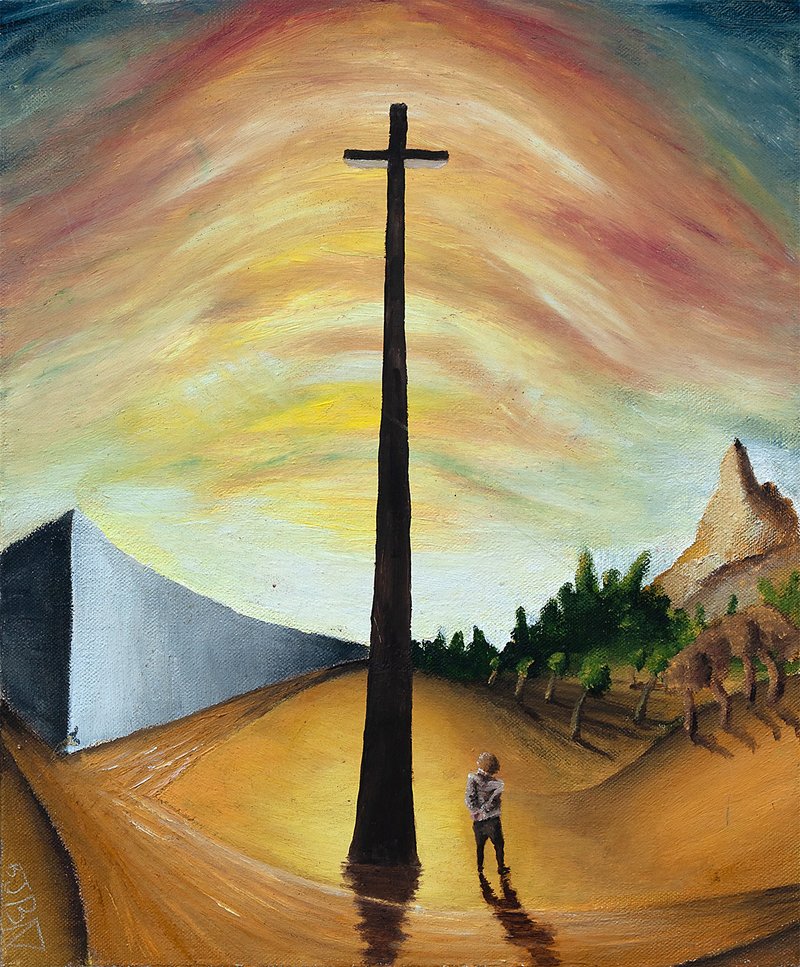
A dark wooden cross stands center, planted on a curving, fisheye-distorted path, beneath a radiating sunset sky in bands of orange, rose, and pale yellow — the same vortex-sky device used in After Turner and Antiquity. To the left, a gray angular concrete block; to the right, an invented mass of trees and hills, imagined rather than observed. A small figure stands near the base of the cross, arms held behind the back, gaze out toward the horizon — a considered, deliberately still 'museum-viewer' stance rather than shielding or turning away. The composition stages the title directly: the gray block is the built, known world (nurture); the trees and hills are an idealized, Romantic 'nature' the artist never actually lived inside. The second description — 'a painting about the religion of romanticism' — names directly what emerged through dialogue: the cross, borrowed from Dalí as a generic symbol of belief rather than Christian faith, stands in for Romanticism itself as a belief system — nature worshipped not because it was known, but because it was needed.
Salvador Dalí — Cross as generic symbol of belief, drawn from Dalí's later-career religious/cross imagery — not a Christian reference for the artist, who was raised atheist. Caspar David Friedrich — Compositional device of a solitary, contemplative figure surveying a landscape larger than itself — consciously echoed, alongside independent reading of Rousseau.
Salvador Dalí · Salvador Dalí
Cross as generic symbol of belief, drawn from Dalí's later-career religious/cross imagery — not a Christian reference for the artist, who was raised atheist.
Caspar David Friedrich · Caspar David Friedrich
Compositional device of a solitary, contemplative figure surveying a landscape larger than itself — consciously echoed, alongside independent reading of Rousseau.
Visual Similarity
Works with similar visual structure, found by comparing image embeddings across the archive.
Related Patterns
Throughlines and bio events that include this work — the same connections shown on those pages, linked back here.
Art/Official sessions
Nature vs Nurture — Art/Official session, August 12, 2026
This is a copy of the session record, August 12, 2026. Canonical URL: /sessions/nature-vs-nurture-2026-08-12.
Also mentioned in
Vision Analysis
A dark, near-black wooden cross occupies the vertical center of the canvas, planted on a curving, fisheye-distorted ochre path. The sky behind it radiates outward in concentric bands of orange, rose, and pale yellow, cooling toward blue-gray at the top corners — a hand-painted vortex effect that reads as both sunset and halo, the bands echoing the cross's crossbar as if the light itself were emanating from it. A small figure stands near the base of the cross, rendered simply, arms held behind the back, posture upright and still rather than active — a contemplative stance, facing outward rather than toward the viewer or the cross itself. To the left, a hard-edged gray and white geometric wedge reads as a concrete or architectural block, sharply lit, its faceted planes contrasting with the loose, blended brushwork of the sky. To the right, a dense band of green trees and a tan rock or hill formation curves back into the distance, painted with more texture and less geometric precision than the block on the left — an invented, generalized landscape rather than a specific observed one. The ground itself is warm ochre and gold, reflecting the sky's palette and unifying the composition. The overall structure is symmetrical and axial: one dominant vertical form, flanked by two contrasting zones (hard architecture versus soft imagined nature), beneath a sky whose scale and radiating movement dwarfs the small human figure below.
View all analyses →