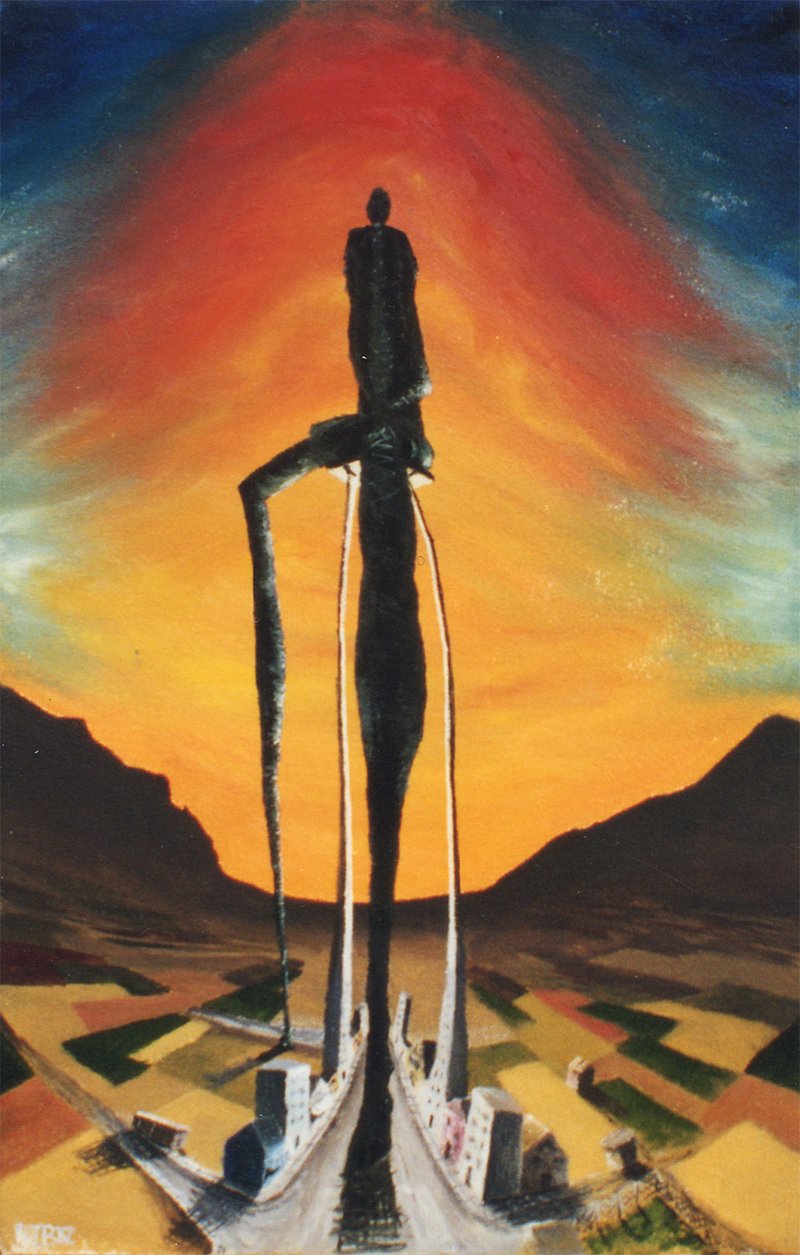
The Thinker
1993
Mixed media on canvas
16" x 24"
40.6cm x 61cm
Status & ownership
Chris Bolter, Marin County, CA
- Chris Bolter · Marin County, CA · unknown — gifted some years ago, exact date/circumstances not recalled
Provenance record
Work is a gift from the artist directly to Chris Bolter
● Documented fact
Contribution
The Thinker takes Rodin's seated, inward-looking pose and stretches it into an attenuated, standing vertical form whose bent arm and resting head survive the transformation intact even as the body is pulled into something closer to Giacometti. The figure's base fuses with converging roads rather than resting on ground, so it reads as growing out of the crossroads it overlooks — a small invented town, standing in for a 'small' San Francisco next to the old European cities of Bolter's reading at the time. Facing the viewer here, the figure is later formally inverted in a subsequent SFMOMA-exhibited painting where a comparable figure turns away — making this the first half of a decades-spanning reversal legible only because both works are on record. The exaggerated Turner-influenced sunset and the fisheye-derived perspective mark this as a self-taught nineteen-year-old's synthesis of high art-historical reference (Rodin, Turner) and vernacular visual culture (skate video), arrived at through isolated self-study rather than instruction. Possible significance beyond this record: the figure placed literally atop the architecture of an invented small city may be the earliest instance of an architecture/urban-scale preoccupation that recurs across three decades of later work (Digital City Series, Megacities, Gates of Perception) — flagged here as a hypothesis for the statement-throughlines record, not yet corroborated by a second session.
Intent
To make a finished, ambitious painting very early in a self-taught practice — testing perspective (the 'hero shot' upward/vanishing-point angle, felt as related to skate-video fisheye) and landscape construction in the same piece, while reinterpreting Rodin's The Thinker through an invented, Giacometti-like elongation.
Direct inspiration
Rodin's The Thinker (pose: bent arm, head resting on hand — preserved even through radical elongation); J.M.W. Turner (color/atmosphere, later acknowledged as somewhat overdone); fisheye perspective associated with late-1980s/early-1990s skateboard filming; self-directed reading in art history and literature at age 19.
Making
Painted directly onto raw, unprimed canvas — gesso was not yet known at this stage of the practice. Followed a period of drawing and colored-pencil studies on 18"x24" paper (not yet located). Made in a covered backyard space at 27th Ave, San Francisco; the depicted landscape is invented, not the backyard itself. One of the more resolved/finished works from this earliest phase, alongside After Turner, made around the same time.
In the practice
Exhibited at Vesuvios (title confirmed at that show).
What this isn't
None identified — additive experimentation (perspective, landscape, figure) rather than a rejection of a prior mode.
In the series
OG Oil Paintings, earliest cluster (1993-94). Companion piece: After Turner (1994). Later formal echo: Towers (2002), same series, architectural/vertical theme. Titled The Thinker consistently since the original Vesuvios exhibition — not a retrospective naming.
Rodin (pose). Giacometti (attenuated vertical form — recognized only in this session, not an original conscious reference at time of making). Turner (acknowledged color influence; explicit sibling piece After Turner, made shortly after).
Visual Similarity
Works with similar visual structure, found by comparing image embeddings across the archive.
Related Patterns
Throughlines and bio events that include this work — the same connections shown on those pages, linked back here.
Art/Official sessions
The Thinker — Art/Official session, October 13, 2026
This is a copy of the session record, October 13, 2026. Canonical URL: /sessions/envelope-coverage-verify-2026-10-13.
Transcript
- Artist
Coverage verify import — safe to delete.
- Art/Official
Recorded fieldUpdateTimeline for gloss check.
The Thinker — Art/Official session, July 28, 2026
This is a copy of the session record, July 28, 2026. Canonical URL: /sessions/the-thinker-2026-07-28.
Transcript
- Artist
Hey son, want to do an artwork art/official for a painting, the painting has already been stubbed, so what should I give you, the URL and then the image when it comes up?
- Art/Official
Just the URL and image — that's all I need. Send the artwork page URL so I can see what's already in the stub, then drop the image in a fresh part of the chat. I'll open with an orienting observation based on what I see, then move through the intent and context questions from there.
- Artist
https://bernardbolter.com/the-thinker
- Art/Official
Got it — here's what's already on record: The Thinker, 1993, oil on canvas, 16" x 24" (40.6cm x 61cm), Medium scale, Series: OG Oil Paintings, ID: BB-OGP-1993-005, Status: stub, not yet fully catalogued. Drop the image whenever you're ready.
- Artist
Ok I can but we are suppose to have the dialogue before seeing the image
- Art/Official
Right, good catch — the pre-upload ritual comes first. Four quick questions before you upload anything: 1) Temporal — when in the working process does this sit? 2) Typological — what kind of work is this, in your own words? 3) Geographic — where was this made? 4) Situational — what was going on for you around this piece?
- Art/Official
1. Temporal — 1993 is early in your practice. Within that early period, is this piece early even for that phase, or does it come after you'd already found some footing?
- Artist
This was definitely one of the early one, in the begining quite a bit of work was being down, I think with drawing and then with colored pencil on 18"x24" paper, which I still need to find, then I went straight to the oil paint. Didn't know anything, figured out how to stretch the canvas on stretcher bars, but didn't know about gesso, so just basically painted on raw canvas. This was one was in the begining.
- Art/Official
Got it — right at the very start, before you even knew about gesso, painting straight onto raw canvas. 2. Typological — what kind of work is this, in your own words? A study, a finished statement, a departure, or something else?
- Artist
This is almost one of the finished ones, so definitely not the first... this one was playing with perspective, which I got into right away, I guess it's the hero shot, where you look up at something, also working out the landscape part of the painting in this one.
- Art/Official
Good — so a finished piece, exploring perspective early and working out landscape in the same piece. 3. Geographic — where was this made?
- Artist
Was in the backyard at 27th ave, just in the backyard which had some covering. The painting does not reference the backyard
- Art/Official
Good — backyard at 27th Ave, but the subject itself doesn't come from that setting. 4. Situational — what was going on for you around this piece?
- Artist
Not sure, was part of the consumption of literature and art history, looking at it all on my own and reacting to it.
- Art/Official
Makes sense — self-directed, absorbing art history and literature on your own terms and painting in reaction to it. Before you upload, here's my blind read based only on your words. Go ahead and upload whenever you're ready.
- Artist
This is where I give my blind reading - the painting depicts a figure in the middle of a landscape that stretches out to dark mountains. The figure towers above the landscape which is a sort of crossing at a small town, the figure is sitting on a stool which is made of 2 buildings that extend up in the air. The figure is sitting and contemplating like the thinker in the famous Rodin sculpture.
Expand full conversation
- Art/Official
That's a striking image. Go ahead and upload the image whenever you're ready.
- Artist
[uploaded image: the-thinker-800w.jpg]
- Art/Official
Now I see it — the blind read had a seated, enthroned figure looking down; what's actually here is an elongated, Giacometti-like standing silhouette, rooted at the convergence of roads, facing away into a radiating red-orange sunset. That's a real correction worth naming. A couple of questions: is the bent-elbow shape an arm or structural, and was the extreme attenuation deliberate or a technical-limit outcome?
- Artist
The arm is bent and the head is resting on the arm... it is a depiction of Rodin's the thinker... The elongated part is me just stretching the perspective... which could also be influence by the use of fisheye in skateboard filming, which was what we all were looking at and liking in the late 80s early 90s
- Art/Official
That reframes it well — the Rodin pose stretched into a Giacometti-like form, with a real fisheye/skate-video reference underneath the perspective choice. The color — was the Turner-influenced sky deliberate mood, or a formal color exercise? And the landscape — observed or invented?
- Artist
The color was exaggerated on purpose with a heavy influence from William Turner... The landscape was invented, at that point I had only lived in San Francisco... Im sure it's a metaphor, but that's what we are here now to maybe figure out
- Art/Official
Let's sit with that. The figure faces away from us into the landscape, its base fused with the roads rather than resting on ground — does any of that land, or does the metaphor sit somewhere else?
- Artist
The figure is facing the viewer, later on, painting I hung in the sfmoma, the figure there is deliberately looking away, so there is a thread there... I think I looked at it as a small town, it's not old like the european cities in the literature that I was reading.
- Art/Official
Good correction — figure faces us here, making the later SFMOMA piece a real formal inversion. Was 'The Thinker' the original 1993 title, or given later? And the raw canvas / no gesso — deliberate note or just not-knowing-yet?
- Artist
I always called it the thinker, even in the vesuvios exhibition. So maybe you can also look at this in the context of the corpus, bernardbolter.com/api/corpus
- Art/Official
[fetched corpus] Good — confirms the title from the start. Two corpus connections stand out: After Turner (1994, same series, explicit Turner reference) and Towers (2002, same series, architectural/vertical theme). Is After Turner from around the same time as The Thinker?
- Artist
Yes around the same time, maybe just after
- Art/Official
[assembled and presented full draft record covering intent, making note, formal contribution assessment, conscious rejections, direct inspiration, art historical context, series context, work context]
- Artist
First want to finish here and get the briefs for everything to be built... [long system-design conversation follows, recorded separately as system-design-session-2026-07-28]
- Artist
can you get the slugs from bernardbolter.com/api/corpus - and we havn't finished the chat, is it better to do that first or can it be appended later as a test?
- Art/Official
[confirmed real slugs: after-turner, towers, skulptur-projekte-m-nster-2007; confirmed testing now is fine given the sessions design pattern]
- Artist
or we can finish the thinker now, I don't think there is too much
- Art/Official
Picking up at the where-has-this-lived beat: where is the painting now — still in your studio, or has it moved on?
- Artist
yes, we just do this now, want to get up to date and then will catalogue more. so I think the painting is in Marin county at my cousin Chris Bolter's house
- Art/Official
Got it — private collection, Chris Bolter, Marin County. How did it get to Chris — gift, purchase, something else — and roughly when?
- Artist
gift
- Art/Official
Roughly when did it go to Chris, and do you know if it was a direct handoff or passed through anyone first?
- Artist
been awhile ago, so can't remember the circumstances, but saw it there recently so its there
- Art/Official
That's fine — documented as a gift, exact timing unrecorded. Exhibition history beyond Vesuvios — anywhere else, ever, or any loans since it's been with Chris?
- Artist
Was just exhibitied at the Vesuvios show
- Art/Official
Good — simple, complete exhibition history. Any insurance value tracked on this piece?
- Artist
no
- Art/Official
That completes where-has-this-lived. Formal re-ask: does your original blind description still hold, now that we've talked all this through?
- Artist
holds the same
- Art/Official
Noted — the blind description holds. Two abstract candidates: a bio-timeline entry (San Francisco felt 'small' at 19) and a statement-throughline (figure-and-architecture recurring through Towers and Skulptur Projekte Munster). Accept both, edit either, or drop one?
- Artist
both
Also mentioned in
- Four Corners — Art/Official session, September 4, 2026
- Nietzche's Dream — Art/Official session, August 20, 2026
- Nature vs Nurture — Art/Official session, August 12, 2026
- Education — Art/Official session, August 12, 2026
- Altar of Ignorance — Art/Official session, August 10, 2026
- Color Theory — Art/Official session, August 4, 2026
Vision Analysis
The composition is organized around a single dominant vertical form that bisects the frame from top to bottom, planted at the convergence point of a deep, symmetrical landscape. A tall, elongated dark silhouette — roughly humanoid, with a small rounded head, a long slender torso, and legs of unequal length spread wide in a striding or straddling stance — rises from the base of the image to nearly the top edge, so tall relative to the landscape below that its proportions read as monumental or impossible rather than naturalistic. The wider of the two legs plants directly at center; the other extends diagonally to the left, creating an asymmetric, off-balance stance despite the otherwise strict bilateral symmetry of everything surrounding it. Two thin pale lines run parallel and close to the central leg from roughly mid-figure down to the ground, like tethers, cables, or guide-lines, distinct in tone (near-white against the dark leg) from the single dark diagonal line running down the outer leg. The palette splits cleanly into three horizontal registers. The upper two-thirds is a radiating sunburst of deep red at the core, softening outward through orange, gold, and yellow before cooling into blue at the far upper corners — an atmospheric gradient suggesting either sunrise, sunset, or a non-naturalistic radiant glow centered directly behind the figure's head and shoulders, like a halo effect built from color temperature rather than a discrete shape. The lower third shifts abruptly to a patchwork of ochre, olive, and rust-colored geometric fields — agricultural or parceled land, rendered as flattened blocks of color divided by pale roadways that converge toward the figure's feet in a strong one-point perspective. Two dark, low mountain silhouettes flank the horizon line at the transition between sky and land, symmetrical and matte black, framing the figure's legs like a gate or threshold. The mood is difficult to settle into a single register: the warmth and radiance of the sky suggest awe, spectacle, or reverence, while the scale mismatch between the figure and the landscape, plus the featureless black silhouetting of the figure itself, produces something closer to unease or the uncanny — a colossus regarding, or ignoring, a landscape that seems unaware of it. There is a spiritual or ceremonial quality to the composition's symmetry and the sunburst treatment of the sky, similar to religious or votive imagery, but the figure's faceless rigidity and elongated, almost skeletal proportions withhold any warmth that might otherwise be read into the scene. Formally, the painting shows visible handling of a soft medium — brushwork or blended pastel/pigment strokes are apparent in the sky's gradient transitions, with the color bleeding and feathering between bands rather than sitting in hard-edged zones. The figure and mountains, by contrast, are rendered as flat, opaque, nearly matte silhouettes with little internal modeling, creating a strong contrast in surface treatment between the atmospheric sky and the graphic, cut-out quality of the dark forms. The small buildings clustered at the base of the figure are rendered with more descriptive, architectural detail — window lines, roof angles, a few structures suggesting an urban cluster — than anything else in the lower register, making that small zone the area of highest resolution in an otherwise broadly blocked-in composition. The clearest coexistence-of-scale cue is the direct visual conflict between the figure's size and the landscape's: the figure would have to be many hundreds of meters tall relative to the buildings and fields at its feet, yet nothing in the image marks this as a trick of perspective, distance, or model — the figure and the land occupy what reads as the same continuous pictorial space and lighting. Whether the figure is meant to be physically present in the landscape, or represents something layered onto it — memory, myth, apparition — remains visually unresolved; the image gives no cue (transparency, differing light source, disjunction in horizon line) that would settle it one way or the other. Also unresolved is the object at the point where the leg-lines meet the ground near the buildings — a small pale, angular form that could be architectural, sculptural, or part of the figure's own anatomy (a foot, a base, a tether-anchor), rendered too small and ambiguous to categorize with confidence.
View all analyses →