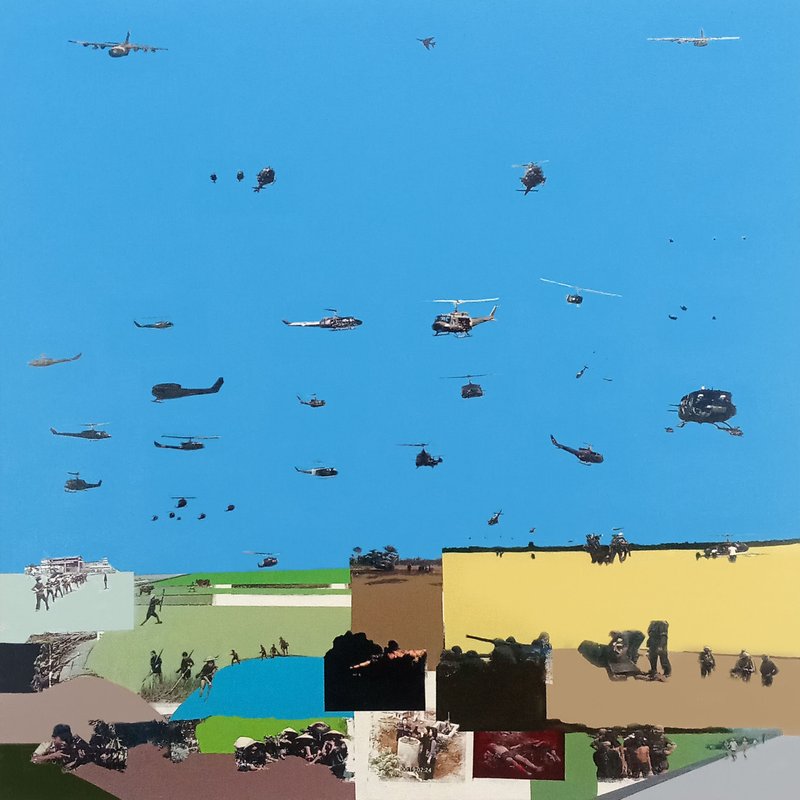
Vietnam War in Video Stills
2024
Mixed media on canvas
80cm x 80cm
31 1/2" x 31 1/2"
What runs through this work
Claims that include this work, and the other works they connect.
Throughlines
- Learning to perform for the camera
Camera-awareness chain across the triptych: World War One's raw documentary photography teaches a generation to see itself historically.
Read the full claim
World War Two's subjects perform for that awareness (soldiers staging themselves for the camera, propagandists exploiting the same awareness to manufacture a moral narrative WWI never received). Vietnam's subjects are again not looking at the camera, but this is not a return to WWI's innocence — it is unawareness of a different mechanism (live, uncensored broadcast exposure) rather than unawareness that the camera would matter at all. Recognition, not present during painting.
3 works
- Moral credit spent down
The trust-economy across WWI, WWII, and Vietnam: WWII's manufactured 'good vs evil' narrative (built through propaganda apparatus on both sides, exemplified by the staged Khaldei Reichstag photograph) functions as capitalized moral credit for the US/West.
Read the full claim
Vietnam spends that credit down with a lag rather than starting from zero — the backfire of raw, uncensored Vietnam War footage was delayed by the size of the reserve built in the 1940s, and further diffused by the war spanning multiple US presidents rather than attaching to a single confirmed figure the way WWII attached to Hitler. The credit was badly dented (My Lai, the Pentagon Papers) but not exhausted, which is why the US was not rewritten as history's villain the way Nazi Germany was.
3 works
- The Korea gap
The Korea-gap: Korea (1950-53) is entirely absent from the Mediums of War project, chronologically sitting between WWII and Vietnam.
Read the full claim
Identified as technologically caused rather than thematically excluded: Korea falls in the gap between the recording media the project actually traces (still photography, color photography, 16mm sync-sound film) — the lightweight sync-sound cameras and broadcast infrastructure that defined Vietnam's media relationship weren't in place until deep into the 1960s. May be part of why Korea reads culturally as 'the forgotten war' more broadly, not just within this project.
2 works
- The Peace Walk as root
Global Peace Walk 2000 as the shared root of Art Collision and Mediums of War: The Global Peace Walk 2000 (San Francisco to New York, events at American University and elsewhere in DC with Native spiritual leaders, arriving in New York for the UN's 55th anniversary) is already on record as Art Collision's philosophical turning point.
Read the full claim
Stated this session as also underlying Mediums of War, made twenty-plus years later: the same peace-oriented conviction turned toward a direct examination of war. Explicit stated intent: the paintings exist in part to make people 'look again and remember that we need peace.' Background: the walk followed the Nipponzan Myōhōji tradition of walks reenacting the Trail of Tears as meditation; a monk named Yamato, who participated in walks since the 1970s and in a 1995 walk, is recalled by the artist as involved, held as artist-remembered history without external documentation (the walk was deliberately low-media).
7 works
Process
Partial record only, surfaced through cross-painting comparison during the World War Two session rather than a dedicated cataloguing pass. Confirmed: BB-ACH-2024-002, 2024, 80x80cm, A Colorful History, 'Mediums of War' sub-series, third of three. Horizon-drop plan (pre-visualized before painting, sky claiming progressively more of the canvas across the triptych as war becomes more airborne) fully realized here — sky occupies ~70% of the canvas. Sky dominated by helicopters (Hueys) rather than fixed-wing aircraft, historically specific to this conflict. Land register is flat solid-color fields with no monumental anchor structure comparable to World War Two's ruined tower, read as connected to the absence of a single confirmed 'evil defeated' figure (Vietnam's leadership was diffuse across five US presidents). Black box motif recurs as two boxes fused directly into dark, near-silhouette combat photographs rather than existing as a separate mark, positioned above Vietnamese farmer-militia manning an anti-aircraft gun — read as industrial air power meeting improvised agrarian resistance. Camera-unawareness noted as distinct from World War One's unawareness: not unaware that recording matters, but unaware of the mechanism (live, uncensored broadcast) by which it would matter. Missing: blind first description, dedicated source-image list, full row-by-row compositional walkthrough, and individual image identification comparable to World War One and World War Two. Recommend a dedicated cataloguing session before considering this record complete.
Art/Official sessions
Every work in this archive is catalogued through a recorded conversation between the artist and an AI. The record above was written during this session — the transcript is where it came from, kept whole so any claim on this page can be checked against what was actually said.