SFAI
1996
observational
21.5cm x 14cm
8 1/2" x 5 1/2"
Status & ownership
Private collection
If you own this work, get in touch. I'll add you to the record and officially connect you to its history.
Contribution
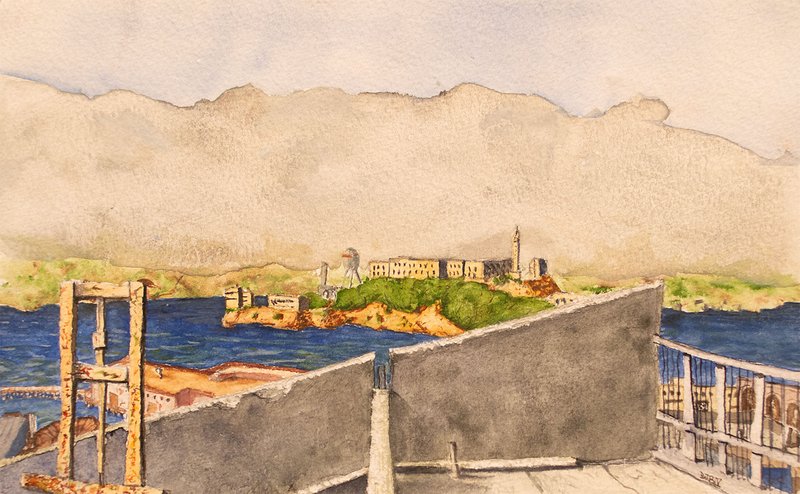
SFAI is the earliest work in the archive and stands apart from every series that followed. It is a small, unassuming painting whose formal modesty — half a letter sheet, muted watercolour over pencil, made on the spot — carries considerable retrospective weight. The pencil-first, watercolour-as-atmosphere method reflects Bolter's engagement at the time with the draftsmanship tradition of Dürer, Rembrandt, and the Renaissance painters; the structural drawing is the primary act, colour a secondary one. The empty easel in the left foreground functions as an accidental compositional device that now reads as the work's emotional centre: the absent painter, the romantic ideal of artmaking that the self-taught outsider was waiting to inhabit. Alcatraz at the centre of the bay — visible, central, enclosed — reinforces this without any deliberate intention at the time of making. The work's contribution is partly documentary (a specific rooftop, a specific year, a specific position in relation to an institution) and partly autobiographical: it is the clearest record of the outsider stance that persists across Bolter's entire practice.
About the work
Watercolour and pencil on paper, made on location on the roof of the San Francisco Art Institute in 1996. The view takes in the bay, Alcatraz at centre, and a rooftop easel at left — someone else's setup, pointing at the same scene. Made on the roof of a school he was never enrolled in, SFAI is one of Bolter's earliest surviving works on paper — a small, direct observation painted on the spot before any formal art education, before Amsterdam, before the transfer paintings. The process was consistent with his watercolours of this period: a pencil sketch first to lay in the structure, then watercolour filling in with a muted, restrained palette. The pencil remains visible throughout, the drawing doing the primary work while the paint holds tone and atmosphere. The view looks out over the San Francisco Bay with Alcatraz sitting dead centre in the composition — a place clearly visible from this vantage point but inaccessible, a tourist landmark built on the architecture of confinement. At the left of the frame, an easel stands on the roof — not Bolter's, but already there. It became the occasion for the painting: a trigger that turned a familiar rooftop into a subject. Looking back, Bolter reads the empty easel as a stand-in for the painter he was waiting to become — a romantic, self-taught idea of what an artist was supposed to be. He would go up to the SFAI roof regularly, felt drawn to the school as the definitive fine art institution in San Francisco, but always as an outsider: someone who tried to hang around, looked into a scholarship that never came through, and eventually went to Europe where art school was significantly cheaper. The painting was made at a place he almost attended, looking at a prison he could see but not enter, with an easel belonging to a painter who wasn't there. The watercolours were themselves a move away from the surrealist oil paintings that came before — a turn from invented worlds toward direct observation of the real one. That shift, and the outsider position this work embodies, runs as a thread through everything that followed.
Intent
Not fully conscious at the time, but the empty easel in the composition reads now as a stand-in for an absent painter — the one Bolter was waiting for, who would never show up because they don't exist. He had self-taught romantic ideas about what an artist was supposed to be, and felt like an outsider looking in at a school he couldn't attend. The painting captures that position: on the roof, uninvited, already making work.
Direct inspiration
The San Francisco Art Institute was the definitive fine art school in the city. Bolter would try to hang around but felt intimidated and like an outsider. He had considered applying but couldn't afford the fees and a scholarship didn't come through. The roof was accessible via the back stairs — not officially permitted, but showing up with a sketchbook meant nobody questioned it.
Making
Watercolour kept muted, with the pencil sketch doing the structural work. Restrained palette was characteristic of these on-location scene paintings — watercolour filling in rather than asserting itself.
Context of making
A painting of a prison from an Art School's roof, waiting for an artist that will never show up.
Where it went
Lands in more ways than were conscious at the time of making. The empty easel reads now as the absent painter Bolter was waiting for — a romantic idea of an artist that doesn't exist. Alcatraz sitting dead centre also carries unexpected weight: a place visible from the roof but inaccessible, a tourist landmark that was also a prison, sitting in the middle of the view from a school he couldn't afford to attend.
In the practice
Made in 1996 before any formal art school. Bolter had considered attending the San Francisco Art Institute but it was too expensive; he looked into a scholarship that didn't come through. He eventually went to Europe where art school was significantly cheaper, leading to the Gerrit Rietveld Akademie in Amsterdam. The painting was made on the roof of a school he never attended.
Process
Worked directly on location. Started with a pencil sketch of the scene, then filled in with watercolour.
What this isn't
Moving away from the surrealism of the earlier oil paintings — invented, imagined worlds. The watercolours were a turn toward direct observation, working from the real scene in front of him.
In the series
Predates all the other series — made before any formal art school, before the transfer paintings, before Amsterdam. Feels like a separate chapter from the later practice, but one Bolter would like to return to. The watercolours slowed down over the years but haven't been abandoned.
At the time of making, Bolter was looking at Renaissance painters — Titian, Tiepolo, and particularly those with a strong draftsman tradition. Also Albrecht Dürer and Rembrandt drawings. The pencil-first, watercolour-as-atmosphere approach in these on-location works reflects that lineage: drawing as the primary structural act, colour playing a supporting role.
Visual Similarity
Works with similar visual structure, found by comparing image embeddings across the archive.
Art/Official sessions
SFAI — Art/Official session, June 1, 2026
This is a copy of the session record, June 1, 2026. Canonical URL: /sessions/sfai-2026-06-01.
Transcript
- Artist
This an older work, after the initial start with painting in oil on canvas. I started to make a lot of watercolor paintings, usually starting from a sketch and then filled in with watercolor. this painting is called SFAI, and depicts the view from the roof at the San Francisco Art Institute in 1996. I think I switch to watercolor to be more on the move, and did alot of these on my first travels to europe and over the years
- Art/Official
Good to have that context — a pivotal period, right before the transfer work began.
- Art/Official
Is this part of something ongoing, or does it feel more like a standalone moment?
- Artist
kind of slowed down for the last years, but I really enjoyed making them and looking at them I would like to make more.
- Art/Official
That comes through — there's something about watercolour that suits a certain kind of looking. Where were you when you made this one?
- Artist
was done on the roof of the SFAI, so where the scene is
- Art/Official
Made on the spot, looking at the same view you were painting. Before you upload — describe this work to me first, before either of us sees it. I'll ask you again later, once we've talked it through, and we'll look at both together at the end. There's no right way to do this — however it comes is exactly right.
- Artist
this is a watecolor painting of the view from the San francisco Art Institute. the view overlooks the san francisco bay and alcatraz, there is an easel on the left of the image
- Art/Official
Got it. Go ahead and upload whenever you're ready.
- Artist
I have uploaded the primary artwork image.
- Art/Official
No legacy record for this one — it wasn't on the old site. The image is striking. The easel in the foreground is doing a lot of work — it puts you inside the act of painting while you're looking at the painting. Alcatraz sits right in the middle distance, and that bank of fog/cloud behind it has an almost theatrical weight. The rooftop infrastructure — the wall, the railing, the concrete — is rendered with the same care as the bay itself. Let me get the basics down. The title is SFAI, year 1996 — is that when it was made, or when the scene is from?
- Artist
was made on the spot, so 1996
- Art/Official
Good — made on the roof, in the moment. What's the medium — watercolour on paper?
- Artist
watercolor, pencil on paper - would sketch out the scene with pencil before adding the paint
- Art/Official
The pencil sketch underneath — is it visible in the finished work, or does the watercolour mostly cover it?
- Artist
its visible
Expand full conversation
- Art/Official
That's an interesting quality — the structure showing through. The easel in the foreground makes that even more pointed: you can see the armature of the thing you're looking at. Do you know the dimensions of this one?
- Artist
half a letter size paper
- Art/Official
So roughly 14 × 21.5 cm (or 5.5 × 8.5 in) — landscape or portrait orientation?
- Artist
landscape
- Art/Official
At 21.5 × 14 cm this would typically sit as a small (sm) on the site grid. Does that feel right, or would you want it to read larger?
- Artist
yeah it is small
- Art/Official
The easel in the foreground — was that already there on the roof, or did you place it deliberately in the composition?
- Artist
it was there, but I think that inspired me, I would go up there a bunch, but not always paint
- Art/Official
So the easel was the trigger — it turned a familiar rooftop into a painting. What was it about that particular day that made you pick up the pencil?
- Artist
cant rememeber, must have been nice out, it is san francisco
- Art/Official
Ha — fair enough, you take the windows when they come. Looking at the image, the colour palette is quite muted — the bay and sky are close in tone, and even Alcatraz is almost absorbed into the grey-blue. Was that the weather, or a deliberate restraint with the paint?
- Artist
I think that was just my style for these pencil scene artworks
- Art/Official
Makes sense — the pencil doing the structural work, the watercolour staying quiet behind it.
- Art/Official
You mentioned you switched to watercolour to be more on the move. Was SFAI still during your time at art school, or were you already past that?
- Artist
this was before any art school, I looked into going to that school, but was a hard call considering how much it cost. I think I was looking to get a scholorship at some point, but didn't work out and I started going to europe and art school was significantly cheaper there.
- Art/Official
So this was made at a school you were considering attending — looking at the view from a place you almost ended up. That's a loaded vantage point.
- Art/Official
Did you know people there at the time — was that how you got roof access?
- Artist
You could just walk up the back stairs. I probably wasn't suppose to be there, but if I was painting, nobody was gonna say anything
- Art/Official
That tracks — showing up with a sketchbook is its own kind of permission. The easel being there, the uninvited access, painting the view of a school you couldn't afford to attend — did any of that register consciously at the time, or is that reading coming more from now?
- Artist
reading it a bit more now
- Art/Official
That's usually when the real material is. What were you most drawn to about SFAI specifically — was it the school's reputation, the location, the building itself?
- Artist
the view was great, and the building is quite unique, but it was the definitive fine art school in San francisco. I would try to hang around, but always felt a bit intimidaded and an outsider.
- Art/Official
That "informed outsider" feeling shows up pretty consistently across your whole practice — and here it's almost literal. You're on the roof, you're not supposed to be there, you're painting the view.
- Art/Official
The easel in the composition — someone else's setup, pointing at the same view you're painting — does it feel like a stand-in for that dynamic? Like you're painting the painter who belongs there?
- Artist
almost, maybe painting the painter that's not there, the one that I'm waiting for, but will never show up, because they don't exist. I had all these self taught romatic ideas at that point, and was an outsider like that.
- Art/Official
That's a strong image — the absent painter, the empty easel, the romantic idea of what an artist is supposed to be. And you're already doing it, just not from the inside.
- Art/Official
Looking at it now, with everything that came after — the Rietveld, the transfer paintings, all of it — does it feel like it landed the way it needed to, or like something unresolved?
- Artist
it lands in more ways than I thought of at the moment. also interesting that alcatraz is in the middle of the picture. that is how it is in the bay and it is right there. a big tourist attraction, but also strange that it was a prison
- Art/Official
Alcatraz as the centrepiece — the place you can see clearly but can't freely access, right in the middle of the view from a school you couldn't get into. That's a lot of enclosure sitting in one small painting.
- Art/Official
At that point — 1996, self-taught, on the roof — were you looking at any other painters? Anyone whose work was in the room when you were making these watercolours?
- Artist
I think maybe at this point I was even looking a bit more at renisance painters, like titian, tepenello, expesially the ones wiht a draftsman style, also albrect durer and rembrant drawings
- Art/Official
That lineage makes sense for this work — the pencil as the primary structural act, watercolour as tone and atmosphere rather than the main event. Dürer especially, where the drawing *is* the work and colour is almost secondary.
- Art/Official
This is the earliest work in the archive by quite a stretch — does it feel like the beginning of something, looking back, or more like a separate chapter that the later work grew away from?
- Artist
almost a seperate chapter, but one I would like to continue
- Art/Official
A thread left open rather than closed.
- Art/Official
When you were making these watercolours — the on-location, sketch-first ones — was there anything you were actively moving away from? Something about the oil paintings that felt wrong for what you were trying to do?
- Artist
was probably moving away from the surrealism I was doing in the oil paint
- Art/Official
The oils were imagined worlds; the watercolours put you in front of the actual one.
- Art/Official
You described this at the start as "a watercolor painting of the view from the San Francisco Art Institute — the view overlooks the San Francisco Bay and Alcatraz, there is an easel on the left of the image." After everything we've talked about — the absent painter, the outsider position, Alcatraz sitting there in the middle — does that description still feel like the whole picture?
- Artist
I would call it now a painting of a prison from an Art School's roof, waiting for an artist that will never show up
- Art/Official
That's the title of the description right there.
- Art/Official
Where does this one live now — still with you?
- Artist
at the parents house in San Francisco
- Art/Official
Got it.
- Art/Official
Is it available, or not for sale?
- Artist
not for sale
- Art/Official
Good. I have everything I need — let me put the confirmation draft together.
- Art/Official
Done. Open **Wrap up / confirm** in the sidebar — you'll find all the staged fields and the drafted descriptions there to review and edit before you commit. The encounter note you landed on at the end ("a painting of a prison from an Art School's roof, waiting for an artist that will never show up") is in there too — worth considering whether any of that language belongs in the short description.
- Artist
dont forget the tags
- Art/Official
Right — let me pull those together from the image and session.
- Art/Official
All staged. Have a look through them in the **Wrap up / confirm** panel — adjust anything that feels off, then commit when you're ready.
Also mentioned in
Vision Analysis
The composition is a horizontal watercolor structured in three stacked registers, viewed from an elevated vantage — a rooftop or terrace looking out over water toward an island. The foreground occupies the lower third: a pale rooftop plane rising diagonally from bottom center, flanked by a dark grey parapet wall that cuts across the image in a strong wedge, its top edge irregular and torn-looking against the water. At left stands a weathered post-and-beam structure — a doorframe-like armature of paint-spattered lumber in oranges, ochres, and rust reds, the most color-saturated passage in the picture — and at right a section of railing or fencing with thin vertical balusters, behind which lower rooftops and a glimpse of arched windows descend toward the water. Between wall and railing, a small chimney or vent pipe punctuates the roof's spine. The middle register is the island: a low rocky mass ringed in ochre cliffs and crowned with vivid green vegetation, carrying a cluster of buildings — long yellow-walled blocks with ranks of dark windows, a slender tower with a lantern top at the right end, a water tank on legs standing above the trees, and smaller ruins stepping down to the waterline at the left. The water around it is the darkest, most saturated field in the painting: deep ultramarine and violet-blue laid in choppy horizontal strokes that read as wind-textured chop, hemmed by a far shoreline of low green hills running the full width. The upper half belongs to a single dominant weather event: an enormous bank of fog or cloud in warm grey-buff washes, its lower edge cut into a hard, cliff-like silhouette against a thin strip of pale blue-grey sky above. The bank behaves ambiguously — its profile reads equally as atmospheric mass and as a mountain range, and its warm tone ties it to the paper's own color, so sky and cloud seem partly made of the sheet itself. The palette divides by register: rust and ochre spatter in the foreground armature, neutral greys in the wall and roof, saturated blue-green-gold in the island band, and warm greys above — the picture's chroma concentrated in a narrow horizontal strip at its middle, with near-monochrome zones pressing from above and below. Light is even and shadowless, the diffuse brightness of an overcast marine day. Technically, the work shows transparent watercolor handling throughout: wet washes with visible blooms and granulation in the fog bank, drier and more deliberate brushwork in the buildings and railing, reserved paper whites in the roof plane, and fine dark pen or brush lines tightening the architecture and balusters. A small monogram signature sits at lower right. The paper's texture is active everywhere, particularly in the large fog field, where the pigment settles into the grain. What resists confident description is the fog bank's identity — cloud, mountain, or a second landmass hovering over the first — since the painting gives it a solidity and an edge that atmosphere rarely holds, while placing it where sky must be. The paint-covered wooden armature in the foreground likewise stays open: doorway, easel, scaffold remnant, or sculpture, its spattered surface implying long use for some activity the scene does not depict, and its frame framing nothing but water.
View all analyses →