Deutsche Stadt
2020
Seamless collage
140cm x 200cm
55 1/8" x 78 3/4"
Status & ownership
Original edition — 4 copies
Edition of 3 + 1 AP · 140 × 200 cm · Digital C-print · on Aluminum mount
An edition of 3 plus 1 artist's proof. Each numbered copy is a complete original.
1/3 — Unclaimed
Do you own this copy? Claim it →
2/3 — Unclaimed
Do you own this copy? Claim it →
3/3 — Unclaimed
Do you own this copy? Claim it →
Exhibition history
- 2022 — Herbstsalon im Frühling· ZWITSCHERMASCHINE (Palladium Studios, 5th floor, Pallasseum), Berlin
- 2020 — Megacities ↗· Circylar Gallery, Berlin
Contribution
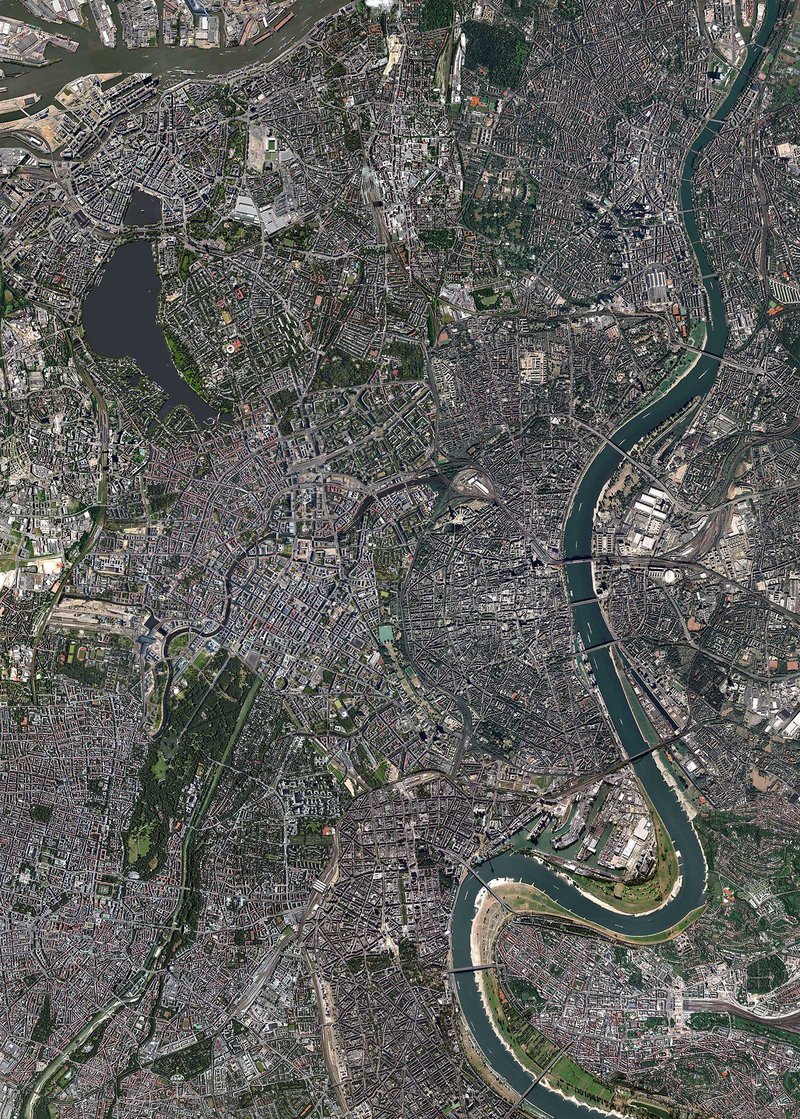
Deutsche Stadt establishes the formal and conceptual template for the Megacities series. Its primary contribution is demonstrating that the country-as-subject framework works — that satellite imagery, organised by population ranking and stitched into a seamless composite, can function simultaneously as a portrait of a specific place and a proposition about the universality of urban settlement. The river alignment that structures the composition — found through instinct and confirmed by geography — gives the work a formal coherence that Bolter identifies as present from the first attempt, unlike the early Digital City Series works. The piece also marks a methodological turning point: the Puppeteer capture tool was built mid-process in response to the demands of this work, making Deutsche Stadt both the first Megacities output and the origin of the technical infrastructure the series runs on.
About the work
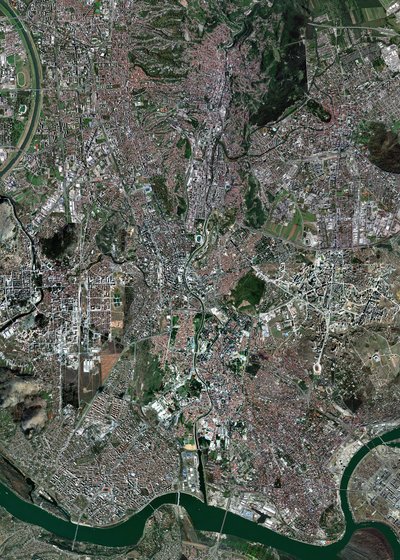
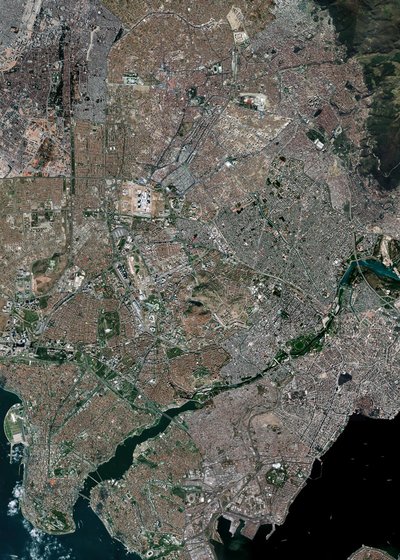
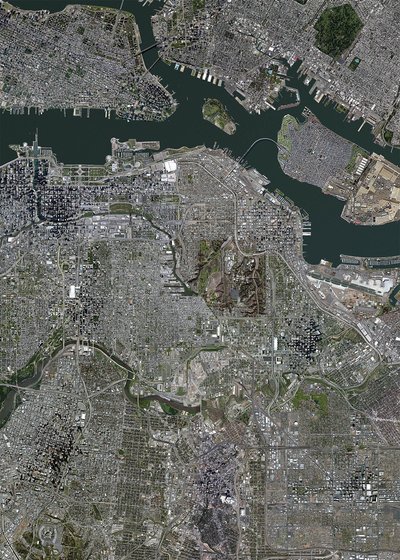
A seamless collage of satellite images of Germany's nine largest cities by population — Berlin, Hamburg, Munich, Frankfurt am Main, Cologne, Düsseldorf, Essen, Dortmund, and Stuttgart — stitched into a single continuous urban landscape. At first encounter it reads as one place; the collage only reveals itself on closer looking. Deutsche Stadt is the first completed work in Bernard Bolter's Megacities series and the piece that established the series methodology. Nine German cities — selected by population ranking — are assembled from satellite imagery into a seamless composite that reads, on first encounter, as a single continuous urban landscape. The collage only reveals its structure on closer looking. The compositional spine is the river system. Frankfurt's Main appears at the top of the image; the Rhine runs through Cologne in the middle and Düsseldorf at the bottom. Three distinct geographic moments on connected waterways — the Main flows into the Rhine at Mainz — read as one continuous river across the work. This alignment was found through visual instinct rather than geographic research; the underlying truth was discovered after the fact. The series traces directly back to the Digital City Series. In 2013, Bolter made a satellite image collage for the cover of a DCS book — a rough assembly of around ten cities. That image sat dormant for seven years until the conceptual framework arrived: organising cities by national population ranking gave the collage a subject at scale. Germany was the natural starting point; Bolter was living there and already reading German satellite maps as part of everyday navigation. The Puppeteer capture tool — a custom JavaScript script that snapshots cities at 10,000px square — didn't exist when work began. It was built partway through Deutsche Stadt to replace manual screenshot stitching, which had become unworkable. The composition phase itself took around ten hours of active work spread over several days, placing all nine cities on a single Photoshop document and trying arrangements until something locked. The Megacities series positions itself at the threshold the Overview Effect describes — the altitude where Earth first becomes legible as a single object. These works stop just short of that vanishing point: close enough to see the universality of urban settlement (streets, houses, train tracks, rivers look fundamentally similar everywhere), far enough to hold an entire country in a single image. The country frame reintroduces specificity within that sameness. Germany is legible as Germany — the Ruhr's dense industrial mesh, the Rhine's broad curves, the green corridors between cities — even as the work proposes that cities everywhere share the same underlying grammar. Andreas Gursky's aerial logic is a direct reference; the Overview Effect is the conceptual horizon.
Art/Official sessions
Deutsche Stadt — Art/Official session, June 2, 2026
This is a copy of the session record, June 2, 2026. Canonical URL: /sessions/deutsche-stadt-2026-06-02.
Transcript
- Artist
this is a more recent artwork from 2020, its called Deutsche Stadt from the megacities series and is 1.5m x 2m, prninted on aluminum
- Art/Official
Good — recent work, large format, aluminum print.
- Art/Official
Is this part of something ongoing, or does it feel more like a standalone moment?
- Artist
this is part of the megacites series, where there are like 9 full size complete images and 30 figured out
- Art/Official
Good, that tracks with where the series is. Where were you when you made this one?
- Artist
I was in my apartment in Alt Treptow berlin
- Art/Official
Before you upload — describe this work to me first, before either of us sees it. I'll ask you again later, once we've talked it through, and we'll look at both together at the end. There's no right way to do this — however it comes is exactly right.