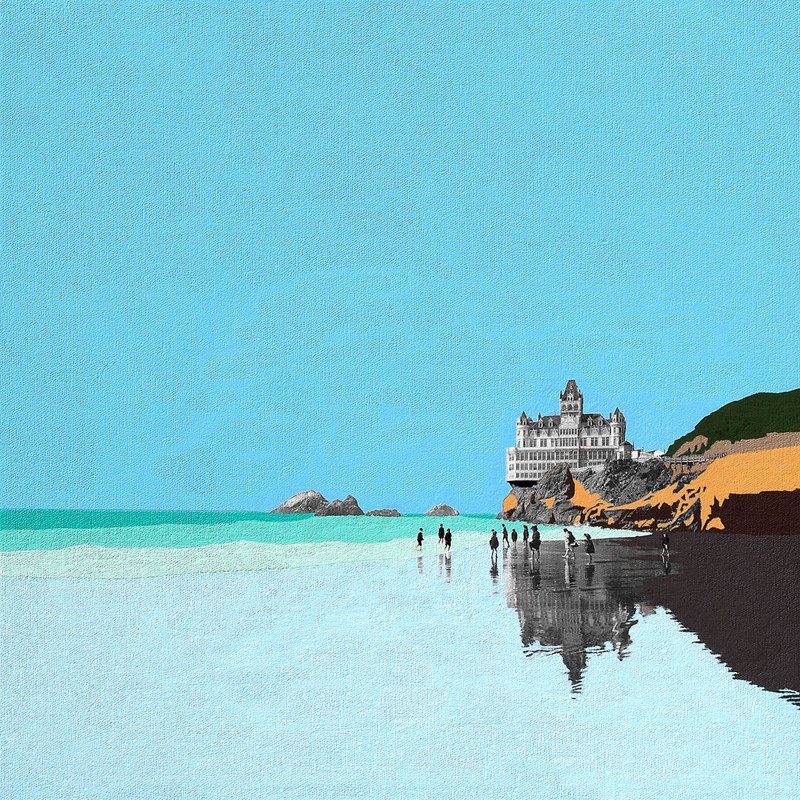
Cliff House . 1902
2015
Mixed media on canvas
26" x 26"
66cm x 66cm
Intent
To take a well-known, mass-produced, unauthored tourist photograph and run it through a deliberately personal, authored color process — testing the same warm/cool complementary color-balance principle (drawn originally from Goethe's Zur Farbenlehre, via Color Theory, 1995) against a subject far more iconic than the series' obscure founding image.
Direct inspiration
Goethe's proportional color-balance principle, first tested in Color Theory (1995): a dark, saturated color balanced by a larger field of its light complement. Applied here as a warm ochre cliff face answering the cool blue sky and teal water.
Making
The reflection was the technical turning point — once it resolved, the rest of the painting came easily. The ochre cliff color was a deliberate departure from the cliff's actual greenery, chosen for color-balance reasons rather than observation; the real green was relocated to the headland above instead.
Johann Wolfgang von Goethe — Zur Farbenlehre — Complementary color-proportion principle carried forward from Color Theory (1995) and applied here to the cliff/sky relationship.
Johann Wolfgang von Goethe — Zur Farbenlehre · Johann Wolfgang von Goethe — Zur Farbenlehre
Complementary color-proportion principle carried forward from Color Theory (1995) and applied here to the cliff/sky relationship.
Visual Similarity
Works with similar visual structure, found by comparing image embeddings across the archive.
Art/Official sessions
Cliff House . 1902 — Art/Official session, August 5, 2026
This is a copy of the session record, August 5, 2026. Canonical URL: /sessions/cliff-house-1902-2026-08-05.
Transcript
- Art/Official
I'm briefed on Cliff House . 1902 as the second work in A Colorful History, painted in 2015, a year after Cliff House . 1863 founded the series. I know the founding piece well — Richard Hamilton reference, t-shirt transfer method, the nine-work French collector sale — but I'm going in blind on what happened in the year between 1863 and this one, and why you returned to Cliff House itself rather than a new subject. If anything in that framing is off, correct it now — otherwise let's go. Before we look at it together — is this a recent work, or something you've been sitting with for a while?
- Artist
This was a bit of an older work, one of the ACH when I was making them for the city art gallery in SF, so middle SF series and right when the technique was hitting its stride
- Art/Official
Good — that places it right in the early run, past the founding experiment and into the technique finding its footing. Question two: Is this part of something ongoing, or does it feel more like a standalone moment?
- Artist
Was right in the middle of the SF run of the ACH
- Art/Official
Makes sense — squarely inside the run, not a bookend piece. Question three: Where were you when you made this one?
- Artist
Was made in the backyard studio in SF
- Art/Official
Good — same setup as the founding piece, then, working in that backyard space. That's the three orientation questions. Last one before the image: I'd like you to describe this work to me first, before either of us sees it.
- Artist
The painting is of the cliff house in SF at ocean beach, an old black and white photo is transfered to canvas and the viewpoint is from below on ocean beach. You can see seal rock and the ocean and a reflection on the water with some 19th century people wading in the water.
- Artist
[image upload: 1000020684.jpg]
- Art/Official
The Victorian chateau Cliff House sits perched on the rocky headland, black-and-white photo transfer against flat acrylic color fields. One divergence from the blind description: the framing reads head-on/elevated rather than steeply from below. Medium/support: Acrylic photo transfer on canvas — correct? Dimensions 66cm x 66cm (26in x 26in), Year 2015, Series A Colorful History, BB-ACH-2015-019.
- Artist
Yes those match
- Art/Official
What made you pick this particular photo of it?
- Artist
It's a striking photo and also you're right the Victorian house is the iconic one I grew up seeing, so in the first painting was interesting to see that there was a building before. Can you try and find the photo?
- Art/Official
[web search identified a Rare Historical Photos image captioned 'Beach walkers near Cliff House. 1902' as a candidate match]
- Artist
Yes that's the one, is there more info about the photographer and the photo
- Art/Official
[searched Library of Congress] Two LOC records look like strong candidates, both ca. 1902. Neither names an individual photographer.
Expand full conversation
- Artist
Yes, let's log that
- Art/Official
This photo is a very different kind of source than the 1863 one — recognizable and iconic versus obscure. Does that shift change anything about how you approached the painting?
- Artist
Not sure, maybe I wanted to wait for the iconic images until the technique was good... For San Francisco this was definitely the most popular image I made, in a way like the brandenburg gate 1899... I didn't really know for either one until after.
- Art/Official
Is there something you can point to that's doing the work of making it land the way it did?
- Artist
I think the reflection, but also the colors on the right side gave it a nice balance
- Art/Official
Was the ochre cliff color a deliberate departure from the actual greenery, or something else?
- Artist
Has to do with my idea of color balance that's comes from the color theory painting if you can look that up, the hills needed a dark orange to balance all the blue.
- Art/Official
[retrieved Color Theory session transcript] The principle comes from Goethe's Zur Farbenlehre — complementary pairs in inverse proportion to weight. That maps directly onto the Cliff House hills.
- Artist
[infrastructure discussion re: Color Theory record not yet published — resolved separately, not part of this artwork's content]
- Art/Official
Picking the thread back up — where is Cliff House . 1902 now?
- Artist
The cliff house 1902 painting was made a couple of times, I think I made like 5 of them, originally there was a 26" and a 18" sold at city art gallery in SF... my cousin Chris Bolter has one of them and then the last one was made in Berlin. Warren Dot contacted me years later after seeing it on display at live worms gallery in north beach SF and almost bought it with his wife then, she passed away, unexpectedly, but he remembered that she really loved the piece, so even though I said I wouldnt paint any more of them, I painted one last one for him
- Art/Official
Is this specific canvas the original 26in one sold at City Art Gallery?
- Artist
This is the mage of the original 26" inch one
- Art/Official
[proposed paintingEditions schema field with the artist, briefed for Cursor] Do you know who bought it, or has the trail gone cold?
- Artist
I don't know at the moment who got that one, and we can just make a brief in this chat for the extension to be created and then I'll come back and fill
- Art/Official
How do you think about the gap between what's happening in that 1902 photo and what your painting is doing to it?
- Artist
Yes, that an interesting part, not sure. Any suggestion
- Art/Official
The photograph is memory, unaltered; the color is you, arriving on top of it. Does that read as true?
- Artist
What about something in the history of when that photo was taken, we touched upon the idea that a lot of these photos from the past were sort of tourist photos and then managed by a photo company but don't know how took the photo
- Art/Official
An anonymous, mass-produced tourist image, run through a deliberately personal, authored process.
- Artist
I like that angle
- Art/Official
Have we got the history timeline done? [proposed 5-entry keyHistoricalDates, 1863 to 1907]
- Artist
Yes that looks good let's just keep it the timeline
- Art/Official
Looking at the painting in front of you — how would you describe this work now?
- Artist
The painting is a color painted enhancement of a leisure photo from the turn of the century
Vision Analysis
The Victorian chateau Cliff House occupies the right third of the frame, perched on a rocky headland — a black-and-white photographic transfer rendered in fine architectural detail against flat, hand-painted acrylic color fields. Above, a turquoise sky. Below and to the left, a teal-to-white gradient ocean giving way to near-black wet sand in the foreground, with a warm ochre cliff face rising beside the building and a dark green headland capping it above. Small dark figures wade at the tideline, their forms and the building's silhouette both mirrored in a clean, unbroken reflection on the wet sand. The composition balances the photographic architecture against three large, confidently flat color fields — a deliberate proportional answer between cool (sky, water) and warm (cliff), consistent with a recurring warm/cool complementary logic elsewhere in this artist's practice.
View all analyses →