Cardboardman Visits Utrecht
2000
Documentary photography
Status & ownership
Private collection
If you own this work, get in touch. I'll add you to the record and officially connect you to its history.
Contribution
A student-era collaborative performance that resolves its assignment brief — 3D to 2D — through the body in public space rather than studio fabrication. The formal contribution is modest by design: the suit was built quickly, the concept emerged in the doing, and the photographs are the work. What distinguishes it is the unscripted arc of the walk — refusal, encounter, collapse — and the way the documentation captures a performance that exceeded its brief without trying to. The Beuys parallel (material deterioration, body as medium) is retrospective rather than programmatic, which makes it more honest. The work sits comfortably in the archive as an early, unrepeated gesture — a standalone from a friendship and a year that didn't last long institutionally but clearly mattered.
About the work
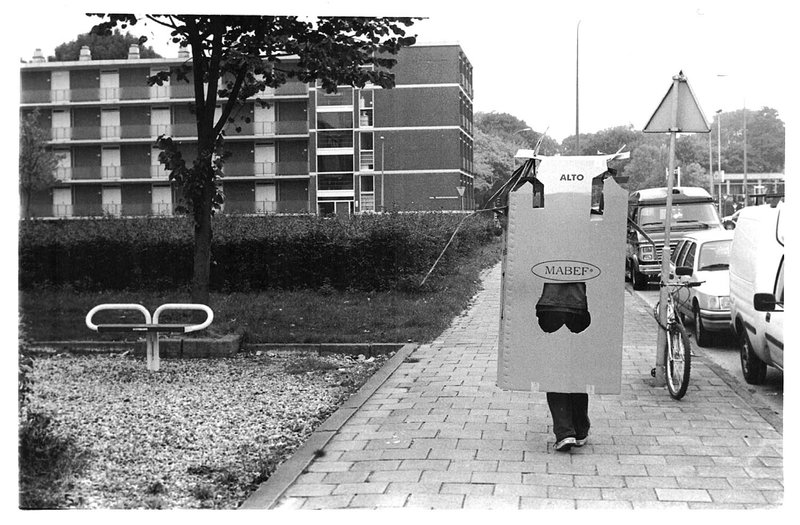
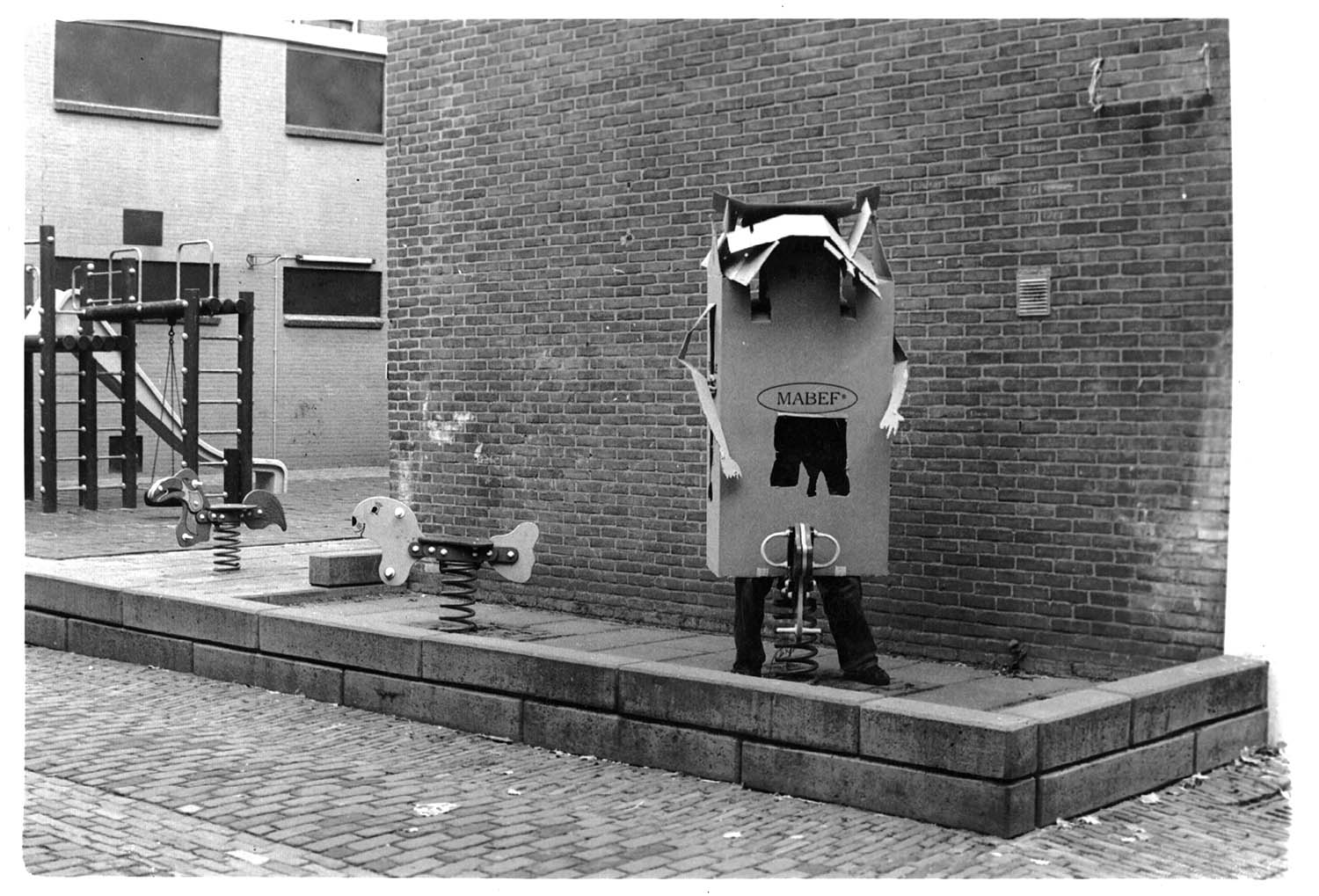
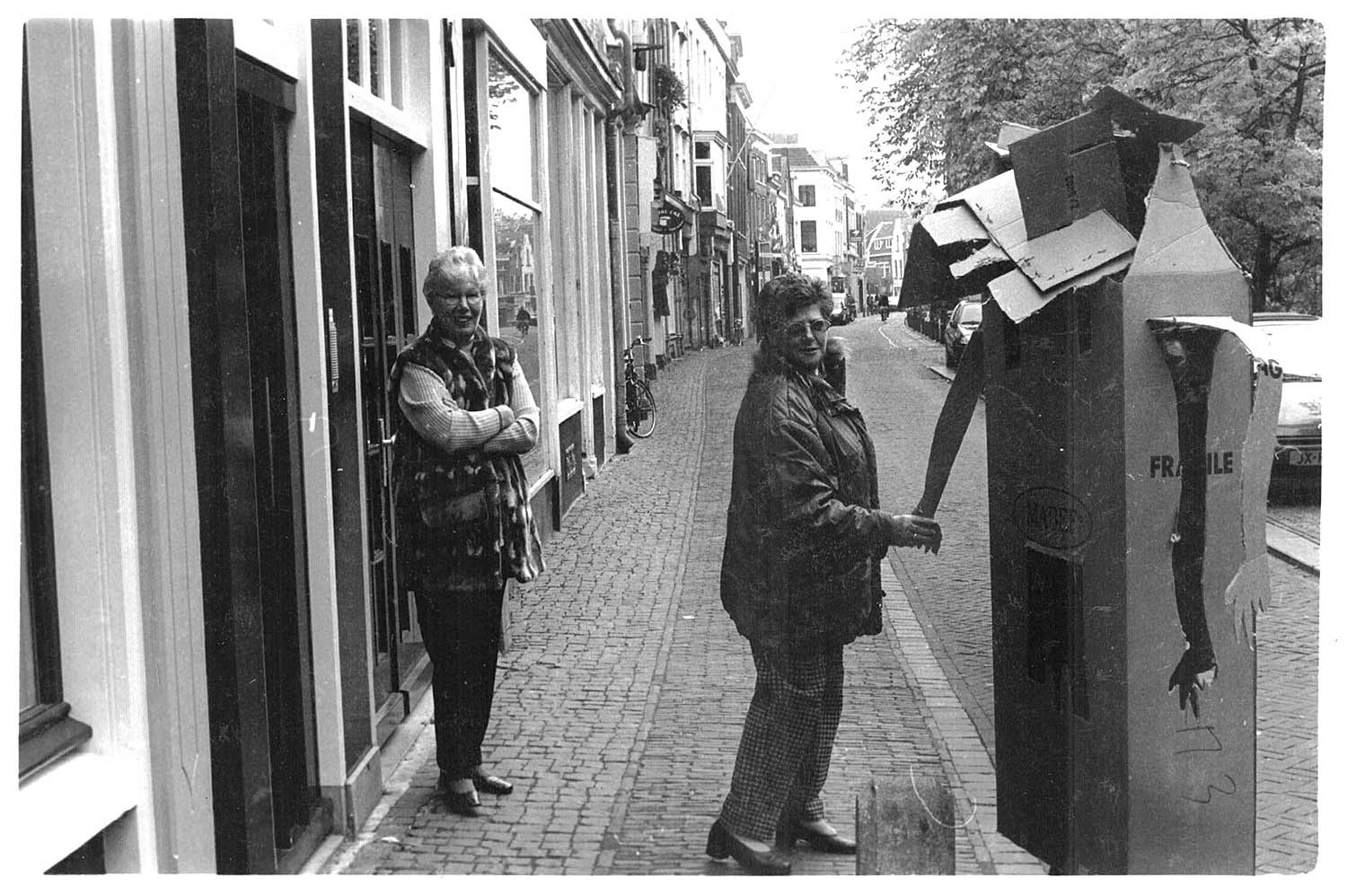
A collaborative street performance made with Jur Jarring at the HKU Utrecht in 2000. Dressed in a homemade cardboard box suit, the two artists walked from the art school into the centre of Utrecht and back — documented in three black-and-white photographs showing the suit progressively falling apart. Cardboardman Visits Utrecht began as a school assignment: make something three-dimensional, then turn it into something two-dimensional. Bernard Bolter and his friend Jur Jarring built a wearable suit from cardboard boxes and took it out onto the streets of Utrecht, camera in hand. The concept sharpened as they walked — the suit deteriorating, the photographs accumulating, the loop between the 3D object and its 2D document closing in real time. The three surviving photographs trace an arc: the suited figure walking away down a brick-paved residential street; the cardboard caving in at a children's playground; and finally, on a shopping street in the city centre, two older women completely delighted — one laughing, one reaching out to touch the collapsing structure, "FRAGILE" printed on its side. A coffee shop had turned them away. The women outside were more welcoming. That encounter felt like the natural end of the walk; the suit came off and they went back to school. The teacher said it wasn't what she was looking for, but that it worked. The more meaningful reception was among other students. Bolter left HKU after one year. The photographs — A5 prints — are currently at his parents' house in San Francisco. The connection to Joseph Beuys, encountered at HKU and championed by a classmate from Bochum, is more visible in retrospect: the material that carries meaning through use and deterioration, the body as medium, the street as the gallery.
Intent
The 2D photographs were the stated end goal of the assignment — the suit was a means to produce them, not an object to be presented in itself. Not much time was spent on the suit's construction; the walk and the documentation were the work.
Art/Official sessions
Cardboardman Visits Utrecht — Art/Official session, June 1, 2026
This is a copy of the session record, June 1, 2026. Canonical URL: /sessions/cardboardman-visits-utrecht-2026-06-01.
Transcript
- Artist
I'd like to catalogue an artwork. Please open with your briefing on my practice (brief, no generic welcome), then ask your first pre-upload question.
- Art/Official
Your practice spans four bodies of work — transfer paintings built from historical photographs and acrylic colour fields, seamless city composites shot from a skateboard, satellite-scale urban collages chasing the Overview Effect, and an ongoing sub-series tracking how image capture technology shapes historical perception. The archive is rooted in Brooklyn, ran through Amsterdam and San Francisco, and is now centred in Berlin. Before we look at it together — is this a recent work, or something you've been sitting with for a while?
- Artist
his is a live performance work documented with three photographs — not a painting or print. I'll upload the strongest documentation still first as the primary image, then add the other two photos in the Media panel under "More views of the work" (work-view / alternateViewImages). Please treat it as time-based: stage measurementType ["time-based"], ask about performance length for duration, and stage all five tag fields after you see the primary image. Focus on what happened in the room — I can't rely on vision alone for the performance itself. Don't run painting/DCS/ACH workflows. After dimensions (if any) or size tier, weave in the reflective questions — don't save them for the end. This is an older work that was made with a friend Jur Jarring while at art school in utrecht