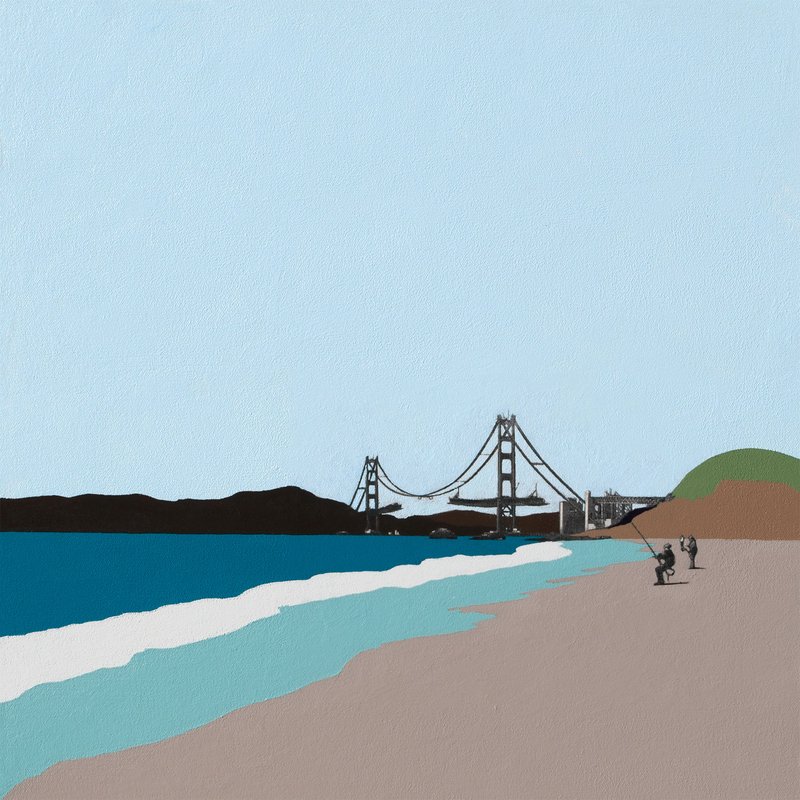
Baker Beach . 1935
2016
Mixed media on canvas
30" x 30"
76.2cm x 76.2cm
Status & ownership
Private collection
If you own this work, get in touch. I'll add you to the record and officially connect you to its history.
Exhibition history
- · Heron Arts, San Francisco
About the work
Two fishermen cast lines at Baker Beach as the Golden Gate Bridge rises unfinished behind them, San Francisco, 2016. Baker Beach . 1935 sits at the height of the San Francisco chapter of A Colorful History — the point at which the artist's acrylic photo-transfer and painted-field technique had reached a natural, resolved fluency, made just before the deliberate deconstruction of process that would define the Berlin years. The source photograph, likely from the Underwood Archives (Getty Images) and dated circa 1936 though found by the artist through online research, shows two fishermen at Baker Beach with the Golden Gate Bridge under construction behind them — towers standing, deck not yet strung across. The bridge held personal significance well before this painting: visible from the artist's childhood home at 22nd Avenue and Fulton in San Francisco, it was always a private icon of the city rather than a found or arbitrary subject. The painting sold after being shown at ArtSpan Selections 2017 — purchased by skateboarder and musician Tommy Guerrero after he contacted the artist directly on Instagram. Sold at a deep discount of $300, the sale helped fund the artist's first scouting trip to Berlin ahead of the eventual move.
Intent
Painted at the point where the classical photo-transfer-plus-painted-field technique was reaching a natural, fluent finish — the last body of work made before the deliberate deconstruction of process that began after the move to Berlin. The bridge, visible from the artist's childhood home at 22nd Avenue and Fulton in San Francisco, functions as a personal icon rather than a found subject; the fishermen were included for the contrast between an ordinary, unhurried ritual and a landmark feat of engineering being born in the background — a moment of daily life the artist says he never once witnessed happening in his own life.
Making
Made in the backyard studio in San Francisco. No specific making details recalled beyond the technique feeling increasingly natural and flowing at this point in the series.
Context of making
A square canvas holding two registers at once — a black-and-white photo-transfer of two fishermen at Baker Beach, set inside a fully saturated, flat-painted color field. Sky in pale blue, ocean in layered turquoise-to-deep-blue bands, sand in warm taupe, and a deliberately cheerful green hill on the right balancing the composition against the industrial grey of the Golden Gate Bridge, shown mid-construction with its towers up and deck not yet strung across.
In the series
Continuation of the San Francisco-era A Colorful History historical-photo paintings, made at the point where the classical fully-painted technique was 'finding its own way' — distinct from the deconstructed, sometimes deliberately unfinished approach adopted later in Berlin.
Visual Similarity
Works with similar visual structure, found by comparing image embeddings across the archive.
Art/Official sessions
Baker Beach . 1935 — Art/Official session, August 1, 2026
This is a copy of the session record, August 1, 2026. Canonical URL: /sessions/baker-beach-1935-2026-08-01.
Transcript
- Art/Official
I know this one sat next to Lombard Street . 1922 v2 at ArtSpan Selections 2017, and that it sold later, separately from that show — not that night. What I don't have yet is anything about the making of it: no intent, no source material, no sense of what pulled you toward Baker Beach as a subject in the first place. If any of what I just said is off, correct it now — otherwise let's start. Before we look at it together — is this a recent work, or something you've been sitting with for a while?
- Artist
This one is a bit older at this point like almost 10 years, was made in the peak of the a colorful history series San Francisco run, before moving to Berlin.
- Art/Official
Good — that places it right at the height of the SF chapter, same stretch as the Lombard Street repaint. Ten years is enough distance that you're not looking at it through the heat of making it anymore. Is this part of something ongoing, or does it feel more like a standalone moment within A Colorful History?
- Artist
Was a continuation of the SF style of the historical photo paintings, right at the point where my classical fully painted technique was finding its own way
- Art/Official
Good to have that on record — not just "part of the series" but a marker of the technique itself maturing, the point where the classical painted approach was becoming distinctly yours rather than inherited. Where were you when you made this one?
- Artist
I was in San Francisco at he backyard studio
- Art/Official
The backyard studio — that's where a good chunk of the SF-era Colorful History work came out of, if I remember right. Before you upload — I'd like you to describe this work to me first, before either of us sees it. I'll ask you again later, once we've talked it through, and we'll look at both together at the end. There's no right way to do this — however it comes is exactly right.
- Artist
The painting is a black and white photo of a fisherman on baker beach fishing while the golden gate bridge is being buiilt
- Art/Official
[image uploaded — Baker Beach . 1935] That's a strong divergence right there — you described it blind as black and white, and it's the opposite: full, flat, saturated color throughout, the photo-transfer figures rendered in that same grayscale-into-color treatment while the rest of the field is pure painted color. The bridge is caught mid-construction, exactly as you said — towers up, deck not yet strung across. Two fishermen, not one — did you say "a fisherman" out of memory shorthand, or is that worth a second look?
- Artist
Out of memory, the transfered photo is black and white
- Art/Official
That makes sense — the source photo is black and white, and your memory held onto that truth even though what actually ended up on the canvas is the full-color field around a grayscale-toned transfer. That's a real distinction worth having on record: the photographic layer stays black and white in tone, but it's sitting inside your color, not floating in isolation from it. Let's get the small facts locked in. What are the dimensions of this piece, and is it acrylic photo transfer with painted acrylic fields — same medium as the rest of the series?
- Artist
Same medium, 30" x 30"
- Art/Official
Good — 30" x 30", square format, same acrylic photo transfer + painted field medium as the rest of ACH. What drew you to this particular photograph — the two fishermen at Baker Beach with the bridge going up behind them? Was it something about that juxtaposition of an everyday, timeless act next to this massive feat of engineering being born in the background?
- Artist
Where I grew up originally in SF on 22nd Ave and Fulton, I could see the bridge from my house, so it is always an icon of SF and personal to me. But yes, the juxtopisition of the fishermen is a nice contrast, and I'd never seen anybody fish there in my life.
- Art/Official
That's a real anchor for the whole series, not just this piece — the bridge wasn't an abstract SF icon you chose, it was something visible from your childhood window on 22nd and Fulton. And the fact that you'd never actually seen anyone fish there in your own life adds a strange charge to the image — you're painting a moment from before you existed, doing something you never witnessed happening at all. Where did the source photograph come from — do you know, or remember, where you found it?
- Artist
From online research, I think wiki commons, can you look for it?
Expand full conversation
- Art/Official
[web search: Baker Beach fishermen Golden Gate Bridge construction, source research] No individual photographer credited — it's attributed as "Underwood Archives / Getty Images," meaning it comes out of the Underwood & Underwood photo agency's archive rather than a named single photographer, and most sources date it to circa 1936 rather than pinning it exactly. No indication of a Wiki Commons origin — this one lives in the commercial stock/archive world (Getty, Alamy, Bridgeman, SuperStock all carry it), which tracks with it being a widely circulated period photo rather than a public-domain upload. Good detail for the record either way — do you want me to note "Underwood Archives" as the source in the record, or leave source as unconfirmed/researched-but-uncredited?
- Artist
We can put in what we have and maybe find out more later
- Art/Official
Good, we'll log "Underwood Archives (Getty Images), circa 1936" as source, flagged as researched-but-not-fully-confirmed — open to updating if you turn up more later. Something I noticed in the image itself: the painted field carries a real horizon logic — the ocean is rendered in those layered turquoise-to-deep-blue bands, sand in a warm taupe, and that green hill on the right breaks the palette in an interesting way, almost too cheerful against the industrial grey of the bridge and the grayscale figures. Was that hill a deliberate color anchor, or did it settle into that green more instinctively as you worked?
- Artist
It was a deliberate choice to balance the painting
- Art/Official
Makes sense — that green gives the eye somewhere to land that isn't the bridge or the water, and it keeps the whole thing from tipping too cool. Stepping back to the bigger picture of the technique itself — you mentioned earlier this piece sits right at the point where your classical painted approach was "finding its own way." What specifically changed in how you were painting around this piece, compared to the earlier ACH work?
- Artist
I think the SF time for these paintings was trying to figure out how to fully finish the paintings, the transfer technique for better and the painting was getting to a point of feeling natural and flowing, I think I wanted to get this down first and then in Berlin I started to deconstruct the process and not finish all the paintings completely
- Art/Official
That's a real throughline for the whole practice, not just this piece — SF as the period of getting the technique to feel complete and natural, Berlin as the point where you deliberately started leaving things unfinished. Baker Beach sits right at the hinge of that, still fully resolved, made before the deconstruction started. Let's shift to where this piece has lived. Beyond the ArtSpan Selections 2017 show — is it still in your possession, or did it sell? And has it shown anywhere besides that one exhibition?
- Artist
Just exhibited at tgat show, but then was later sold to Tommy Guerrero the skateboarder after he contacted me on instagram
- Art/Official
That's a great provenance story — a direct Instagram contact leading to the sale, no gallery intermediary. Tommy Guerrero, worth confirming the spelling for the record — Guerrero, the skate legend and musician? And roughly when did that sale happen — around the ArtSpan show, or sometime after?
- Artist
A bit after, I sold it for a deep discount at 300 dollars, but he was a skate legend for me and I used that money when I went to Berlin to check things out for moving there
- Art/Official
That's a meaningful detail to have on record — not just a sale, but one tied directly to the Berlin move. $300, at a real discount, because Guerrero mattered to you as a skate legend — and that exact money became part of your first scouting trip to Berlin. The painting funded the very move that would go on to change how you made the next ones. Is there anything else about where it's lived since — did Guerrero ever share where it hangs, or has it stayed private since the sale?
- Artist
I've seen a picture on his Instagram where I saw the painting hanging at his house
- Art/Official
That's good to have — confirmed present-day home, not just a sale into the void. Worth linking or noting the Instagram sighting as the source for that, even if you don't have the exact post saved. Before we move to wrapping up — is there anything about the making of this piece, the technique, or its life since that we haven't touched yet that you want on the record?
- Artist
Not so much, but we still need to go through the a colorful history fields
- Art/Official
Good — now the ACH-specific fields: olderStory (older layer — the photo's history, place, technology, loss of record), newerStory (your side — making it, when, why), and keyHistoricalDates (3–5 dates with year, event, Wikipedia link). For olderStory — what's the older layer here? The bridge under construction, the fact that this specific 1930s moment of leisure fishing right next to a massive engineering project has basically vanished from Baker Beach today?
- Artist
It's still a liesure place, but is a bit of a contrast of this new engendering marvel being built and regular people just getting their fishing on
- Art/Official
That contrast is exactly the older-layer material — the ordinary, unbothered ritual of fishing carrying on right beside one of the era's biggest engineering undertakings, like the bridge is just weather in the background of someone's Tuesday. For newerStory — you've already given me a lot of it: SF backyard studio, technique reaching a natural, fluent point, right before the Berlin deconstruction began. Anything to add about the actual making of this one — how long it took, anything about that session at the easel?
- Artist
Can't remember specifically
- Art/Official
That's fine — not everything needs a specific memory attached, and "the technique was flowing" already tells us more than a studio-session detail would. For the key historical dates — I'd suggest three: 1933 (bridge construction begins), 1936 (this photo, bridge nearing completion — the moment depicted), 1937 (bridge opens to the public). That gives the timeline real motion: before, during, after. Want to keep it at those three, or add a fourth?
- Artist
Was also thinking for fun we could have the date of the invention of the modern fishing pole
- Art/Official
[web search: invention of the modern fishing rod / reel history] There isn't a single clean "invention of the modern fishing pole" moment — it's a much longer, murkier evolution. But the closest fit for a "modern" turning point is 1905, when Albert Illingworth patented the first modern spinning reel design in England — the point most historians treat as the birth of the reel type still used today. It's the reel rather than the rod itself that "modernized," but that's likely close enough to what you're after — and it lands nicely just before this piece's own 1933–1937 window, giving the timeline an extra century of running start. Want that one — 1905, Illingworth's spinning reel patent — as the fourth node, or does that feel like the wrong kind of fact to lead with?
- Artist
Yes it shows the contrast, and then maybe just the begining of the bridge construction and the completion date, the photo date is implied
- Art/Official
Good — that gives us three nodes with real spread and contrast: 1905 (Albert Illingworth patents the first modern spinning reel), 1933 (Golden Gate Bridge construction begins), 1937 (Golden Gate Bridge opens to the public). Photo date (c.1936) stays implied by the painting itself rather than a fourth node. I'll pull Wikipedia links for each of those to attach. That covers the ACH fields. Before we move to formal re-ask and confirmation — anything else on your mind about this one, or should we move toward closing it out?
- Artist
We can close this one
- Art/Official
One last thing before we close — you described it at the start as a black-and-white photo of a fisherman on Baker Beach fishing while the Golden Gate Bridge is being built. Now that we've been through it together — the full color field, two fishermen not one, the green hill balancing the composition, the technique sitting at its most resolved point before Berlin — how would you describe it now?
- Artist
A painting of a moment of regular day life with a symbol of modernity being built in the background
- Art/Official
That's a real shift — from a literal inventory of what's in the frame to what the painting is actually about: the ordinariness of a day folded up against a symbol of modernity arriving. The first description told me what you saw; this one tells me what you made.
Vision Analysis
The composition splits cleanly into three horizontal registers: a large, flat pale-blue sky occupying the upper half; a middle band of dark, silhouetted coastal hills and a distant bridge structure; and a lower foreground of layered ocean and sand rendered in flat, unmodulated color. The palette is saturated and confident — deep teal and turquoise banding in the water, a warm taupe-grey sand, and a notably bright, almost cheerful green hill on the right that sits in deliberate tension with the otherwise cool, industrial tones of the bridge and hillside silhouette. The bridge itself is depicted mid-construction: two towers stand with cabling strung between them, but no roadway deck spans the gap, and support structures are visible in the water near the base of the near tower. Two small figures stand at the shoreline on the right, rendered in muted grayscale tones distinct from the surrounding full-color field — one crouched, one standing, both oriented toward the water with what appears to be fishing gear. This grayscale treatment of the figures, set inside an otherwise saturated color field, is the clearest visual cue of two coexisting time registers within a single frame: a photographic, documentary layer describing the human presence and the specific historical moment, set inside a flat, illustrative, present-tense color field describing the landscape around it. The horizon line is high and confidently held, giving the sky significant weight relative to the incident of the composition, which is concentrated in the lower right quadrant. Brushwork and surface quality are not legible at this resolution — the image reads as flat, hard-edged color throughout, with no visible texture or painterly variation, though this may be an artifact of image compression rather than the actual painted surface. The precise relationship between the grayscale figures and the color field beneath them — whether the transfer sits on top of painted color or the color is worked around a masked transfer area — resists confident description from the image alone.
View all analyses →